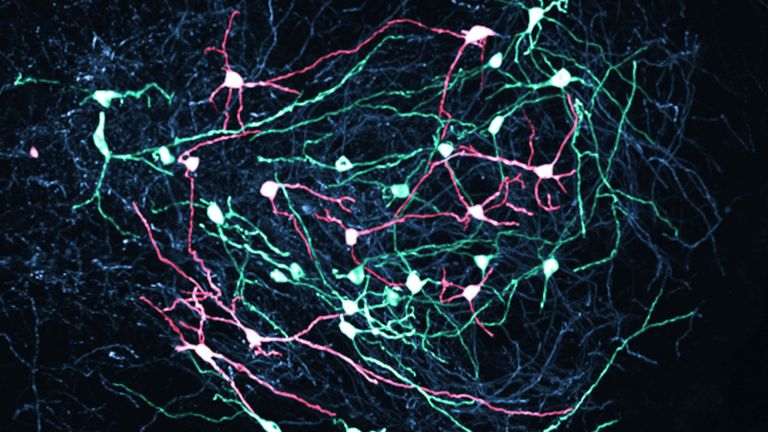
The Striatum
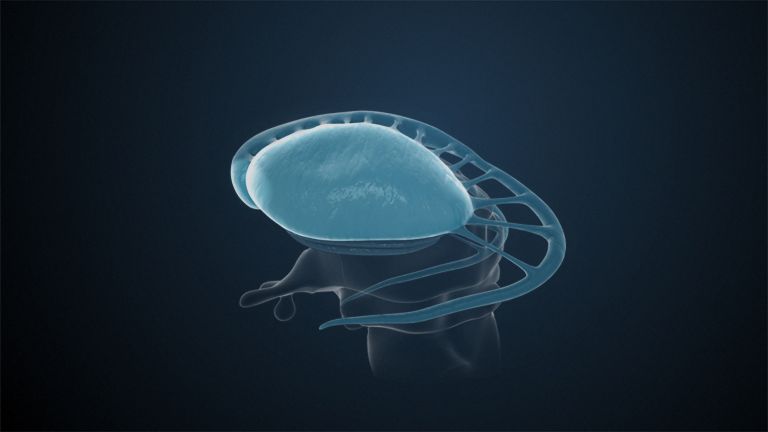
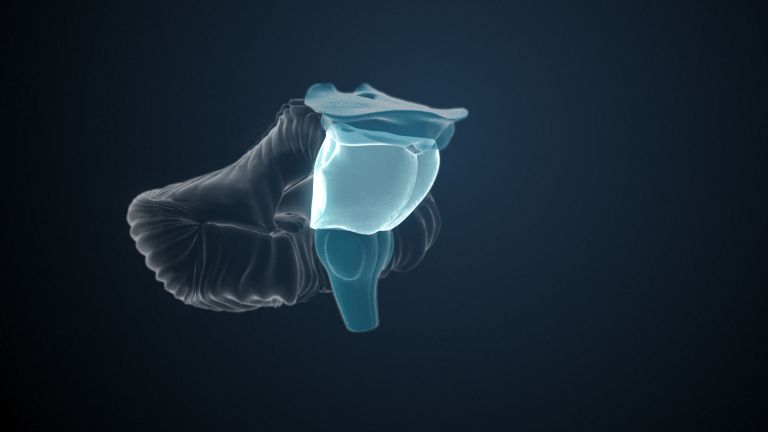
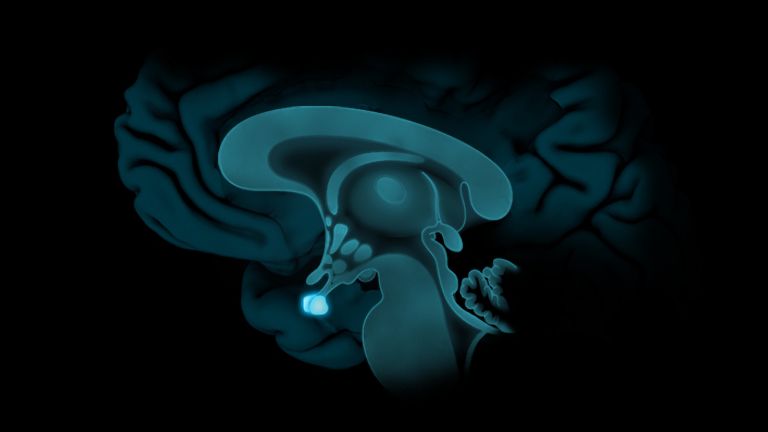
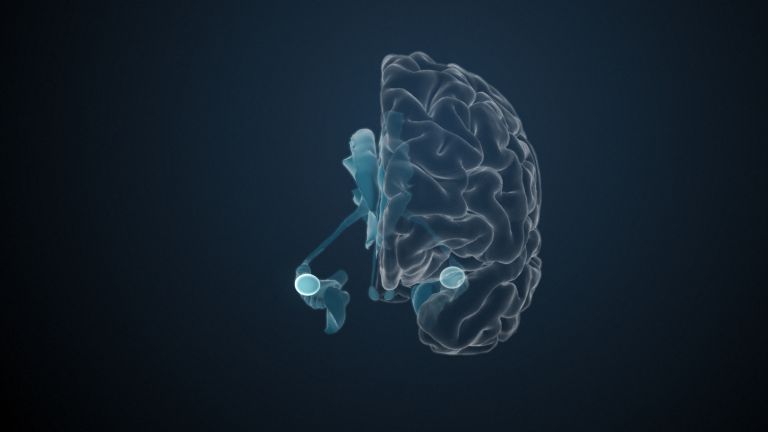
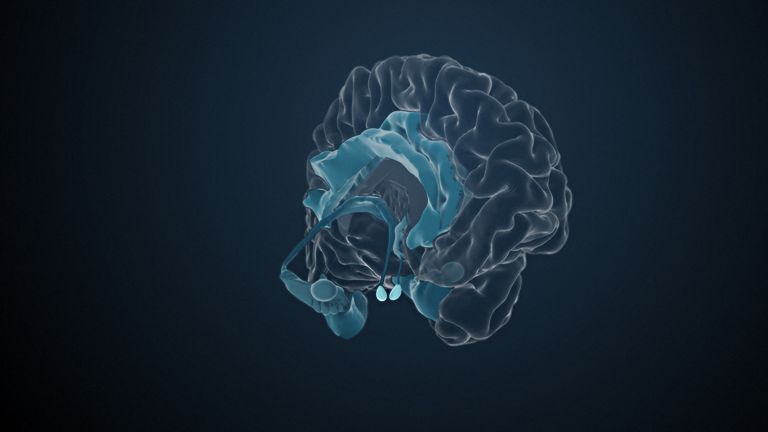
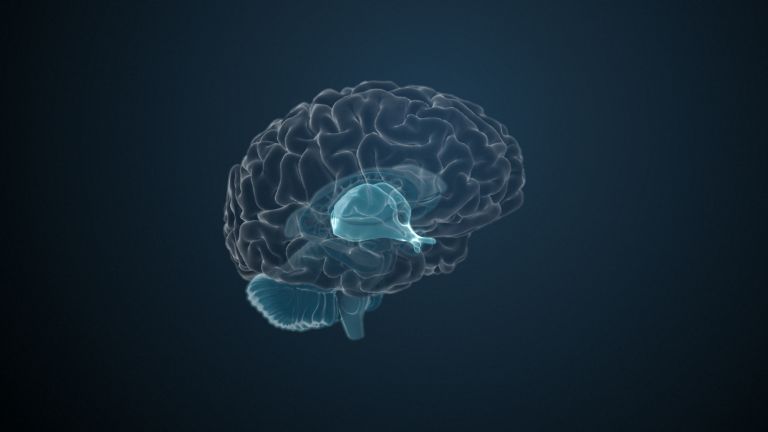
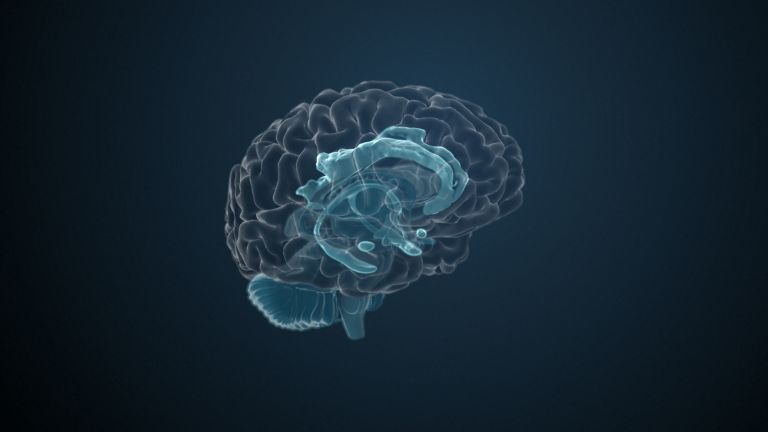
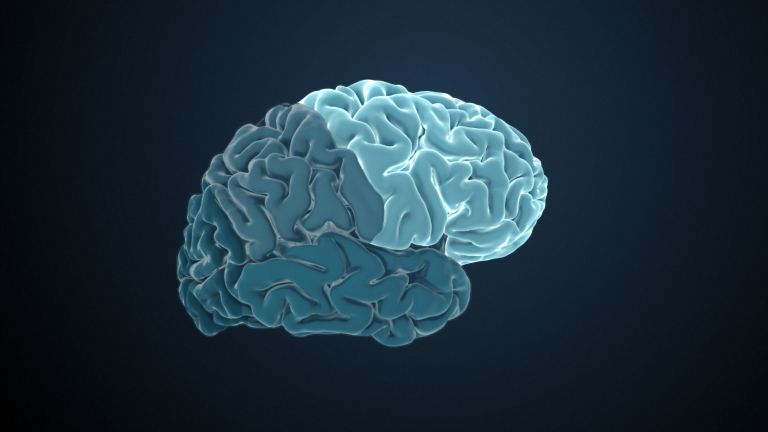
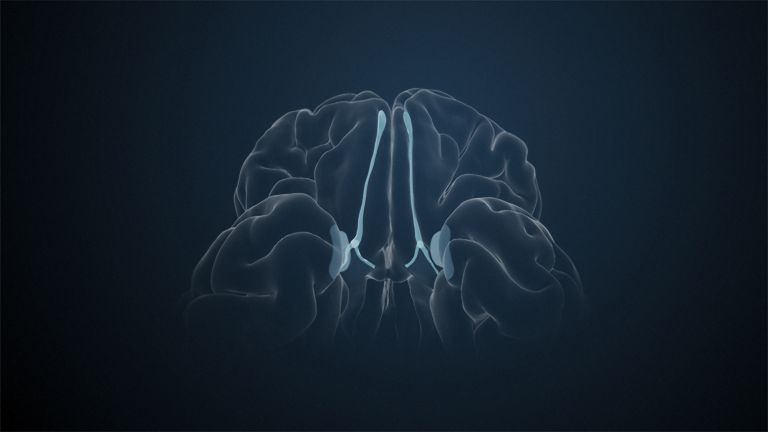
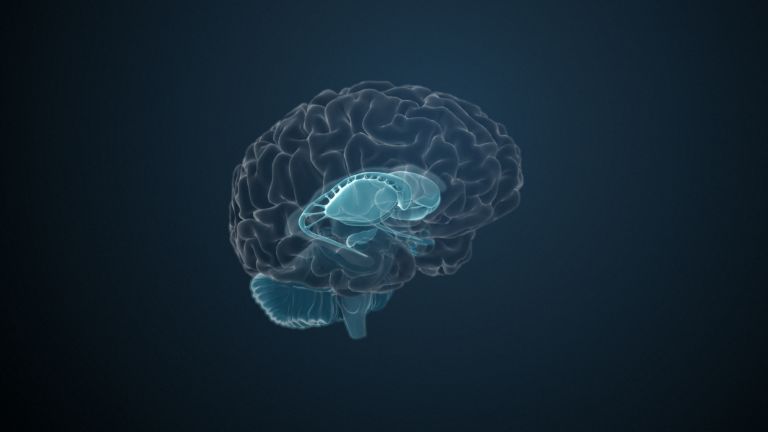
The striatum is easily recognizable as striped. It is considered the input area of the basal ganglia, where the complex interconnection of a targeted movement begins. The front area also contains an important structure of the reward system.
Scientific support: Prof. Dr. Horst-Werner Korf
Published: 28.11.2025
Difficulty: intermediate
The Striatum is easily recognizable as striped. It is considered the input area of the basal ganglia, where the complex interconnection of a targeted movement begins. The front area also contains an important structure of the reward system.
Striatum
Corpus striatum
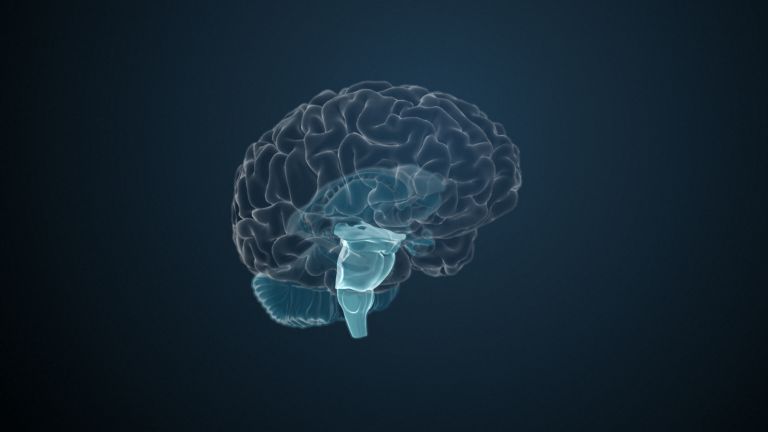
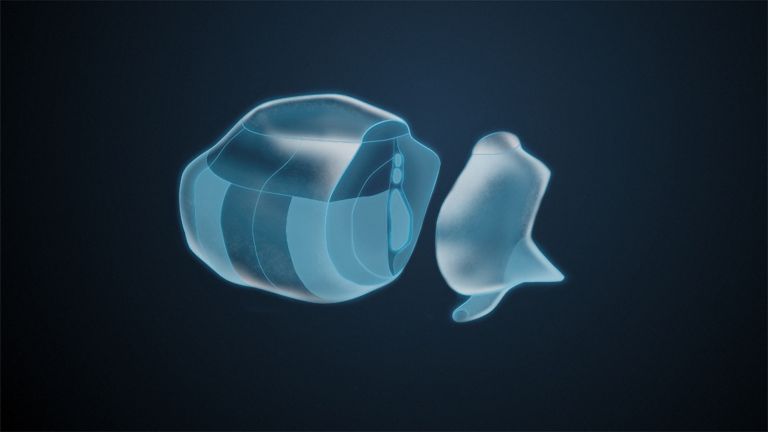
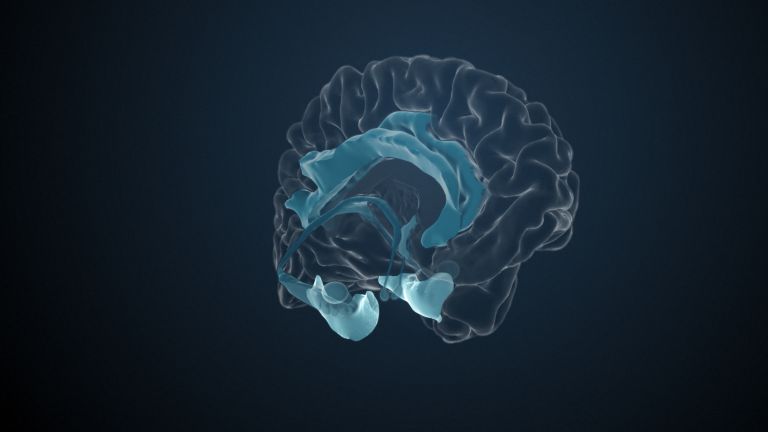
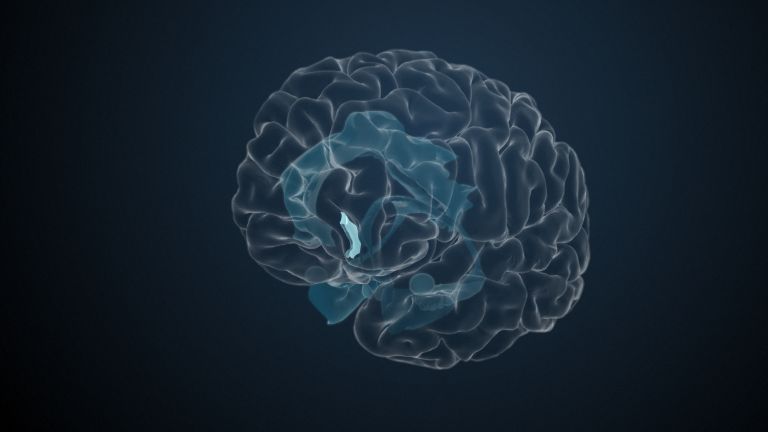
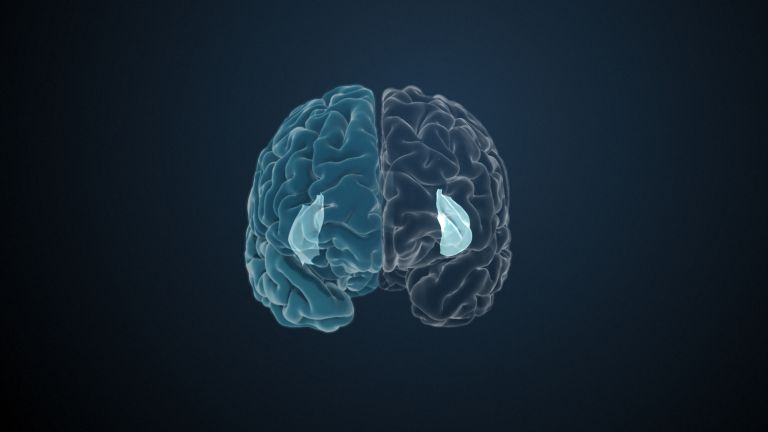
The striatum is a central structure of the basal ganglia. It consists of the caudate nucleus and putamen; the nucleus accumbens is also functionally part of it as its ventral portion. As the most important input structure of the basal ganglia, the striatum plays an essential role in controlling movement sequences as well as in cognition, motivational processes, and the reward system.
The corpus Striatum – also known as the striatum and in German striped body – is the uppermost part of the Basal ganglia and is one of the highly complex motor control circuits of the Cerebrum. There, it primarily has an inhibitory effect, yet leads to excitation. And at least in its front, frontal part, it is indeed impressively striped.
Striatum
Corpus striatum
The striatum is a central structure of the basal ganglia. It consists of the caudate nucleus and putamen; the nucleus accumbens is also functionally part of it as its ventral portion. As the most important input structure of the basal ganglia, the striatum plays an essential role in controlling movement sequences as well as in cognition, motivational processes, and the reward system.
Basal ganglia
Nuclei basales
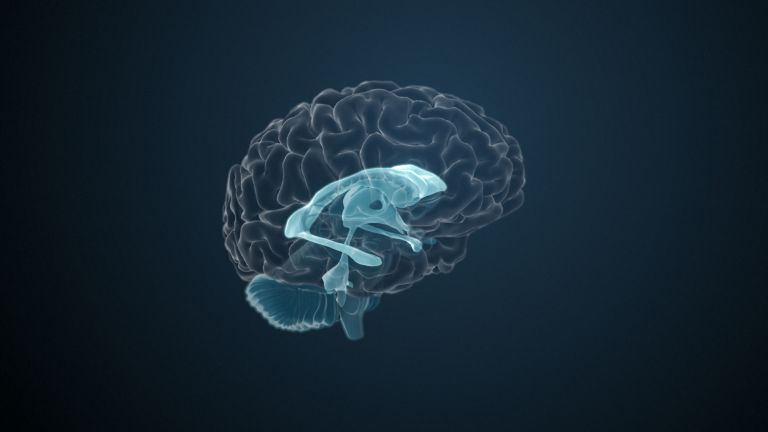
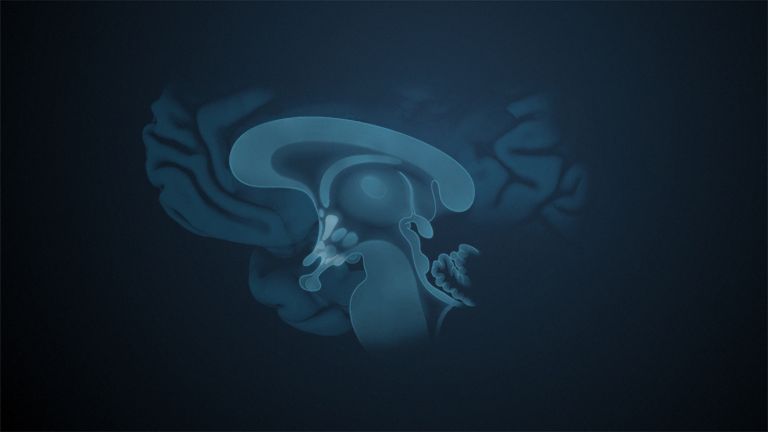
The basal ganglia are a group of subcortical nuclei (located beneath the cerebral cortex) in the telencephalon. The basal ganglia include the globus pallidus and the striatum, and, depending on the author, other structures such as the substantia nigra and the subthalamic nucleus. The basal ganglia are primarily associated with voluntary motor function, but they also influence motivation, learning, and emotion.
Cerebrum
telencephalon
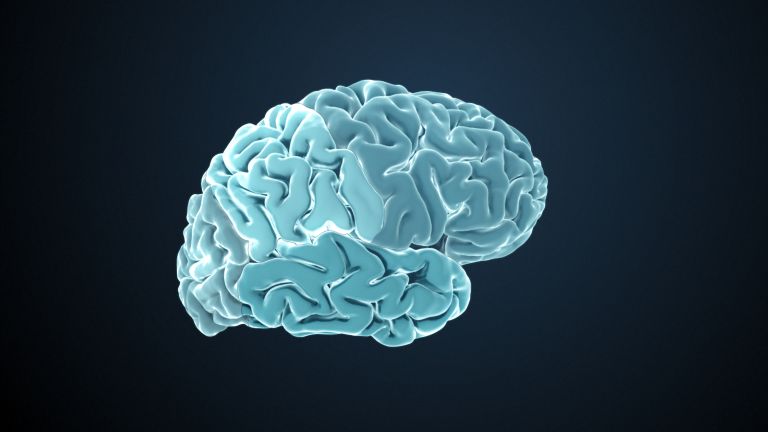
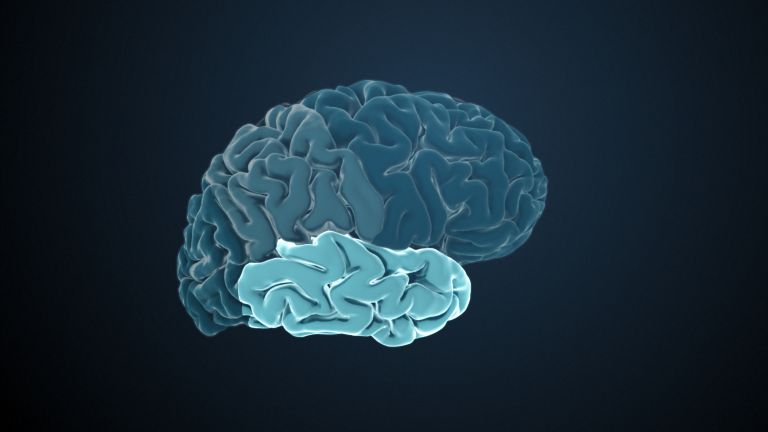
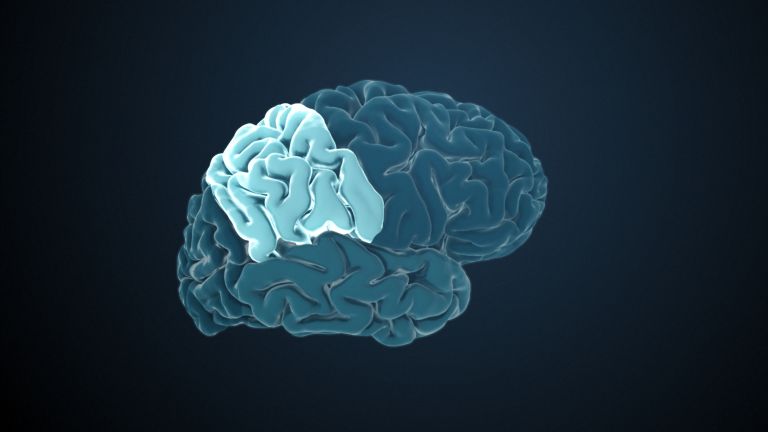
The cerebrum comprises the cerebral cortex (gray matter), the nerve fibers (white matter), and the basal ganglia. It is the largest part of the brain. The cortex can be divided into four cortical areas: the temporal lobe, frontal lobe, occipital lobe, and parietal lobe.
Its functions include the coordination of perception, motivation, learning, and thinking.
frontal
An anatomical position designation – frontal means "towards the forehead," i.e., at the front.
Related nuclei
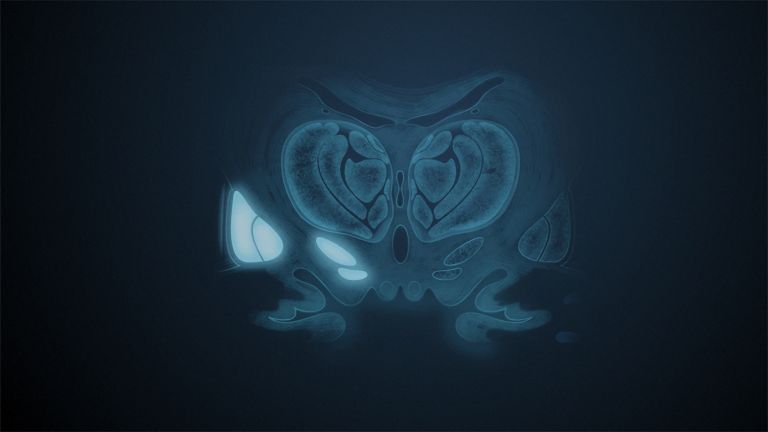
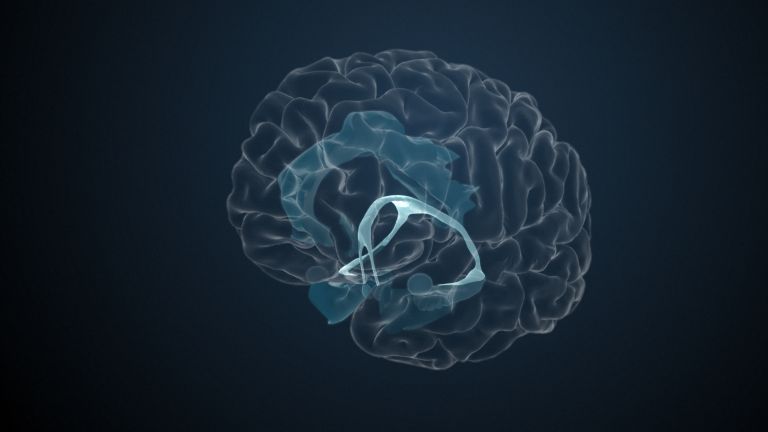
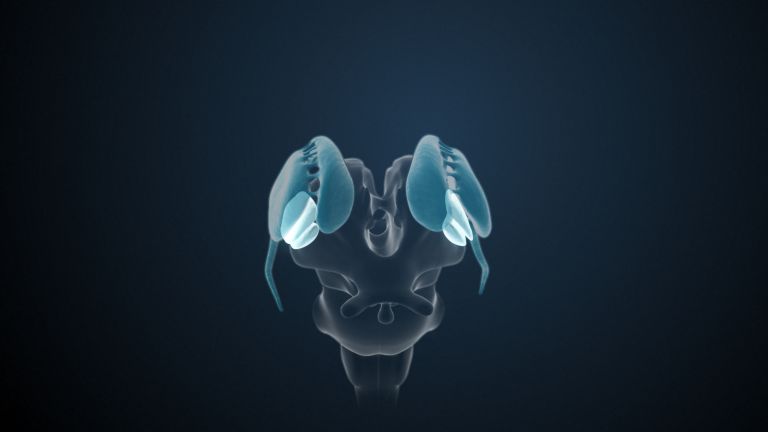
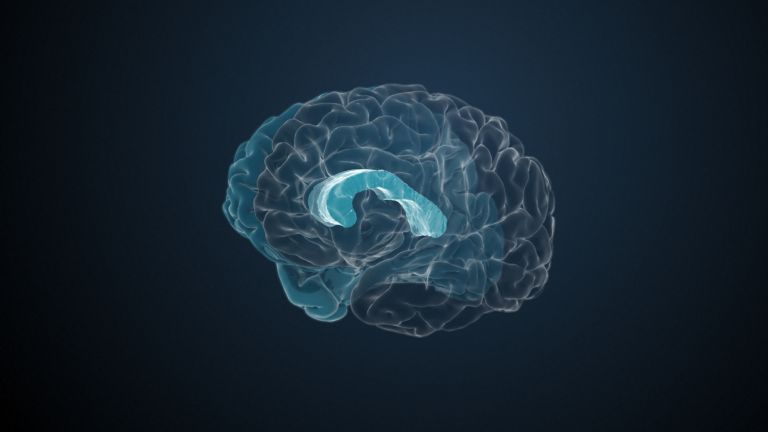
This eponymous striping is caused by fiber tracts of the internal capsule, which partially traverse the Striatum on their way between the thalamus and the Cortex – and divide it into the Caudate nucleus and the Putamen. Originally, those two formed a single unit, both in embryonic development and in phylogenetic history. The internal capsule was added later, as the cortex became increasingly complex. And so, in animals that have poorly developed cortices and therefore no internal capsule, the two divisions of the striatum cannot be differentiated – or only with difficulty. In fact, even in humans, the putamen and caudate cannot be distinguished in terms of their cell types, function, and connections.
Striatum
Corpus striatum
The striatum is a central structure of the basal ganglia. It consists of the caudate nucleus and putamen; the nucleus accumbens is also functionally part of it as its ventral portion. As the most important input structure of the basal ganglia, the striatum plays an essential role in controlling movement sequences as well as in cognition, motivational processes, and the reward system.
Cortex
cortex cerebri
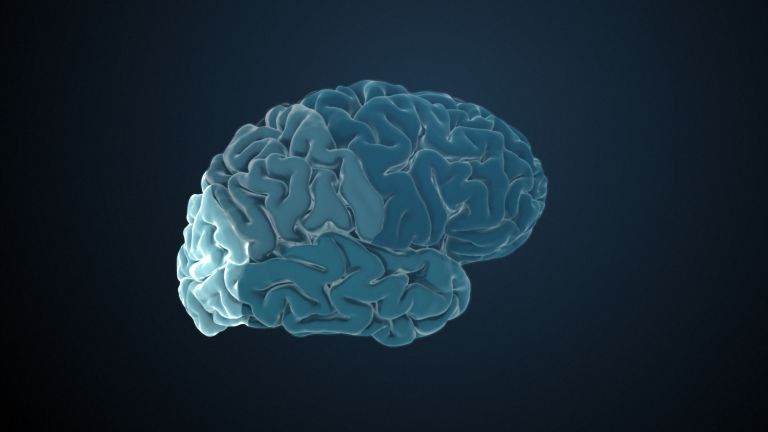
Cortex refers to a collection of neurons, typically in the form of a thin surface. However, it usually refers to the cerebral cortex, the outermost layer of the cerebrum. It is 2.5 mm to 5 mm thick and rich in nerve cells. The cerebral cortex is heavily folded, comparable to a handkerchief in a cup. This creates numerous convolutions (gyri), fissures (fissurae), and sulci. Unfolded, the surface area of the cortex is approximately 1,800cm².
Caudate nucleus
nucleus caudatus
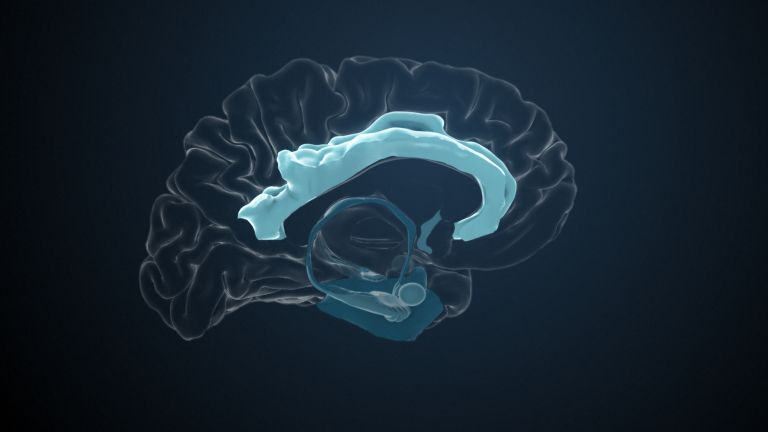
Part of the basal ganglia, it forms the striatum together with the putamen. Anatomically, the caudate nucleus is located frontally in the center of the brain and extends backward, forming a C shape. It consists of a head (caput nuclei caudati), a body (corpus nuclei caudati), and a tail (cauda nuclei caudati). In contrast to the more motor-related parts of the basal ganglia, this area is strongly connected to the prefrontal cortex in addition to its motor functions. As a result, this part of the striatum is also heavily involved in cognition, motivation, and emotion.
Putamen
A nucleus of the basal ganglia that, together with the caudate nucleus, forms the striatum. As part of the extrapyramidal motor system, it is involved in voluntary motor function (intentional movement).
Circuits of motor regulation
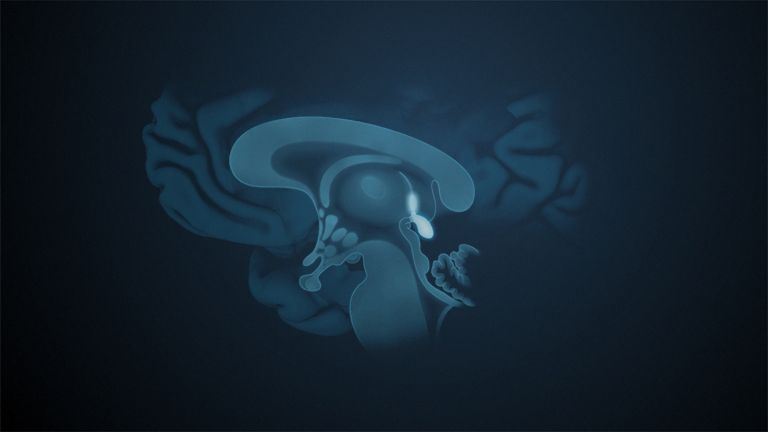
The Striatum regulates voluntary motor function; it is the “input element” in the complex system of the Basal ganglia What does this mean, for example, when reaching for a glass? Well, the striatum receives its inputs from neurons in the motor centers of the cortex, where an action plan is formed. The axons of these cortical neurons use Glutamate as a Neurotransmitter and thus exert an excitatory influence on the nerve cells of the striatum. To simplify, one could say that it integrates the motor “intention” of the Cortex – the reaching movement – and “collects” it before it is actually executed.
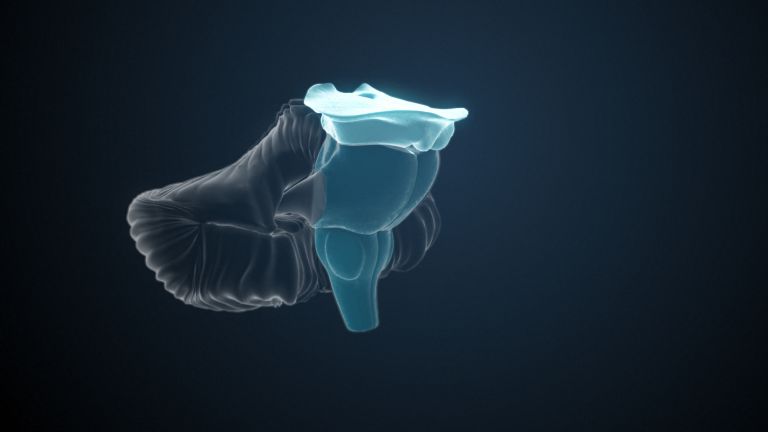
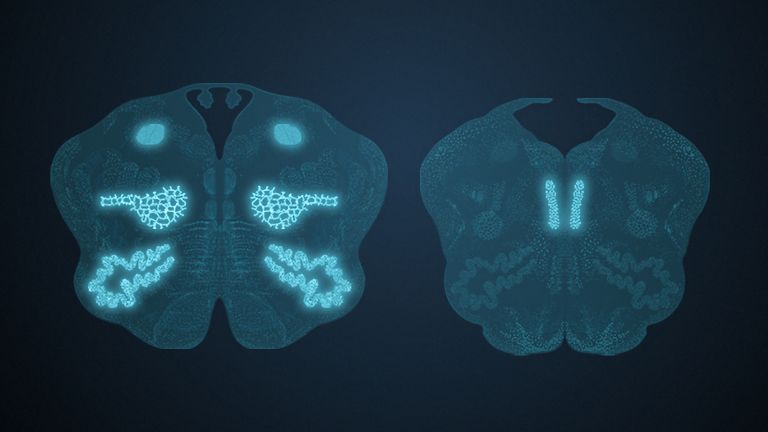
The nerve cells of the striatum that are excited in this way are the medium spiny neurons (MSNs), named after the fine structures on their dendrites. And this is where the excitatory fibers from the cortex end. But the glass is not yet reached for. The MSNs themselves are inhibitory nerve cells. Their axons mainly extend to two other core areas: the substantia nigra, the black nucleus, and the globus pallidus, the pale nucleus, where they release GABA, an inhibitory neurotransmitter.
That sounds complicated. And it gets more complicated, because the Substantia nigra sends its axons back into the striatum. These axons use Dopamine as a neurotransmitter, which in turn has an inhibitory effect on the spiny cells. However, the Inhibition of an inhibition is an excitation. In other words, the striatum–substantia nigra–striatum loop ultimately acts as a positive feedback loop and thus as an activator of the spiny cells.
Striatum
Corpus striatum
The striatum is a central structure of the basal ganglia. It consists of the caudate nucleus and putamen; the nucleus accumbens is also functionally part of it as its ventral portion. As the most important input structure of the basal ganglia, the striatum plays an essential role in controlling movement sequences as well as in cognition, motivational processes, and the reward system.
Basal ganglia
Nuclei basales
The basal ganglia are a group of subcortical nuclei (located beneath the cerebral cortex) in the telencephalon. The basal ganglia include the globus pallidus and the striatum, and, depending on the author, other structures such as the substantia nigra and the subthalamic nucleus. The basal ganglia are primarily associated with voluntary motor function, but they also influence motivation, learning, and emotion.
Glutamate
Glutamate is an amino acid and the most important excitatory neurotransmitter, which acts as a messenger substance in the transmission of information between neurons at their synapses.
Neurotransmitter
A neurotransmitter is a chemical messenger, an intermediary substance. It is released by the sender neuron at the sites of cell-cell communication and has an excitatory or inhibitory effect on the receiver neuron.
excitatory
Exciting synapses are described as excitatory when they depolarize the subsequent cell membrane and can thus lead to the formation of an action potential. An excitatory effect is usually produced by an exciting transmitter (messenger substance), such as glutamate. The opposite is an inhibitory synapse.
Cortex
cortex cerebri
Cortex refers to a collection of neurons, typically in the form of a thin surface. However, it usually refers to the cerebral cortex, the outermost layer of the cerebrum. It is 2.5 mm to 5 mm thick and rich in nerve cells. The cerebral cortex is heavily folded, comparable to a handkerchief in a cup. This creates numerous convolutions (gyri), fissures (fissurae), and sulci. Unfolded, the surface area of the cortex is approximately 1,800cm².
Substantia nigra
A nucleus complex in the ventral mesencephalon that plays a central role in initiating and modulating movement. It appears dark due to neuromelanin. Its dopaminergic neurons project via the nigrostriatal pathways to the putamen and caudate nucleus. Failure of these neurons leads to the typical symptoms of Parkinson's disease.
Dopamine
Dopamine is an important neurotransmitter in the central nervous system that belongs to the catecholamine group. It plays a role in motor function, motivation, emotion, and cognitive processes. Disruptions in the function of this transmitter play a role in many brain disorders, such as schizophrenia, depression, Parkinson's disease, and substance dependence.
Inhibition
Neuronal inhibition describes the phenomenon whereby a sender neuron sends an impulse to a receiver neuron, causing the latter's activity to decrease. The most important inhibitory neurotransmitter is GABA.
When inhibition fails
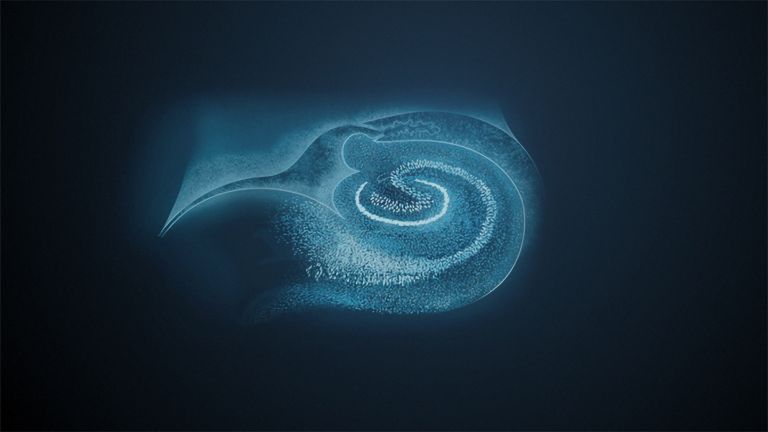
Couldn't it be simpler? Apparently not, because we can see what happens without this positive feedback loop through the Substantia nigra when its neurons die and no more Dopamine reaches the Striatum. The result is impaired motor function, or more precisely, “hypokinesia”: the body's movements become “small,” the steps “trippy,” the face “mask-like,” and, in general, there is a lack of movement. All these symptoms are seen in Parkinson's disease, which, among many other things, also destroys the dopaminergic cells of the substantia nigra. This affects the reaching for a glass in such a way that the movement towards it is slowed down and the hand trembles in a characteristic manner. Once the target is reached, drinking can proceed normally.
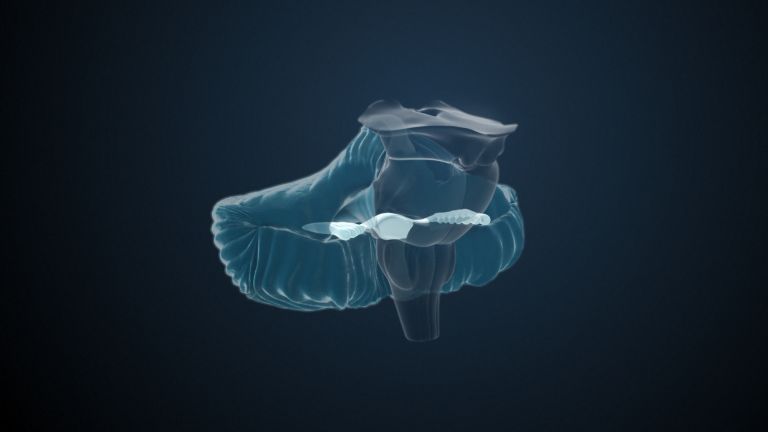
The signals “calculated” in the loop between the substantia nigra and the striatum are transmitted to the motor system via the globus pallidus, the other target Nucleus of the striatum. Put simply, the globus pallidus is responsible for the “output” of the entire Basal ganglia system.
Substantia nigra
A nucleus complex in the ventral mesencephalon that plays a central role in initiating and modulating movement. It appears dark due to neuromelanin. Its dopaminergic neurons project via the nigrostriatal pathways to the putamen and caudate nucleus. Failure of these neurons leads to the typical symptoms of Parkinson's disease.
Dopamine
Dopamine is an important neurotransmitter in the central nervous system that belongs to the catecholamine group. It plays a role in motor function, motivation, emotion, and cognitive processes. Disruptions in the function of this transmitter play a role in many brain disorders, such as schizophrenia, depression, Parkinson's disease, and substance dependence.
Striatum
Corpus striatum
The striatum is a central structure of the basal ganglia. It consists of the caudate nucleus and putamen; the nucleus accumbens is also functionally part of it as its ventral portion. As the most important input structure of the basal ganglia, the striatum plays an essential role in controlling movement sequences as well as in cognition, motivational processes, and the reward system.
Nucleus
In cell biology, the nucleus in a cell is the cell nucleus, which contains the chromosomes, among other things. In neuroanatomy, the nucleus in the nervous system refers to a collection of cell bodies – known as gray matter in the central nervous system and ganglia in the peripheral nervous system.
Basal ganglia
Nuclei basales
The basal ganglia are a group of subcortical nuclei (located beneath the cerebral cortex) in the telencephalon. The basal ganglia include the globus pallidus and the striatum, and, depending on the author, other structures such as the substantia nigra and the subthalamic nucleus. The basal ganglia are primarily associated with voluntary motor function, but they also influence motivation, learning, and emotion.
Emotion and motor function
As mentioned above, the Caudate nucleus and Putamen appear to be separated. However, despite this separation, they meet at the front, lower part of the Striatum and merge. This section is called the fundus striati (“bottom of the striatum”) or Nucleus accumbens septi – septi because it is located near the septum.
The nucleus accumbens is characterized by intense inputs from the Limbic system and thus represents a link between emotion and motor function. It is considered part of the reward system and has been referred to in the media as the “G-spot” of the brain because of its activation by food, some addictive drugs, and even money. That is a bit of an exaggeration. However, it is safe to say that the Dopamine systems of Motivation and motor function overlap in the nucleus accumbens – and that this intersection often contains things that make life worth living.
Caudate nucleus
nucleus caudatus
Part of the basal ganglia, it forms the striatum together with the putamen. Anatomically, the caudate nucleus is located frontally in the center of the brain and extends backward, forming a C shape. It consists of a head (caput nuclei caudati), a body (corpus nuclei caudati), and a tail (cauda nuclei caudati). In contrast to the more motor-related parts of the basal ganglia, this area is strongly connected to the prefrontal cortex in addition to its motor functions. As a result, this part of the striatum is also heavily involved in cognition, motivation, and emotion.
Putamen
A nucleus of the basal ganglia that, together with the caudate nucleus, forms the striatum. As part of the extrapyramidal motor system, it is involved in voluntary motor function (intentional movement).
Striatum
Corpus striatum
The striatum is a central structure of the basal ganglia. It consists of the caudate nucleus and putamen; the nucleus accumbens is also functionally part of it as its ventral portion. As the most important input structure of the basal ganglia, the striatum plays an essential role in controlling movement sequences as well as in cognition, motivational processes, and the reward system.
Nucleus
In cell biology, the nucleus in a cell is the cell nucleus, which contains the chromosomes, among other things. In neuroanatomy, the nucleus in the nervous system refers to a collection of cell bodies – known as gray matter in the central nervous system and ganglia in the peripheral nervous system.
Nucleus accumbens
The nucleus accumbens is a nucleus in the basal ganglia that receives dopaminergic (dopamine-responsive) inputs from the ventral tegmental area. It is associated with reward and attention, but also with addiction. In pain processing, it is involved in motivational aspects of pain (reward, pain reduction) and in the effect of placebos.
Septum
area septalis
The septal nuclei are located medially in the basal forebrain, near the anterior tip of the cingulate gyrus. They are connected to the olfactory cortex and linked to other limbic structures via the fornix. Functionally, they play a role in emotional processes and reward processing.
Limbic system
The limbic system is a functional unit in the brain. It consists of interconnected structures, primarily in the cerebrum and diencephalon. The structures assigned to the system vary depending on the source, but the most important components are the hippocampus, amygdala, cingulate gyrus, septum, and mammillary bodies. The limbic system is involved in autonomic and visceral processes as well as in mechanisms of emotion, memory, and learning. Some authors mistakenly reduce the limbic system to the emotional world by referring to it as the "emotional brain."
Dopamine
Dopamine is an important neurotransmitter in the central nervous system that belongs to the catecholamine group. It plays a role in motor function, motivation, emotion, and cognitive processes. Disruptions in the function of this transmitter play a role in many brain disorders, such as schizophrenia, depression, Parkinson's disease, and substance dependence.
Motivation
A motive is a reason. When this motive takes effect, the living being feels motivation – it strives to satisfy its need. For example, for food, protection, or reproduction. Motivation can be intrinsic (from within, e.g., curiosity) or extrinsic (from outside, e.g., reward).
First published on August 23, 2011
Last updated on November 28, 2025