
Neural Networks: So Much for “Hard-Wired”

Viewing nervous systems as rigid circuits is an oversimplification. Instead, different regions exchange information with one another, thereby ensuring flexibility.
Scientific support: Prof. Dr. Jochen F. Staiger
Published: 10.03.2023
Difficulty: intermediate
- The brain and nervous system are not “hard-wired” together; rather, they influence one another.
- The “top-down” organizational principle directs attention specifically toward elements of the external world.
- The counterpart to “top-down” is “bottom-up,” meaning when the brain’s attention is triggered by the sensory systems.
- Stimulus processing in the visual system has been .particularly well studied. It is influenced, for example, by body movements, which alter perception and attention in response to the external world.
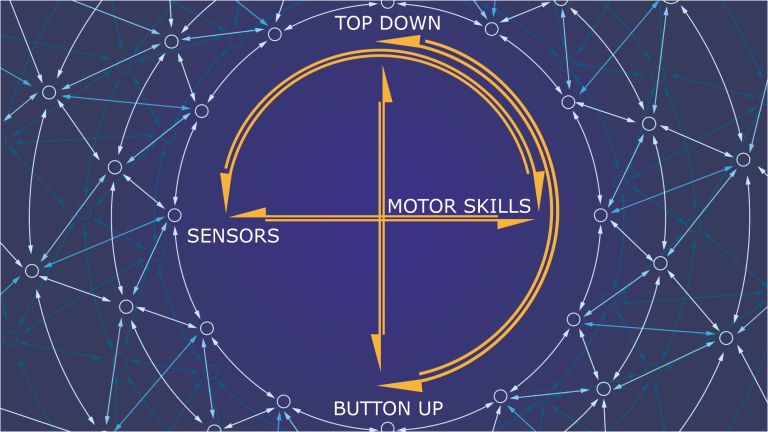
Actually, it all seems quite simple: The brain commands, and the body responds. It’s no coincidence that we often refer to the brain as the “thinking organ,” equating it with the “little head” or the “skull” – and tap our foreheads when someone isn’t quite right in the head. Yet many everyday observations cannot be explained by the simple model of a “thinking center” from which commands are relayed hierarchically from top to bottom. This principle of “top-down” organization of neural networks is contrasted by the “bottom-up” principle, in which information is first registered by the sensory organs and then – usually through several processing steps – reported “upward.”
The latter is the case, for example, when a bright red poppy in a field catches our Attention. This happens without us having planned to look at this flower and without us having specifically sought it out. In addition to color contrasts, bottom-up processes can also detect movements, unexpected touches, or unusual sounds. It is believed that these processes evolved in many animals to quickly detect predators and escape them. The top-down principle, on the other hand, supports goal-directed behavior – such as when a predator sneaks up on its prey.
Attention
Attention
Attention serves as a tool for consciously perceiving internal and external stimuli. We achieve this by focusing our mental resources on a limited number of stimuli or pieces of information. While some stimuli automatically attract our attention, we can select others in a controlled manner. The brain also unconsciously processes stimuli that are not currently the focus of our attention.
Two network principles for survival
Investigating the underlying principles is complicated – because the neural networks involved seem to have a life of their own. They are neither mere recipients of commands from the brain nor simple reporting systems that send information “upward.”
At the Max Planck Institute for Neurobiology in Martinsried near Munich, Herwig Baier and his research group are studying this phenomenon in zebrafish, one of the most popular model organisms. He focuses on bottom-up processes, whose benefits he explains as follows: “To survive, animals often have to make decisions based on incomplete sensory information. To catch prey or escape predators, zebrafish larvae must be able to focus on a specific object and ignore distracting stimuli.” When the larvae are presented with two objects simultaneously, dynamic neural computations ensure that only one stimulus is selected and their behavior is directed toward it.
Baier and his team are developing a behavioral paradigm to observe this neural decision-making process in free-swimming larvae. One goal is to identify the neural circuits in which salience – that is, the highlighting of individual stimuli – is encoded and which govern the selection of the corresponding behavior. Ultimately, the goal is to uncover the causal relationships between neural activity and visual object recognition.
Sometimes a compromise, sometimes all or nothing
Among the numerous techniques in the neuroscientists’ lab, two are particularly helpful for tracking and manipulating the Attention of zebrafish larvae: Two-photon microscopy, when combined with behavioral tests, allows researchers to identify the neurons involved in this process. Optogenetics, on the other hand, provides a toolkit for non-invasively disrupting or redirecting attention using light.
Baier and his colleagues have thus identified two neural networks whose activity patterns predict the relative salience of competing visual objects. Depending on the situation, two different strategies appear to be employed: If a stimulus is detected by only one eye, a neural network in the inner Retina makes a decision based on the “all-or-nothing” (winner-take-all) principle.
The decision-making process is significantly more complex when a stimulus is presented to both eyes. Here, the researchers were able to demonstrate that information flows back and forth between a neural node in the hindbrain (Nucleus isthmi) and the roof of the Midbrain (Tectum). Both hemispheres of the brain are involved. The calculation of the salience of both stimuli is now influenced by their relative position to one another. Attention is then directed either solely at one stimulus (winner-take-all), or an average value is calculated and attention is, so to speak, split in two.
Attention
Attention
Attention serves as a tool for consciously perceiving internal and external stimuli. We achieve this by focusing our mental resources on a limited number of stimuli or pieces of information. While some stimuli automatically attract our attention, we can select others in a controlled manner. The brain also unconsciously processes stimuli that are not currently the focus of our attention.
Retina
The retina is the inner layer of the eye covered with pigment epithelium. The retina is characterized by an inverse (reversed) arrangement: light must first pass through several layers before it hits the photoreceptors (cones and rods). The signals from the photoreceptors are transmitted via the optic nerve to the processing areas of the brain. The reason for the inverse arrangement is the evolutionary development of the retina, which is a protrusion of the brain.
The retina is approximately 0.2 to 0.5 mm thick.
Nucleus
In cell biology, the nucleus in a cell is the cell nucleus, which contains the chromosomes, among other things. In neuroanatomy, the nucleus in the nervous system refers to a collection of cell bodies – known as gray matter in the central nervous system and ganglia in the peripheral nervous system.
Midbrain
mecencephalon
The midbrain is the uppermost section of the brain stem. Its regions are located around the aqueduct, a canal filled with cerebrospinal fluid. Prominent structures include the tectum, tegmentum, and substantia nigra.
Tectum
A structure in the midbrain consisting of two pairs of mounds, the upper colliculi and the lower colliculi.
Mice in motion
Also in Munich, Laura Busse is investigating the principles of top-down regulation. The professor at the Faculty of Biology at Ludwig Maximilian University focuses primarily on mice as her research subjects. She combines electrophysiological measurements in the thalamus and Visual cortex of the animals with optogenetic methods, which allow for the manipulation of neural circuits. She also employs the CRISPR/Cas9 technique, which enables the targeted modification of genetic information.
The focus of her research is on how physical activities – especially movement – affect neural information processing in the early Visual system Busse and her colleagues confirmed that the animals’ visual Perception does not simply mirror their environment on a 1:1 basis, but is highly context-dependent. In this context, not only can different sensory stimuli compete with the visual system for attention, but so can past experiences and goals that the mice have been trained to pursue through the administration of rewards.
Visual cortex
The visual cortex refers to the areas of the occipital lobe that are involved in processing visual information. These include the primary visual cortex and the associative visual cortices V1 to V5. According to Brodmann, the visual cortex comprises areas 17, 18, and 19.
Visual system
The visual system is the part of the nervous system that processes visual information. It primarily comprises the eye, the optic nerve, the optic chiasm, the optic tract, the lateral geniculate nucleus, the optic radiation, the primary visual cortex, and the visual association cortices.
Perception
The term describes the complex process of gathering and processing information from stimuli in the environment and from the internal states of a living being. The brain combines the information, which is perceived partly consciously and partly unconsciously, into a subjectively meaningful overall impression. If the data it receives from the sensory organs is insufficient for this, it supplements it with empirical values. This can lead to misinterpretations and explains why we succumb to optical illusions or fall for magic tricks.
Feedback between the cerebrum and diencephalon
The state of the brain at a given moment thus has a fundamental influence on how information is processed in the Visual cortex Specifically, as early as 2014, Busse demonstrated in a highly acclaimed study how the movement of mice in a running wheel caused a sort of “decoupling” of V1 neurons and, furthermore, led to increased activity in a “switching station” of the diencephalon, the dorsal Lateral geniculate nucleus (dLGN). As running speed increased, the animals’ pupils also dilated – an important marker of arousal and cognitive processes. Other research groups have observed a similar phenomenon in human subjects: visual performance improved when participants stood instead of sitting, or when they moved instead of remaining still.
Since then, Busse and her team have uncovered further details and described how a feedback loop between the cortex, the dLGN, and the visual sector of the thalamic reticular Nucleus (visTRN) – which is also located in the thalamus – influences the processing of spatial information in the thalamus. Put simply, the Cortex sharpens Perception in the dLGN and suppresses distracting signals with the help of the visTRN. “All of this can be precisely visualized using the new methods, and you can see how the cerebral cortex effectively modulates its own input,” says Busse.
Visual cortex
The visual cortex refers to the areas of the occipital lobe that are involved in processing visual information. These include the primary visual cortex and the associative visual cortices V1 to V5. According to Brodmann, the visual cortex comprises areas 17, 18, and 19.
dorsal
The positional term dorsal means "towards the back." In relation to the nervous system, it refers to a direction perpendicular to the neural axis, i.e., upwards towards the head or backwards.
In animals that do not walk upright, the term is simpler, as it always means toward the back. Due to the upright posture of humans, the brain bends in relation to the spinal cord, making dorsal mean "upward."
lateral
A positional term – lateral means "towards the side." In relation to the nervous system, it refers to a direction at right angles to the neural axis, i.e., to the right or left.
Lateral geniculate nucleus
corpus geniculatum laterale
The lateral geniculate nucleus is the section of the thalamus (the largest part of the diencephalon) where around 90% of the optic nerve axons terminate. It has a characteristic stratification into six cell layers. The nerve cells of the lateral geniculate nucleus send their projections to the visual cortex. Together with the medial geniculate nucleus, it forms the metathalamus.
Nucleus
In cell biology, the nucleus in a cell is the cell nucleus, which contains the chromosomes, among other things. In neuroanatomy, the nucleus in the nervous system refers to a collection of cell bodies – known as gray matter in the central nervous system and ganglia in the peripheral nervous system.
Cortex
cortex cerebri
Cortex refers to a collection of neurons, typically in the form of a thin surface. However, it usually refers to the cerebral cortex, the outermost layer of the cerebrum. It is 2.5 mm to 5 mm thick and rich in nerve cells. The cerebral cortex is heavily folded, comparable to a handkerchief in a cup. This creates numerous convolutions (gyri), fissures (fissurae), and sulci. Unfolded, the surface area of the cortex is approximately 1,800cm².
Perception
The term describes the complex process of gathering and processing information from stimuli in the environment and from the internal states of a living being. The brain combines the information, which is perceived partly consciously and partly unconsciously, into a subjectively meaningful overall impression. If the data it receives from the sensory organs is insufficient for this, it supplements it with empirical values. This can lead to misinterpretations and explains why we succumb to optical illusions or fall for magic tricks.
Reality emerges from modulation
Although this is purely basic research, unraveling these complex regulatory processes could also contribute to our understanding of human diseases – or at least provide new hypotheses about what might go wrong in mental illnesses such as schizophrenia. “One hypothesis is that changes in the inhibitory activity of certain neural circuits could also play a role here,” explains Busse.
For example, certain optical illusions are not perceived by schizophrenia patients, unlike healthy subjects. These patients are less sensitive to the context in which a stimulus is embedded. Of course, mouse models would not do justice to such a complex disease, but they could provide an explanation for some specific deficits, according to Busse. Certain stimuli are apparently modulated more strongly in healthy individuals: “One could say that patients see the truth, while others perceive a modulated form of reality.” Who would have thought that the question of how neural networks are organized would lead to such astonishing insights?