Mindfulness in Everyday Life

A meditation program featuring easy-to-learn concentration and movement exercises improves quality of life, promotes good health, and has even made its way into the workplace. Britta Hölzel conducted research on MBSR at Harvard.
Published: 14.07.2026
Difficulty: intermediate
- Mindfulness-Based Stress Reduction (MBSR) is a group program featuring sitting meditation, concentration exercises, and movement exercises.
- It was developed in the 1970s by Jon Kabat-Zinn at the University of Massachusetts.
- The program’s effectiveness has been well-documented. For healthy individuals, it has been shown to increase well-being; for patients, it helps alleviate anxiety and depression, among other conditions.
- Scientists are currently working to investigate its mechanisms of action in greater detail.
Mindfulness programs are also increasingly being used in the workplace. In recent years, various programs have been developed that are practiced in groups within companies. In addition to stress reduction and improved self-care, some of these programs focus on enhancing communication within the company and boosting creativity. So far, there has been very little empirical research evaluating the effects of these programs.
In the U.S., Google developed an eight-week group program called “Search Inside Yourself” (www.siyli.org). This program includes components similar to those in the MBSR program, but its individual elements are even more specifically geared toward helping participants better tap into their own creative potential at work. In Germany, there are various organizations and interest groups working to integrate mindfulness into workplace settings. Among other things, they offer the “Mindfulness in the Workplace” (www.achtsamkeit-am-arbeitsplatz.de) program? In addition, there is an initiative working to bring the practice of mindfulness into the business world: the Mindful Business Network (www.achtsame-wirtschaft.de).
Where am I? Right now? Mentally? Very few people can answer these questions with “in the here and now.” That’s because, more often than not, our minds are occupied with memories, problems, and ruminations. And unfortunately, these are often unpleasant thoughts focused on what isn’t going right in life. You don’t have to subscribe to the Buddhist teachings on overcoming suffering to recognize that thoughts of failures, bad luck, and mishaps don’t make life any happier. In fact, they contribute to our daily stress.
Research in recent years increasingly shows that the practice of mindfulness meditation can help address a range of stress-related – as well as other – illnesses. Furthermore, this practice can be used to enhance well-being and quality of life.
The concept of mindfulness originates in Buddhist philosophy and is practiced within the Buddhist tradition to attain unconditional well-being. Mindfulness is typically cultivated through formal meditation practices, such as sitting meditation, walking meditation, or mindful movement. Attention is directed toward the experience of bodily sensations, emotions, or thoughts, which are perceived as they arise and pass in a given moment.
In doing so, the meditator practices approaching all sensations with openness, acceptance, and curiosity. Internal reactions such as aversion or attachment are acknowledged without giving in to them. When attention wanders and follows daydreams or memories, it is patiently and steadily redirected back to the object of attention as soon as the practitioner notices this.
Attention
Attention
Attention serves as a tool for consciously perceiving internal and external stimuli. We achieve this by focusing our mental resources on a limited number of stimuli or pieces of information. While some stimuli automatically attract our attention, we can select others in a controlled manner. The brain also unconsciously processes stimuli that are not currently the focus of our attention.
A practice of attention control
In current stress-reduction programs, mindfulness exercises are usually taught without delving into the underlying Buddhist philosophy. Even within the Buddhist context, the practice of mindfulness was not tied to religious dogma, but rather represented a mental practice of Attention control and inner attitude.
One of the first mindfulness-based programs adapted for a Western audience is Mindfulness-Based Stress Reduction (MBSR). The method was developed in the late 1970s by Jon Kabat-Zinn at the Center for Mindfulness at the University of Massachusetts Medical School. MBSR is an eight-week group program. The group meets once a week for a session lasting about two and a half hours, and also gathers for a practice day lasting about six hours on the weekend of the sixth week of the course.
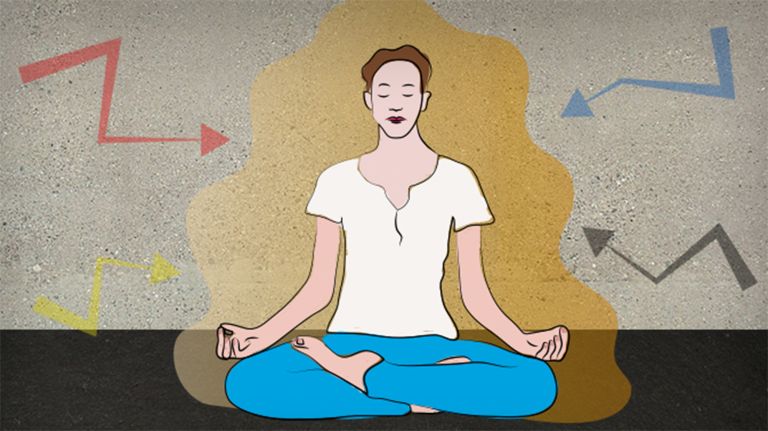
During the sessions, various practices are taught that aim to develop mindfulness. For example, the course includes sitting meditations in which the focus of concentration is initially directed toward the sensation of breathing; in later weeks, it also extends to bodily sensations, hearing, seeing, emotions, and thoughts. As the course progresses, attention is also directed toward awareness itself, without focusing on any specific object. In addition to sitting meditations, the course also teaches the so-called “body scan” – an exercise in which attention is systematically guided throughout the entire body – as well as mindful movement and stretching exercises (very simple yoga exercises) and walking meditation.
The various exercises last up to 45 minutes and are practiced daily by course participants at home, guided by audio recordings. What all exercises have in common is that participants are taught to maintain their focus on the present moment or to bring it back there if their attention has wandered. Instead of falling back into familiar patterns of judgment and resistance, participants are encouraged to repeatedly adopt an open, friendly, and curious attitude toward everything they experience and toward themselves.
Attention
Attention
Attention serves as a tool for consciously perceiving internal and external stimuli. We achieve this by focusing our mental resources on a limited number of stimuli or pieces of information. While some stimuli automatically attract our attention, we can select others in a controlled manner. The brain also unconsciously processes stimuli that are not currently the focus of our attention.




Mindfulness while doing the dishes
In addition to formal exercises, informal exercises are incorporated to gradually integrate mindfulness into daily life. For example, course participants eat a meal mindfully and develop mindfulness toward daily activities, such as doing the dishes, showering, or brushing their teeth. They try to recognize their own typical stress responses and react to stress-inducing situations with mindfulness.
In each group session, the participants’ experiences are reflected upon, questions are addressed, and guidance on practice is provided. Additionally, the course covers other topics, such as constructive ways of dealing with illness and healing, the physiology of stress, breaking the stress cycle through mindfulness, mindful communication, and the impact of diet and various activities (including watching TV and other media consumption) on well-being.
This serves to broaden participants’ perspectives on experience and behavior, and to encourage them to choose behaviors that promote their own well-being.
The MBSR program served as the foundation for a series of additional programs tailored to specific problem areas and areas of interest: for example, Mindfulness-Based Cognitive Therapy (MBCT) for Depression relapse prevention, Mindfulness-Based Relapse Prevention (MBRP) for addiction issues, Mindfulness-Based Eating Awareness Training (MB-EAT) for eating disorders, and the Mindfulness-Based Childbirth and Parenting (MBCP) program.
Depression
A mental illness whose main symptoms are sadness and a loss of joy, motivation, and interest. Current classification systems distinguish between different types of depression.

A flood of publications
The number of publications in the field of mindfulness research has risen exponentially over the past two decades. Im Juli 2026 waren fast 1.900 Publikationen unter dem Begriff 'Mindfulness Based Stress Reduction' in der PubMed-Datenbank registriert.
Research has shown that mindfulness meditation leads to a number of positive effects in psychiatric, psychosomatic, and stress-related disorders. It is therefore increasingly being integrated into psychotherapeutic programs. Mindfulness-based interventions are successfully used, among other things, in the treatment of anxiety disorders, for relapse prevention in recurrent depressive episodes, in substance dependence, and in eating disorders. Some studies also show positive effects of mindfulness meditation in bipolar disorder and attention-deficit/hyperactivity disorder (ADHD). Significant improvements in quality of life have also been reported for various physical conditions, such as chronic pain and cancer. ▸ How Meditation Heals
Furthermore, it has been demonstrated that mindfulness meditation has positive effects on a range of health-related variables. For example, improved immune system function, reduced blood pressure, and reduced cortisol levels have been documented. Mindfulness meditation is not only successfully used in the treatment of medical conditions; it has also been shown to increase psychological well-being and reduce stress in healthy participants.
The most recent meta-analysis assessing the effects of mindfulness-based interventions, which combined the effects on various mental health conditions, concluded that mindfulness-based interventions exhibited medium effect sizes compared to a waiting-list control group or in pure before-and-after measurements. Compared to other treatments, the effect sizes were still small to moderate, meaning that mindfulness-based therapies were more effective than control programs. However, mindfulness did not prove to be more effective than cognitive-behavioral therapy interventions. The most pronounced effects were observed for anxiety symptoms and depression, where large effect sizes were found.
Despite the growing number of publications, the field is relatively young, and many of the findings have yet to be replicated. It is also important that the findings obtained so far be re-examined in studies with better methodological control. Although initial findings are promising, much scientific work remains to be done to better understand the mechanisms and effects of mindfulness practice.
However, that doesn’t mean you can’t start today.
Further reading
- Baer, R. A., “Mindfulness Training as a Clinical Intervention: A Conceptual and Empirical Review,” *Clinical Psychology, Science & Practice*, 10(2):125–143, 2003, go to abstract
- Ekman P et al, Buddhist and Psychological Perspectives on Emotions and Well-Being, Current Directions in Psychological Science, 14(2):59–63 2005, to the text
- Khoury, B et al, Mindfulness-based therapy, A comprehensive meta-analysis, Clinical Psychology Review, 33(6):763–771 2013, to the abstract
Emotions
Neuroscientists understand "emotions" to be complex response patterns that include experiential, physiological, and behavioral components. They arise in response to personally relevant or significant events and generate a willingness to act, through which the individual attempts to deal with the situation. Emotions typically occur with subjective experience (feeling), but differ from pure feeling in that they involve conscious or implicit engagement with the environment. Emotions arise in the limbic system, among other places, which is a phylogenetically ancient part of the brain. Psychologist Paul Ekman has defined six cross-cultural basic emotions that are reflected in characteristic facial expressions: joy, anger, fear, surprise, sadness, and disgust.
First published on April 15, 2014
Last updated on July 14, 2026