Why Meditation?

Even today, many people consider meditation to be part of esotericism. But brain research now sees things differently, and psychologist Ulrich Ott from the University of Giessen has played a part in this for years. Here, he explains why there are very good reasons to meditate.
Published: 30.07.2026
Difficulty: easy
- Regular meditation has a lasting effect on the brain
- Emotional regulation, attention, introspection, and even compassion can be cultivated through appropriate meditation practices, and pain Perception can be influenced
- Researchers are hoping for drug-free therapies, for example, for Depression and anxiety disorders
Perception
The term describes the complex process of gathering and processing information from stimuli in the environment and from the internal states of a living being. The brain combines the information, which is perceived partly consciously and partly unconsciously, into a subjectively meaningful overall impression. If the data it receives from the sensory organs is insufficient for this, it supplements it with empirical values. This can lead to misinterpretations and explains why we succumb to optical illusions or fall for magic tricks.
Depression
A mental illness whose main symptoms are sadness and a loss of joy, motivation, and interest. Current classification systems distinguish between different types of depression.
Meditation is an umbrella term for numerous and very diverse methods of Mental training For a long time, they were all associated with the fields of religion, spirituality, and esotericism – the term was linked to the image of monks and nuns leading a contemplative life in monasteries. Or ascetic yogis, deeply immersed in the lotus position.
Although meditation continues to play a central role as a spiritual practice in various religious traditions, other areas of application have emerged: Today, meditation is also recognized in the secular world as a relaxation technique with proven effectiveness. Training programs incorporating Mindfulness-Based Stress Reduction (MBSR) are successfully used in the treatment of physical and mental illnesses ▸ Perceiving and Accepting: How Meditation Heals. Meditation has also long since moved beyond its niche status. And it’s not just about sitting still: In addition to classic, motionless seated meditation, there are also practices that involve movement. Tai Chi, Qigong, and the physical exercises of yoga are particularly widespread. According to a representative survey, approximately 15 percent of adults in Germany practice some form of meditation at some point in their lives, and more than 10 percent can imagine starting to do so in the next 12 months. Key motivations often include reducing stress, promoting health, and improving physical fitness.
Mental training
Originally a concept from sports psychology: athletes imagine movement sequences and optimize them in their minds. Although comparable methods are now also used in other areas of life, the effectiveness of mental training has been most thoroughly researched in athletes. According to research findings, mental imagery actually changes the brain. This works because imagining movement sequences activates similar areas of the brain as during actual training.
Questions from researchers
In brain research, meditation is primarily understood as “mental training” that leads to improved self-awareness and self-regulation. In addition to influencing the Autonomic nervous system in the sense of a relaxation response ▸ The Neuroscience of Meditation, the focus of research interest is on the direction of Attention: What is the long-term effect of the effort to keep one’s attention on a specific object – for example, the sensations of breathing – and not to drift off into daydreams? ▸ Improved Concentration Through Meditation
Another key focus of research is the regulation of Emotions. Here, for example, the question of how practicing mindfulness can positively influence the management of pain, anxiety, depression, or addictions is of interest. Another strand of research examines how meditative training can be used to cultivate positive emotions such as compassion and loving-kindness.
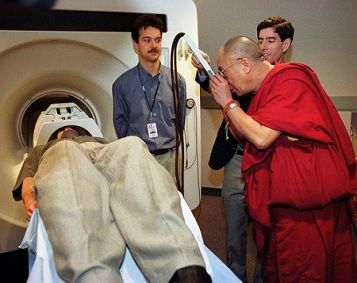
Since the first study using Functional magnetic resonance imaging was published in 2000, research on meditation using imaging techniques has developed rapidly. We can speak of a veritable boom. A key driver of this development has been the work of the Mind and Life Institute, which aims to foster dialogue between representatives of religious traditions and scientists. Through the Dalai Lama’s close collaboration with prominent neuroscientists – such as Richard Davidson and Wolf Singer – and annual conferences, an enormous impact has been achieved. Reports in the press and on the radio about the positive effects of meditation are ubiquitous, and health insurance companies often cover part or even all of the costs for participation in MBSR mindfulness programs.
Autonomic nervous system
The part of the nervous system that primarily controls unconscious vital functions such as breathing, heartbeat, and blood pressure. The autonomic nervous system is divided into the sympathetic nervous system, which is active in performance and stress situations, and the parasympathetic nervous system, which is active during rest and recovery phases. In some cases, the enteric nervous system, which is responsible for gastrointestinal functions, is also considered part of the autonomic nervous system.
Attention
Attention
Attention serves as a tool for consciously perceiving internal and external stimuli. We achieve this by focusing our mental resources on a limited number of stimuli or pieces of information. While some stimuli automatically attract our attention, we can select others in a controlled manner. The brain also unconsciously processes stimuli that are not currently the focus of our attention.
Emotions
Neuroscientists understand "emotions" to be complex response patterns that include experiential, physiological, and behavioral components. They arise in response to personally relevant or significant events and generate a willingness to act, through which the individual attempts to deal with the situation. Emotions typically occur with subjective experience (feeling), but differ from pure feeling in that they involve conscious or implicit engagement with the environment. Emotions arise in the limbic system, among other places, which is a phylogenetically ancient part of the brain. Psychologist Paul Ekman has defined six cross-cultural basic emotions that are reflected in characteristic facial expressions: joy, anger, fear, surprise, sadness, and disgust.
Functional magnetic resonance imaging
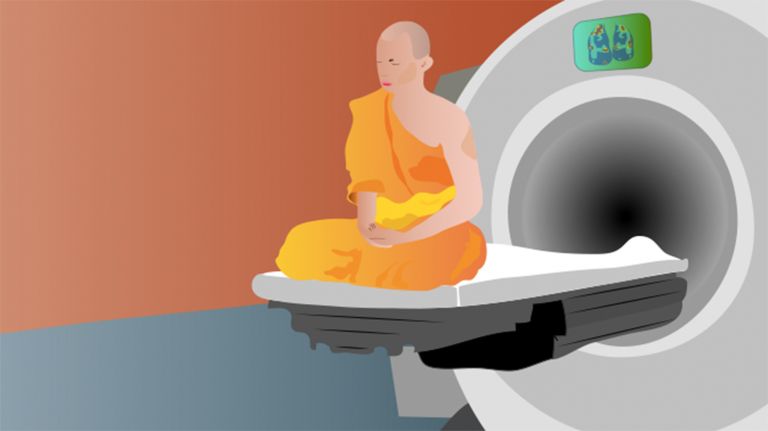
Functional magnetic resonance imaging (fMRI) is a modification of MRI that allows brain activity to be measured indirectly via regional blood flow and oxygen consumption. BOLD (blood oxygen level dependent) contrast is often used, which exploits differences in the magnetic behavior of oxygen-rich and oxygen-poor blood. An increase in the BOLD signal indicates increased neural activity. fMRI provides good spatial resolution and allows detailed conclusions to be drawn about the activity of specific areas of the brain, while the temporal resolution is in the range of seconds.



The changing brain
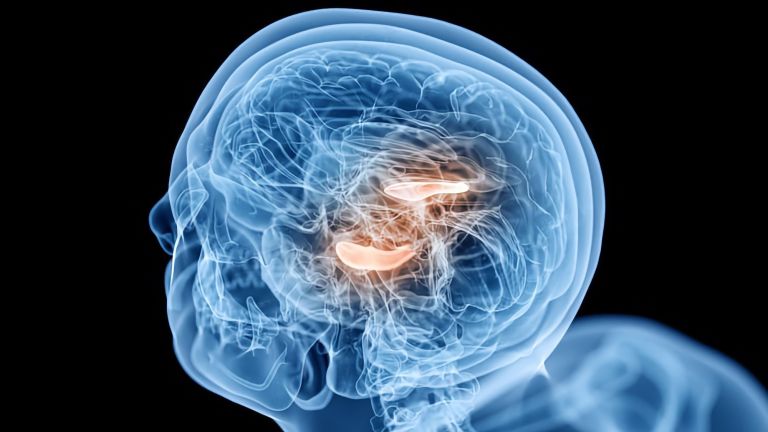
However, brain research is primarily concerned with elucidating the neural mechanisms through which meditation influences attentional performance and the ability to cope with stress. In a series of longitudinal studies, Hölzel and her colleagues were able to show that after just eight weeks of training – with 45 minutes of practice each day – a significant increase in Gray matter density in the Hippocampus could be observed – a structure that, conversely, can be damaged by chronic stress due to high Cortisol levels in the blood. The reduction in subjective stress levels was also associated with a decrease in gray matter density in the amygdala, which, among other things, plays an important role in triggering fear responses. Finally, in a study with anxiety patients, the research group was able to demonstrate how meditation training altered the connectivity between the Prefrontal cortex and the amygdala, which in turn is directly related to the severity of symptoms.
This ability to modify the nervous system through training in order to bring about behavioral changes is fundamental to understanding the effects of meditation. In a therapeutic context, the goal is also to learn to observe bodily sensations, emotions, and thoughts in order to recognize rigid reaction patterns – and to overcome them by cultivating greater freedom for alternative perspectives and responses. The associated mental presence and flexibility could even result in a slower rate of brain aging. Several research groups point to this possibility. Furthermore, a mindful lifestyle is proposed as an important element in the prevention of Alzheimer’s dementia.
Gray matter
Grey matter refers to a collection of nerve cell bodies, such as those found in nuclei or in the cortex.
Hippocampus
The hippocampus is the largest part of the archicortex and an area in the temporal lobe. It is also an important part of the limbic system. Functionally, it is involved in memory processes, but also in spatial orientation and learning. It comprises the subiculum, the dentate gyrus, and the Ammon's horn with its four fields CA1-CA4.
Changes in the structure of the hippocampus due to stress are associated with chronic pain. The hippocampus also plays an important role in the amplification of pain through anxiety.
Cortisol
A hormone produced by the adrenal cortex that is primarily an important stress hormone. It belongs to the group of glucocorticoids and influences carbohydrate and protein metabolism in the body, suppresses the immune system, and acts directly on certain neurons in the central nervous system.
Prefrontal cortex
Prefrontal cortex
The prefrontal cortex (PFC) forms the front part of the frontal lobe and is one of the brain's most important integration and control centers. It receives highly processed information from many other areas of the cortex and is responsible for planning, controlling, and flexibly adapting one's own behavior. Its central tasks include executive functions, working memory, emotion regulation, and decision-making. In addition, the PFC plays an important role in the cognitive evaluation and modulation of pain.
- Cramer, H. (2019). Meditation in Germany: A Nationally Representative Survey. Complementary Medicine Research, 26(6), 382–389. https://doi.org/10.1159/000499900
- Hölzel BK, Carmody J, Vangel M, Congleton C, Yerramsetti SM, Gard T, Lazar SW (2011), Mindfulness practice leads to increases in regional brain Gray matter density, Psychiatry Res., 191(1):36–43, Jan. 30, 2011, abstract
- Hölzel BK, Hoge EA, Greve DN, Gard T, Creswell JD, Brown KW, Barrett LF, Schwartz C, Vaitl D, & Lazar S, Neural mechanisms of symptom improvements in generalized anxiety disorder following mindfulness training, Neuroimage: Clinical, 2, 448–458, 2013, abstract
- Laukkonen, R. E., & Slagter, H. A. (2021). From many to (n)one: Meditation and the Plasticity of the predictive mind. Neuroscience and Biobehavioral Reviews, 128, 199–217. https://doi.org/10.1016/j.neubiorev.2021.06.021
- Luders, E., Cherbuin, N., & Gaser, C. (2016). Estimating brain age using high-resolution pattern recognition: Younger brains in long-term meditation practitioners. NeuroImage, 134, 508–513. https://doi.org/10.1016/j.neuroimage.2016.04.007
- Matko, K., & Sedlmeier, P. (2019). What Is Meditation? Proposing an Empirically Derived Classification System. Frontiers in Psychology, 10, 2276. https://doi.org/10.3389/fpsyg.2019.02276
- Treves, I. N., Pichappan, K., Hammoud, J., Bauer, C. C. C., Ehmann, S., Sacchet, M. D., & Gabrieli, J. D. E. (2024). The Mindful Brain: A Systematic Review of the Neural Correlates of Trait Mindfulness. Journal of Cognitive Neuroscience, 1–38. https://doi.org/10.1162/jocn_a_02230
- van der Velden, A. M., Scholl, J., Elmholdt, E.-M., Fjorback, L. O., Harmer, C. J., Lazar, S. W., O’Toole, M. S., Smallwood, J., Roepstorff, A., & Kuyken, W. (2023). Mindfulness training changes brain dynamics during depressive rumination: A randomized controlled trial. Biological Psychiatry, 93(3), 233–242. https://doi.org/10.1016/j.biopsych.2022.06.038
- Young, K. S., van der Velden, A. M., Craske, M. G., Pallesen, K. J., Fjorback, L., Roepstorff, A., & Parsons, C. E. (2018). The impact of mindfulness-based interventions on brain activity: A systematic review of Functional magnetic resonance imaging studies. Neuroscience and Biobehavioral Reviews, 84, 424–433. https://doi.org/10.1016/j.neubiorev.2017.08.003
Gray matter
Grey matter refers to a collection of nerve cell bodies, such as those found in nuclei or in the cortex.
Plasticity
Neuroplasticity
The term neuroplasticity describes the ability of synapses, nerve cells, and entire areas of the brain to change structurally and functionally depending on the degree to which they are used. Synaptic plasticity refers to the adaptation of the signal transmission strength of synapses to the frequency and intensity of incoming stimuli, for example in the form of long-term potentiation or depression. In addition, the size, interconnection, and activity patterns of different areas of the brain also change depending on their use. This phenomenon is referred to as cortical plasticity when it specifically affects the cortex.
Functional magnetic resonance imaging
Functional magnetic resonance imaging (fMRI) is a modification of MRI that allows brain activity to be measured indirectly via regional blood flow and oxygen consumption. BOLD (blood oxygen level dependent) contrast is often used, which exploits differences in the magnetic behavior of oxygen-rich and oxygen-poor blood. An increase in the BOLD signal indicates increased neural activity. fMRI provides good spatial resolution and allows detailed conclusions to be drawn about the activity of specific areas of the brain, while the temporal resolution is in the range of seconds.
Originally published on April 15, 2014
Last updated on July 30, 2026