The Neuroscience of Meditation
From gray matter density to neurotransmitters: Meditation changes the brain. Emotions, attention, and introspection – even compassion – can be trained through meditation, just like the long jump or cycling.
Scientific support: Dr. Susanne Leiberg, Dr. Marc Wittmann
Published: 04.09.2026
Difficulty: intermediate
- Regular meditation has a lasting effect on the brain.
- Emotional control, attention, introspection, and even compassion can be trained through appropriate meditation practices, and pain Perception can be influenced.
- The effects of meditation can also be detected in Neurotransmitter levels: Yoga exercises increase the concentration of GABA, a neurotransmitter with a relaxing effect, in the brain.
Perception
The term describes the complex process of gathering and processing information from stimuli in the environment and from the internal states of a living being. The brain combines the information, which is perceived partly consciously and partly unconsciously, into a subjectively meaningful overall impression. If the data it receives from the sensory organs is insufficient for this, it supplements it with empirical values. This can lead to misinterpretations and explains why we succumb to optical illusions or fall for magic tricks.
Neurotransmitter
A neurotransmitter is a chemical messenger, an intermediary substance. It is released by the sender neuron at the sites of cell-cell communication and has an excitatory or inhibitory effect on the receiver neuron.
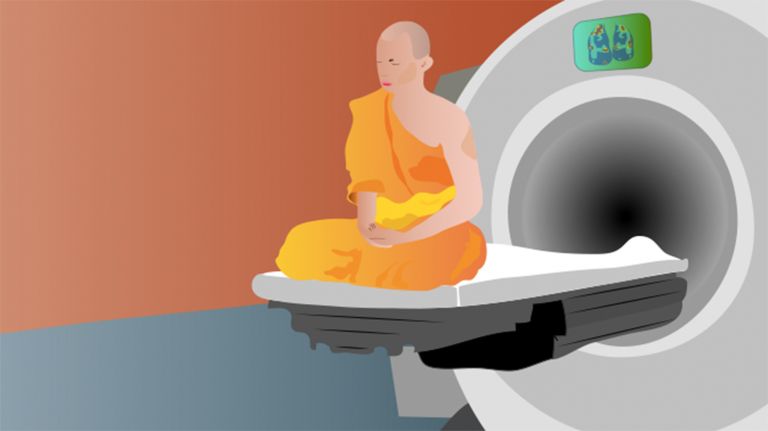
At the Waisman Laboratory for Brain Imaging and Behavior in Wisconsin-Madison, an unusual scene unfolded: A Buddhist monk sat on the table of a brain scanner (MRI) and gathered up his orange-red robe. He allowed Richard J. Davidson and his team to use state-of-the-art equipment to observe what was happening in his brain as he practiced an ancient meditation technique. Meditation has long since emerged from the realm of esotericism. It is considered a legitimate subject of research not only within the fields of cognitive, affective, and social neuroscience. An increasing number of doctors and psychologists are also using meditation practices to treat a wide variety of conditions or to support their therapy, ranging from chronic pain to stress-induced inflammatory responses and Depression. ▸ Perceiving and Accepting – How Meditation Heals
“Through meditation, we ourselves have the opportunity to train the mind and promote our health,” says psychologist Britta Hölzel, who studies the neural correlates of meditation. According to her, the regulation of emotions, attention, and introspection – even compassion and attentiveness – are skills that can be trained, just like the long jump or cycling.
Depression
A mental illness whose main symptoms are sadness and a loss of joy, motivation, and interest. Current classification systems distinguish between different types of depression.
Not a rigidly wired machine
This is possible because the brain is not a rigidly wired machine. It changes with the experiences we have. For example, in musicians and even in people who send a lot of text messages, the area of the brain representing the heavily used fingers is enlarged. Researchers call this phenomenon neural plasticity.
The first EEG studies involving yoga masters in India and Zen Buddhists in Japan date back to the 1950s. In the 1970s, American researchers investigated the effects of Transcendental Meditation, which was all the rage in the U.S. at the time. Today, in addition to the EEG, researchers have access to magnetic resonance imaging, or the “brain scanner.” Since the turn of the millennium, the neuroscience of meditation has been experiencing a veritable boom. “It’s almost eerie to me,” admits Britta Hölzel.
The psychologist, who conducted research in Sara Lazar’s lab at Harvard Medical School – and now runs her own practice in Munich – was able to demonstrate with her research group that even an eight-week training program in Mindfulness-Based Stress Reduction (MBSR) leaves clear traces in the brain. MBSR is a meditation program that incorporates elements from yoga and Buddhist meditation. It teaches participants to focus on the present moment and to approach it with an attitude of openness and non-judgment. After completing the training program, the participants showed an increase in Gray matter density in areas such as the Hippocampus. “This is part of the Limbic system and is important for Memory and the regulation of arousal in emotional situations,” explains Hölzel.
Plasticity
Neuroplasticity
The term neuroplasticity describes the ability of synapses, nerve cells, and entire areas of the brain to change structurally and functionally depending on the degree to which they are used. Synaptic plasticity refers to the adaptation of the signal transmission strength of synapses to the frequency and intensity of incoming stimuli, for example in the form of long-term potentiation or depression. In addition, the size, interconnection, and activity patterns of different areas of the brain also change depending on their use. This phenomenon is referred to as cortical plasticity when it specifically affects the cortex.
EEG
An electroencephalogram, or EEG for short, is a recording of the brain's electrical activity (brain waves). Brain waves are measured on the surface of the head or using electrodes implanted in the brain itself. The time resolution is in the millisecond range, but the spatial resolution is very poor. The discoverer of electrical brain waves and EEG is the neurologist Hans Berger (1873−1941) from Jena.
Gray matter
Grey matter refers to a collection of nerve cell bodies, such as those found in nuclei or in the cortex.
Hippocampus
The hippocampus is the largest part of the archicortex and an area in the temporal lobe. It is also an important part of the limbic system. Functionally, it is involved in memory processes, but also in spatial orientation and learning. It comprises the subiculum, the dentate gyrus, and the Ammon's horn with its four fields CA1-CA4.
Changes in the structure of the hippocampus due to stress are associated with chronic pain. The hippocampus also plays an important role in the amplification of pain through anxiety.
Limbic system
The limbic system is a functional unit in the brain. It consists of interconnected structures, primarily in the cerebrum and diencephalon. The structures assigned to the system vary depending on the source, but the most important components are the hippocampus, amygdala, cingulate gyrus, septum, and mammillary bodies. The limbic system is involved in autonomic and visceral processes as well as in mechanisms of emotion, memory, and learning. Some authors mistakenly reduce the limbic system to the emotional world by referring to it as the "emotional brain."
Memory
Memory is a generic term for all types of information storage in the organism. In addition to pure retention, this also includes the absorption of information, its organization, and retrieval.
Compassion can be learned
Using a game from the repertoire of game theory, Helen Y. Wang and colleagues from Richard J. Davidson’s lab were able to show that just two weeks of training in compassion for others led the participants to act more altruistically. The participants spent 30 minutes a day practicing compassion toward a close friend, a stranger, a difficult person, and themselves. Before and after the training program, their brain activity was measured using Functional magnetic resonance imaging They were compared to a control group that, instead of compassion training, underwent exercises to reframe personal stressful situations. Following the two-week training, participants in both groups were asked to play a distribution game that tested their willingness to use their own money to compensate when someone else distributed money unfairly. The results showed that participants in the compassion group spent significantly more money on others. This was accompanied by greater activity in the inferior parietal Cortex and the dorsolateral Prefrontal cortex compared to the period before the compassion training. Both brain regions are associated with social cognition and emotion regulation. Compassion and altruism, therefore, are not traits that a person either has or does not have; they can be cultivated, according to the study’s authors. In addition, the participants reported greater well-being, lower stress responses, and a better overall mood. Thus, compassion training benefits not only others.
The effects of meditation can also be detected in Neurotransmitter levels. Chris C. Streeter, Perry Renshaw, and colleagues had a group of experienced yoga meditators perform yoga exercises for one hour, while a control group was instructed to rest for one hour. After the exercises, they found a 27 percent increase in the concentration of the neurotransmitter GABA in the yoga group. GABA has a relaxing effect and reduces feelings of anxiety. They were unable to measure any change in the control group.
Antoine Lutz, who also worked in Richard J. Davidson’s lab – and is now at the Lyon Neuroscience Research Center – is particularly interested in the neural correlates of the state of mental clarity reported by experienced meditators. He found that these meditation experts can exhibit strong oscillations in the gamma-wave range during meditation. These brain frequencies are related to learning and the synchronization of different brain regions. The researchers not only found that the oscillations in experts during meditation differed significantly from those of beginners, but also that baseline activity before the start of meditation was higher in experts than in beginners.
Functional magnetic resonance imaging
Functional magnetic resonance imaging (fMRI) is a modification of MRI that allows brain activity to be measured indirectly via regional blood flow and oxygen consumption. BOLD (blood oxygen level dependent) contrast is often used, which exploits differences in the magnetic behavior of oxygen-rich and oxygen-poor blood. An increase in the BOLD signal indicates increased neural activity. fMRI provides good spatial resolution and allows detailed conclusions to be drawn about the activity of specific areas of the brain, while the temporal resolution is in the range of seconds.
inferior
An anatomical position designation – inferior means located further down, the lower part.
Cortex
cortex cerebri
Cortex refers to a collection of neurons, typically in the form of a thin surface. However, it usually refers to the cerebral cortex, the outermost layer of the cerebrum. It is 2.5 mm to 5 mm thick and rich in nerve cells. The cerebral cortex is heavily folded, comparable to a handkerchief in a cup. This creates numerous convolutions (gyri), fissures (fissurae), and sulci. Unfolded, the surface area of the cortex is approximately 1,800cm².
Prefrontal cortex
Prefrontal cortex
The prefrontal cortex (PFC) forms the front part of the frontal lobe and is one of the brain's most important integration and control centers. It receives highly processed information from many other areas of the cortex and is responsible for planning, controlling, and flexibly adapting one's own behavior. Its central tasks include executive functions, working memory, emotion regulation, and decision-making. In addition, the PFC plays an important role in the cognitive evaluation and modulation of pain.
Neurotransmitter
A neurotransmitter is a chemical messenger, an intermediary substance. It is released by the sender neuron at the sites of cell-cell communication and has an excitatory or inhibitory effect on the receiver neuron.
GABA
GABA is an amino acid and the most important inhibitory neurotransmitter, which acts as a messenger in the transmission of information between neurons at their synapses.



Meditation as a pain relief strategy
Meditation techniques aimed at achieving an open state of mind – one that observes without judgment – can also help manage pain. Paradoxically, they lead to a more vivid Perception of pain, yet the pain feels less intense. The research team led by Antoine Lutz and Richard J. Davidson administered painful heat stimuli to the arms of meditation experts while they meditated inside an MRI scanner. After the stimulus ended, the participants were asked to rate how painful it was on a scale. They rated the stimuli as less severe than a control group. At the same time, their brains showed increased activity in the anterior Insula and the Anterior cingulate cortex These regions form the “salience network,” which serves to identify the most important stimuli among those present. At the same time, the researchers measured lower baseline activity in these areas and in the Amygdala before the pain stimulus began. This effect was stronger the more experienced the participants were in meditation. At the same time, the brains of those accustomed to meditation showed faster neural Habituation: they became accustomed to the pain stimulus more quickly, and their response weakened. There are many ways to alleviate, if not the pain itself, then at least the sensation of pain. Meditation has the advantage that it is available anytime and anywhere to anyone who has learned it.
Beyond its medical benefits, some philosophers have also long expressed an interest in meditation. “I don’t understand how the philosophy of mind could have ignored this topic for decades,” says Mainz-based philosopher Thomas Metzinger. He emphasizes the ability of meditators to induce stable and reproducible mental states and to describe them clearly in order to better understand the phenomenon of consciousness. And he is convinced that meditation makes the mind more independent and free: “Meditation increases mental autonomy.”
Perception
The term describes the complex process of gathering and processing information from stimuli in the environment and from the internal states of a living being. The brain combines the information, which is perceived partly consciously and partly unconsciously, into a subjectively meaningful overall impression. If the data it receives from the sensory organs is insufficient for this, it supplements it with empirical values. This can lead to misinterpretations and explains why we succumb to optical illusions or fall for magic tricks.
Insula
lobus insularis
The insula is a recessed part of the cortex (cerebral cortex) that is covered by the frontal, temporal, and parietal lobes. This overlay is called the opercula (lid). The insula influences the motor and sensory functions of the intestines and is considered to be the link between cognitive and emotional elements in pain processing. It is also involved in processes such as taste and physical self-awareness.
Anterior cingulate cortex
Anterior cingulate cortex/Anterior cingulate cortex/anterior cingulate cortex
Like the entire cingulate cortex, the anterior region of the limbic system regulates drive-controlled behavior. In the perception of pain, it is particularly associated with the affective pain component - including social pain as experienced through exclusion.
Amygdala
corpus amygdaloideum
An important core area in the temporal lobe that is associated with emotions: it evaluates the emotional content of a situation and reacts particularly to threats. In this context, it is also activated by pain stimuli and plays an important role in the emotional evaluation of sensory stimuli. Inaddition, it is involved in linking emotions with memories, emotional learning ability, and social behavior. The amygdala is part of the limbic system.
Habituation
If stimuli are repeatedly presented without having any effect, habituation to these stimuli occurs. This weakens the response and, over time, it disappears completely.
Using brain scanners to counter the skeptics
But not everyone is enthusiastic about the current boom in the neuroscience of meditation. Britta Hölzel, for example, fears it’s a flash in the pan that could quickly fizzle out if unrealistic expectations are stoked now and then end in disappointment. Others ask why we even need a neuroscientific explanation for a phenomenon that has proven its effectiveness for centuries. But the meditation researcher does not accept this objection. “For one thing, it’s about selecting from the variety of meditation practices what is best suited for the desired application,” explains Hölzel. This is because the very different techniques – ranging from the whirling dervishes of the Sufis to tai chi and Buddhist meditation – likely also engage very different regions of the brain. Furthermore, these meditation techniques originated in Asian cultures and are closely interwoven with them. It isn’t necessarily sensible to transfer all of their elements to the Western world.
“On the other hand, our goal is to better understand the mind. Meditation can provide an important pathway to this,” says Hölzel. And it’s also partly about reputation: “Of course, people who consider meditation to be an esoteric practice find it easier to embrace it if there is a scientific explanation for how it works,” Hölzel notes from her experience. The researchers are currently working intensively on this explanation.
- Dr. Britta Hölzel, Certified Psychologist, “Mindfulness practice leads to increases in regional brain Gray matter density,” Psychiatry Res, 191(1):36–43, Jan. 30, 2011, to the article
- Dr. Britta Hölzel, licensed psychologist, “Neural mechanisms of symptom improvements in generalized anxiety disorder following mindfulness training,” Neuroimage: Clinical 2:448–458, 2013, text
- Britta Hölzel’s website with links to her work, URL: https://www.brittahoelzel.de/publikationen/wissenschaftliche-publikationen/ [As of: September 7, 2026].
- RJ Davidson, Antoine Lutz, “Buddha’s Brain, Neuroplasticity, and Meditation,” IEEE Signal Processing Magazine, 25(1):176–174, January 1, 2008, to the text
- Meditation Research in Sara Lazar’s Lab, URL: http://www.nmr.mgh.harvard.edu/~lazar/ [Accessed: September 8, 2026]
Gray matter
Grey matter refers to a collection of nerve cell bodies, such as those found in nuclei or in the cortex.
First published on April 29, 2014
Last updated on September 4, 2026