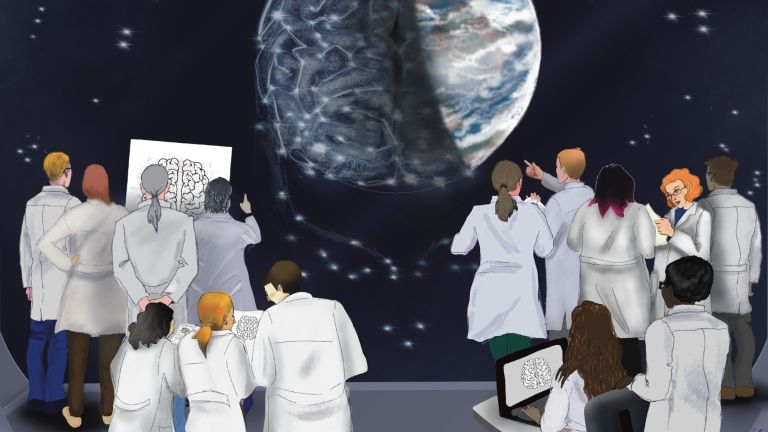
Improved Concentration Through Meditation

When our brain comes to rest, our thoughts begin to wander. We become preoccupied with ourselves, indulging in daydreams instead of staying focused on the task at hand. People who meditate regularly, on the other hand, are better able to concentrate.
Scientific support: Dr. Ulrich Ott
Published: 30.07.2026
Difficulty: intermediate
- The so-called default-mode network in the brain becomes active whenever we come to rest. Then our thoughts tend to wander, and we get lost in daydreams. As a result, we lose our concentration – for example, while reading a book.
- People who are experienced in meditation, on the other hand, can selectively inhibit parts of this default-mode network. The result: present-moment awareness – focus on the here and now.
The brain never takes a break. It’s always working, only sometimes in a fundamentally different way. For example, when we have nothing to do at the moment, our thoughts wander freely, and suddenly the wildest associations pop into our minds. Or when we actually want to concentrate, such as while browsing through a book. And while our eyes obediently follow the lines, our concentration doesn’t – and at the end of a page, we suddenly ask ourselves: Oh, what was that just about? During such phases, the brain switches to a kind of resting state: the so-called default-mode network. Meditation can influence this mode of the brain: In experienced meditators, the activity and connections of the neurons in this network change, allowing them to concentrate better.
This mode was discovered by the living neuroscience legend Marcus Raichle of Washington University in St. Louis (USA). Like many other researchers, he had used Functional magnetic resonance imaging to track which brain regions are activated during specific tasks. When the participants in his studies had nothing to do during the breaks between tasks but were still lying in the scanner, they began to daydream. Raichle noticed that a completely different network was active than usual: It encompasses regions that, viewed from above, extend across the center of the brain from front to back, supplemented in the hindbrain by lateral areas.
Among the core components of this resting-state network is, for example, the medial prefrontal cortex, which evaluates and categorizes events and, in particular, the self – as good, bad, or neutral – from a higher vantage point, so to speak, with a very personal perspective. For example, when people select adjectives from a list that they believe describe them, the medial Prefrontal cortex becomes more active. Not only this region, but other parts of the default-mode network are also closely connected to the hippocampus, which is essential for autobiographical Memory – for example, when it comes to recalling whether we played soccer yesterday or spent a day at the beach. All of this led Raichle to one conclusion: “Whenever people reflect on themselves, they activate their default-mode network.”
Functional magnetic resonance imaging
Functional magnetic resonance imaging (fMRI) is a modification of MRI that allows brain activity to be measured indirectly via regional blood flow and oxygen consumption. BOLD (blood oxygen level dependent) contrast is often used, which exploits differences in the magnetic behavior of oxygen-rich and oxygen-poor blood. An increase in the BOLD signal indicates increased neural activity. fMRI provides good spatial resolution and allows detailed conclusions to be drawn about the activity of specific areas of the brain, while the temporal resolution is in the range of seconds.
lateral
A positional term – lateral means "towards the side." In relation to the nervous system, it refers to a direction at right angles to the neural axis, i.e., to the right or left.
medial
A positional term – medial means "towards the middle." In relation to the nervous system, it refers to a direction toward the body, away from the sides.
Prefrontal cortex
Prefrontal cortex
The prefrontal cortex (PFC) forms the front part of the frontal lobe and is one of the brain's most important integration and control centers. It receives highly processed information from many other areas of the cortex and is responsible for planning, controlling, and flexibly adapting one's own behavior. Its central tasks include executive functions, working memory, emotion regulation, and decision-making. In addition, the PFC plays an important role in the cognitive evaluation and modulation of pain.
Memory
Memory is a generic term for all types of information storage in the organism. In addition to pure retention, this also includes the absorption of information, its organization, and retrieval.
Daydreaming: creative or counterproductive
Take daydreaming, for example: This “internal engagement” is a double-edged sword. It can be useful when it comes to creativity, for instance. Many “eureka” moments have suddenly popped into people’s minds when the brain had nothing else to do but engage in aimless self-reflection. “The content of the daydream determines whether it benefits a person’s well-being or not,” explains neuroscientist Jonathan Smallwood of the University of York. And, of course, the context: When you need to concentrate while studying or engaged in another activity, any deviation from the actual task is counterproductive.
Perhaps it’s no surprise, then, that even in light of modern research, daydreaming is viewed critically. For example, when it comes to Attention deficits – much like Wilhelm Busch’s old German children story Hanns Guck-in-die-Luft, the dreamer who, for instance, falls into a river because he was “looking up at the blue sky.” Or when it comes to people with Depression who can’t break out of ruminative loops and whose thoughts keep circling back to their own selves. One of Marcus Raichle’s studies showed: “Depression is characterized by the inability to downregulate the default-mode network.” Matthew Killingsworth and Daniel Gilbert of Harvard University are definitely no fans of daydreaming. They equipped 2,250 volunteers aged 18 to 88 with a smartphone app. Through this app, they repeatedly asked the participants how happy they were, what they were doing at the moment, and whether they were thinking about their current activity or something else. The result: People spent nearly half their time pondering something other than what they were actually doing. And: This daydreaming usually made them unhappy – it apparently prevented the participants from living in the moment.
Attention
Attention
Attention serves as a tool for consciously perceiving internal and external stimuli. We achieve this by focusing our mental resources on a limited number of stimuli or pieces of information. While some stimuli automatically attract our attention, we can select others in a controlled manner. The brain also unconsciously processes stimuli that are not currently the focus of our attention.
Depression
A mental illness whose main symptoms are sadness and a loss of joy, motivation, and interest. Current classification systems distinguish between different types of depression.
![Hans-guck-in-die-Luft, Heinrich Hoffmann [Public domain] 1917, via Wikimedia Commons](https://www.thebrain.info/sites/default/files/styles/scale_768_w/public/images/Hans_Guck_in_die_LuftTextimBild.JPG.jpg?itok=IL8Bwove)



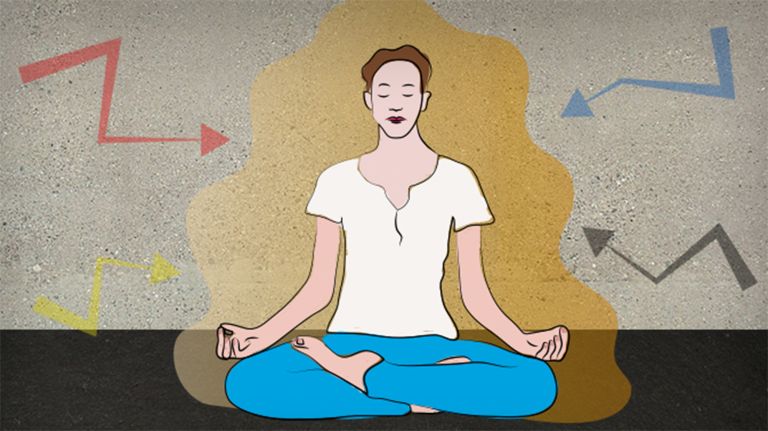
Meditation curbs daydreaming
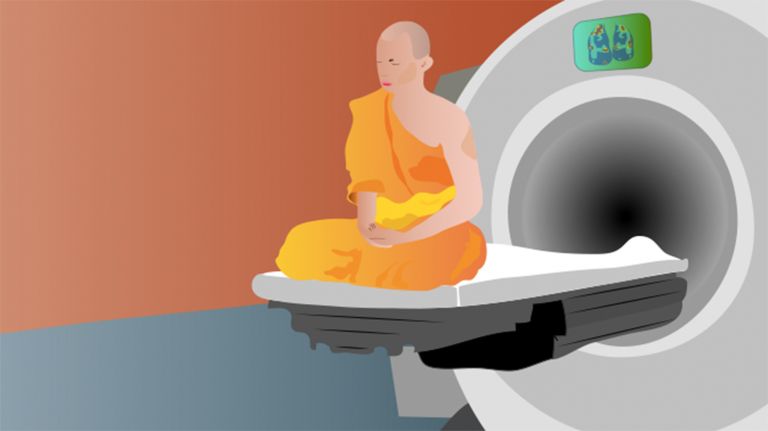
Being in the here and now: This is exactly what people who meditate frequently are quite good at. Naturally, neuroscientists want to know how meditation, daydreaming, and the default-mode network are connected. Psychiatrist Judson Brewer of Yale University, for example, invited twelve people to his lab who had been practicing meditation for more than ten years, as well as 13 participants who had just started. While lying in an MRI scanner, they were asked to practice three different meditation techniques. Using functional magnetic resonance imaging, Brewer and his colleagues determined what was happening in the brain during these sessions – and, as a control, in a relaxed state without meditation.
Unlike the meditation novices, the experienced meditators are able to largely inhibit brain areas that are part of the default-mode network and are associated with daydreaming: the medial Prefrontal cortex and the posterior Cingulate gyrus in the cerebral Cortex. These areas are involved in processing Emotions and directing Attention. As a result, experienced meditators are focused: their thoughts no longer wander aimlessly as often. They truly live in the here and now. Moreover, their default-mode network is routinely much more closely connected to brain regions responsible for conscious control, working memory, and conflict management. For meditators, “greater present-moment awareness,” as the researchers write, is the norm: with fewer self-referential thoughts that otherwise repeatedly interrupt concentration on the here and now. Further studies have since essentially confirmed these findings.
According to recent findings, many diseases are associated with functional disturbances in the default-mode network. For example, if the brain areas that can be “calmed” through meditation are excessively active, this is considered a risk factor for conditions such as attention-deficit/hyperactivity disorder (ADHD), as well as schizophrenia and anxiety disorders. It is therefore plausible to assume that meditation can have a positive influence on neural self-regulation in ADHD and other disorders, thereby reducing symptoms.
medial
A positional term – medial means "towards the middle." In relation to the nervous system, it refers to a direction toward the body, away from the sides.
Prefrontal cortex
Prefrontal cortex
The prefrontal cortex (PFC) forms the front part of the frontal lobe and is one of the brain's most important integration and control centers. It receives highly processed information from many other areas of the cortex and is responsible for planning, controlling, and flexibly adapting one's own behavior. Its central tasks include executive functions, working memory, emotion regulation, and decision-making. In addition, the PFC plays an important role in the cognitive evaluation and modulation of pain.
posterior
A positional term – posterior means "towards the back, located at the rear." In relation to the nervous system, it refers to a direction towards the tail.
Cingulate gyrus
gyrus cinguli
The cingulate gyrus is an important part of the limbic system in the cerebrum. This strip of cortex runs medially in the cerebrum, directly above the corpus callosum. Among other things, it is involved in emotions and memory. Through its connections to limbic and autonomic centers, it can also influence autonomic responses (e.g., heart rate, blood pressure). The anterior (front) region in particular is also associated with attention, motivation, error monitoring, and emotion regulation.
Cortex
cortex cerebri
Cortex refers to a collection of neurons, typically in the form of a thin surface. However, it usually refers to the cerebral cortex, the outermost layer of the cerebrum. It is 2.5 mm to 5 mm thick and rich in nerve cells. The cerebral cortex is heavily folded, comparable to a handkerchief in a cup. This creates numerous convolutions (gyri), fissures (fissurae), and sulci. Unfolded, the surface area of the cortex is approximately 1,800cm².
Emotions
Neuroscientists understand "emotions" to be complex response patterns that include experiential, physiological, and behavioral components. They arise in response to personally relevant or significant events and generate a willingness to act, through which the individual attempts to deal with the situation. Emotions typically occur with subjective experience (feeling), but differ from pure feeling in that they involve conscious or implicit engagement with the environment. Emotions arise in the limbic system, among other places, which is a phylogenetically ancient part of the brain. Psychologist Paul Ekman has defined six cross-cultural basic emotions that are reflected in characteristic facial expressions: joy, anger, fear, surprise, sadness, and disgust.
Attention
Attention
Attention serves as a tool for consciously perceiving internal and external stimuli. We achieve this by focusing our mental resources on a limited number of stimuli or pieces of information. While some stimuli automatically attract our attention, we can select others in a controlled manner. The brain also unconsciously processes stimuli that are not currently the focus of our attention.
Further reading
- Brewer, JA et al., “Meditation experience is associated with differences in default mode network activity and connectivity,” PNAS, 108(50):20254–9, 2011, text
- Feruglio, S., Matiz, A., Pagnoni, G., Fabbro, F., & Crescentini, C. (2021). The impact of mindfulness meditation on the wandering mind: A systematic review. Neuroscience and Biobehavioral Reviews, 131, 313–330. https://doi.org/10.1016/j.neubiorev.2021.09.032
- Garrison, K. A., Zeffiro, T. A., Scheinost, D., Constable, R. T., & Brewer, J. A. (2015). Meditation leads to reduced default mode network activity beyond an active task. Cognitive, Affective & Behavioral Neuroscience, 15(3), 712–720. https://doi.org/10.3758/s13415-015-0358-3
- Hasenkamp, W., Wilson-Mendenhall, C. D., Duncan, E., & Barsalou, L. W. (2012). Mind wandering and Attention during focused meditation: A fine-grained temporal analysis of fluctuating cognitive states. NeuroImage, 59(1), 750–760. https://doi.org/10.1016/j.neuroimage.2011.07.008
- Smallwood, J., & Schooler, J. W. (2015). The science of mind wandering: Empirically navigating the stream of consciousness. Annual Review of Psychology, 66, 487–518. https://doi.org/10.1146/annurev-psych-010814-015331
- Zagkas, D., Bacopoulou, F., Vlachakis, D., Chrousos, G. P., & Darviri, C. (2023). How does meditation affect the default mode network: A systematic review. Advances in Experimental Medicine and Biology, 1425, 229–245. https://doi.org/10.1007/978-3-031-31986-0_22
Attention
Attention
Attention serves as a tool for consciously perceiving internal and external stimuli. We achieve this by focusing our mental resources on a limited number of stimuli or pieces of information. While some stimuli automatically attract our attention, we can select others in a controlled manner. The brain also unconsciously processes stimuli that are not currently the focus of our attention.
Originally published on April 15, 2014
Last updated on July 30, 2026