Sport: An all-around Happiness Package for Body and Mind

We all know that sport is healthy. Nevertheless, we often can't get ourselves off the couch. Perhaps it helps to remind ourselves of the many positive effects of regular exercise – especially on the brain.
Scientific support: Prof. Dr. Melanie Krüger
Published: 01.09.2021
Difficulty: easy
- A variety of exercise promotes cognitive development in children.
- Sport promotes self-regulation and thus also improves the academic performance of children and adolescents.
- In adulthood, exercise primarily serves to maintain balance and prevent physical and mental illness.
- Dancing is well suited to preventing dementia because it makes particularly diverse demands.
- Exercise can also have a significant impact on people with dementia – if approached in the right way.
For some people, there are no excuses: whatever the weather, they lace up their running shoes or hop on their bikes. Others often find it difficult to motivate themselves to exercise. According to a study by US researchers, this has to do with the type of motivation people have. People who were motivated by intrinsic reasons such as fun, challenge, or stress management exercised more often than those who did so solely for health reasons. Whether people preferred individual or group exercises, strength training, or team sports also depended on their personal motives.
“There are essentially three motivations,” says sports scientist Harald Lange from Julius Maximilian University of Würzburg.
1. Fitness People exercise to achieve a certain body image: 10 kilograms less, a six-pack, or toned biceps. Sticking with it melts away fat and strengthens muscles. Your stamina and coordination also improve.
2. Well-being “Many people are not focused on the end result, but on the good feeling they get from exercising,” says Lange. This is especially true for rhythmic movements such as dancing. “The unison between movement and music can create a feeling of harmony,” he explains. In addition, all movements that have to do with balance trigger a certain tension and fascination in us. This can be observed particularly well in children.
3. Social experience Moving together with other people, relating your movements to others and coordinating them – for many people, especially children, this is the most enjoyable and important aspect of sport.
For most children, there is nothing better than romping around with others, moving around a lot and as freely as possible. Not only is this fun, it also benefits their cognitive and motor skills. Even at kindergarten age, it is clear that children who perform well in terms of strength, speed, agility, and coordination are also mentally fitter than their peers.
“Running around outside and inside, climbing, falling on your nose sometimes, getting back up again – all these things are extremely important for children's cognitive development,” says Würzburg-based education researcher Heinz Reinders. This is particularly true between the ages of 0 and 6.
Better grades through soccer
A study by Reinders and his colleagues at the University of Würzburg has shown that young people who play a lot of soccer perform better at school. In both mathematics and German, club soccer players between the ages of 15 and 16 were up to half a grade ahead of their classmates. “This allowed us to dispel the preconception that competitive sports are detrimental to academic development,” says study leader and soccer coach Reinders. He often receives feedback from parents that their child cannot attend training because they have to study for a test. “But that's exactly when it's important for children to let off steam and clear their heads,” says Reinders.
Sport alone may not make you smart, but it is a decisive factor in school motivation. When children and young people exert themselves in sport, they see success. And according to the education researcher, they transfer this to the school context, says Reinders. “They realize that effort pays off.” Athletic children also have higher self-regulation, “they are more aware of their own feelings, plans, and goals, and base their actions more strongly on them,” explains Reinders. This also means they notice more quickly when their thoughts wander while learning and they fail to achieve a goal.
What's more, “In soccer, you learn to quickly translate thoughts into actions. Because you have to make decisions in a fraction of a second.” However, it is important that actions are not practiced in a stereotypical manner, but independently and creatively. Reinders does not give his players any rules at the beginning. He sets them tasks, but without specific instructions. This promotes executive functions particularly well. Because: “The young people have to understand the problem, think of a solution, and put it into practice on the field.” But don't worry if your kids aren't interested in soccer. “No matter what sport you choose, the most important thing is a wide variety of movements and as little routine as possible,” says Reinders.
Every minute of training counts
According to a team of researchers at the University of Minnesota, people who played a lot of sports in their youth or young adulthood have better memory in old age. The longer their average 25-year-old test subjects managed to stay on an increasingly faster treadmill, the better they performed in a memory test conducted 20 years later. For each additional minute on the treadmill, they were able to remember around 0.1 more words from a list of 15 words. “This change may seem modest, but it is significant,” study author David Jacobs is quoted as saying in a press release. This is because tests like these could indicate who is at risk of developing dementia later in life. “Our study is intended to remind young adults how important activities such as running, swimming, and cycling are for brain health,” says Jacobs.
Fortunately, anyone who now thinks, “Damn, I missed my chance,” is wrong: exercise can still have a big impact later in life. “Exercise – especially when done regularly – leads to a special kind of balance,” says sports scientist Harald Lange from the University of Würzburg. Exercise is an excellent compensation, especially for people who don't move much during their working hours.
Our bodies are not made for sitting for hours on end, but for lots of movement. Numerous studies indicate that sitting for long periods of time increases the risk of diabetes and cardiovascular disease. These are among the most common causes of death in western countries. The good news is that regular exercise can prevent a variety of diseases.
Exercise has many positive effects on health. Exercise burns excess fat and builds muscle mass. This boosts the metabolism, because muscles consume more energy even when at rest. When we use them, our muscles need a lot of oxygen. To supply them with this, the heart has to pump harder, which flushes the blood vessels. This makes them more elastic and counteracts deposits that could otherwise cause a stroke or heart attack sooner or later. In addition, exercise makes the body's cells more sensitive to insulin, the hormone that controls the absorption of sugar from the blood. Even people who already have type 2 diabetes can see improvements through regular exercise. Exercise can also counteract brain diseases. In a review of current studies, experts at the University of Queensland in Australia conclude that regular exercise can reduce the risk of developing dementia by 18 percent.
Recommended articles
Dancing against dementia
Dancing is apparently particularly good. “People have to remember new dance steps, orient themselves in space, and adapt their movements to the music,” explains Notger Müller. He heads the Neuroprotection Research Group at the German Center for Neurodegenerative Diseases in Magdeburg. Added to this is the social component: dance partners interact with each other, not only during the dance, but also before and after.
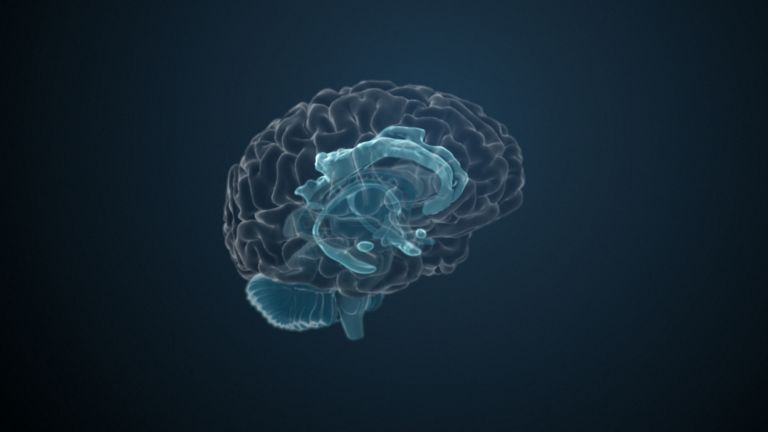
“We know from experiments with mice that a combination of physical and mental stimulation is particularly well suited to stimulating the formation of new nerve cells in the hippocampus and integrating them permanently into neural networks,” reports the neurologist. This region of the brain is particularly important for memory formation; it is severely affected in Alzheimer's patients. But even in the absence of dementia, the hippocampus shrinks by about one percent annually with age.
One consolation: even adults can still form new nerve cells and connections in the hippocampus. That is why Müller and his colleagues investigated how dancing affects the brains of healthy seniors. After six months, they were able to detect positive changes in some areas of the brain, but unfortunately the hippocampus had not grown. “That's why we let the people continue dancing,” says Müller. After a total of 18 months, the team was then able to detect an increase in size in the hippocampus and adjacent regions. The dancers also performed better in memory tests – but only after a study period of five years. In order to not only counteract age-related decline, but also achieve cognitive improvements, it takes a lot of patience.
It's never too late to start
But what if you already have dementia? “Even then, exercise can help,” says Klaus Hauer. He heads the research department at Agaplesion Bethanien Hospital in Heidelberg. A few years ago, health insurance companies attempted to deny rehabilitation to dementia patients, he reports. This was justified by study results showing that rehabilitation had little effect on such individuals. “However, these studies did not apply dementia-oriented concepts,” criticizes Hauer. “Our results, and those of other research groups, show that people with early to moderate cognitive impairment are very much capable of training,” says the movement scientist and biologist.
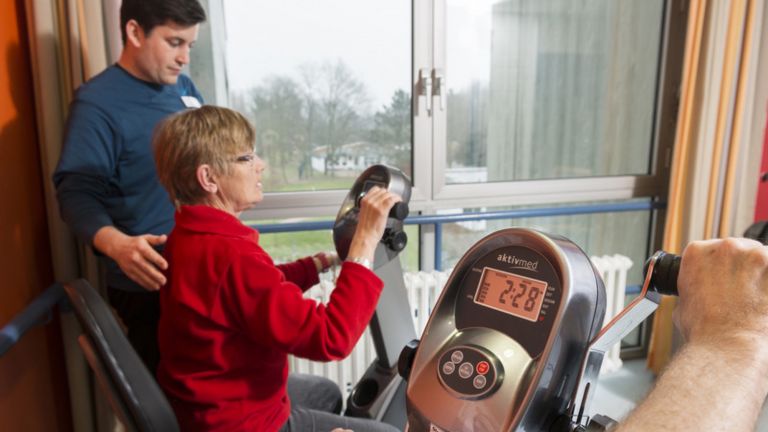
Instead of focusing on their deficits, he emphasizes that we should concentrate on people's resources. The important thing is to look at what people are still capable of and how you can train with them. This can sometimes lead to big surprises: “Even 85-year-olds with dementia can do strength training on equipment,” reports Hauer. So-called exergames – virtual games that encourage physical movement and reactions – are also ideal for training the elderly. “They combine the character of a game with scientifically proven training concepts. This allows you to reach people who have never done sports before,” explains Hauer. Of course, the tasks and level of difficulty must be adjusted accordingly.
Feeling that “I can still do something” motivates people immensely, says Hauer. In psychology, this feeling is also referred to as self-efficacy. Older adults often lose this feeling, partly because their relatives try to do everything for them. With training that is tailored to their needs, they can regain a sense of self-efficacy. As a result, it becomes easier for them to train key functional skills – walking, standing, climbing stairs – and to better cope with everyday life again. So exercise is not only ideal for young children: your body and mind will thank you for it at any age.
Further reading
Recommendations from the World Health Organization (WHO); URL: https://www.who.int/news-room/fact-sheets/detail/physical-activity [as of January 20, 2021]