A Miracle Cure for the Brain
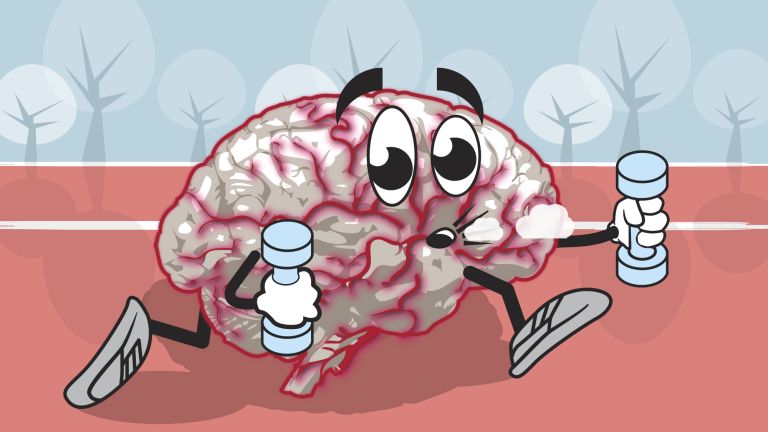
Yeah, sure, exercise is healthy. But it's not just good for the body; it also keeps the mind and brain fit – in many different and surprising ways.
Scientific support: Prof. Dr. Petra Wahle
Published: 01.09.2021
Difficulty: easy
- A healthy heart for a healthy brain: better blood circulation helps the mind to function better
- Exercise leads to a larger Hippocampus and thus better Memory performance
- Physical exercise helps with learning by boosting Attention and concentration
- Intense exercise is good for the psyche, can reduce stress, and help people with Depression break out of their cycle of brooding
- Taking more steps per day leads to a longer life
Hippocampus
The hippocampus is the largest part of the archicortex and an area in the temporal lobe. It is also an important part of the limbic system. Functionally, it is involved in memory processes, but also in spatial orientation and learning. It comprises the subiculum, the dentate gyrus, and the Ammon's horn with its four fields CA1-CA4.
Changes in the structure of the hippocampus due to stress are associated with chronic pain. The hippocampus also plays an important role in the amplification of pain through anxiety.
Memory
Memory is a generic term for all types of information storage in the organism. In addition to pure retention, this also includes the absorption of information, its organization, and retrieval.
Attention
Attention
Attention serves as a tool for consciously perceiving internal and external stimuli. We achieve this by focusing our mental resources on a limited number of stimuli or pieces of information. While some stimuli automatically attract our attention, we can select others in a controlled manner. The brain also unconsciously processes stimuli that are not currently the focus of our attention.
Depression
A mental illness whose main symptoms are sadness and a loss of joy, motivation, and interest. Current classification systems distinguish between different types of depression.
Exercise can help both prevent and treat diabetes. Lack of exercise is one of the fundamental causes of type 2 diabetes. Moderate exercise is therefore an important component in managing diabetes. In people with type 2 diabetes, the body produces sufficient insulin, but the body's cells become increasingly insensitive to it. As a result, less and less glucose enters the cells and blood sugar levels remain permanently elevated. Regular exercise, on the other hand, is key to good insulin action. The reason: physical activity makes the cells more sensitive to insulin, glucose uptake increases, and blood sugar levels drop.
What kind of exercise is best for keeping the brain in shape? Researchers at the University of Basel provide an answer to this question in a review paper. According to their findings, endurance training, strength training, or a combination of these components appear to improve cognitive performance. However, sports that require complex movement patterns and interaction with other players, such as dancing, are significantly more effective.
“Mens sana in corpore sano" – a healthy mind in a healthy body – is often presented to us as ancient Roman wisdom. The catch: this statement was never made in ancient Rome. The ancient Romans could not push people into narrow tubes to examine their brains. Nor could they come up with sophisticated psychological tests. Nevertheless, the message is true, and research has found numerous examples of how sport stimulates our gray matter.
To remember a saying like “Mens sana in corpore sano,” you need a special brain structure called the Hippocampus. And for it to do its job, it needs blood to supply the nerve cells with oxygen and glucose. The hippocampus, which specializes in memory, is supplied by either one or two arteries. This varies from person to person, but it clearly makes a difference to mental performance, as researchers led by Valentina Perosa from Magdeburg University Hospital have discovered. Test subjects who had at least one of their two hippocampi supplied by two arteries demonstrated better Memory and Attention performance. Furthermore, among the older study participants, subjects with healthy blood vessels performed better in cognitive tests than those who suffered from pathological changes in the blood vessels of the brain.
To ensure optimal blood flow, the heart must function sufficiently well. “Severe limitations in heart function can impair blood flow to the brain and reduce cognitive performance,” says neurologist Henning Boecker from the University Hospital in Bonn. However, the reverse is also true: “The improvements in cognitive performance that can be achieved through regular exercise are associated with improvements in cerebral blood flow and metabolism.”
However, exercise not only gets the blood pumping and thus stimulates brain performance, it also leaves traces in the structure of the brain. Researchers at the German Center for Neurodegenerative Diseases (DZNE) analyzed data from more than 2,000 adults. They found that the fitter a person was, the larger their brain volume. Given the purely statistical correlation in the study, it is unclear whether exercise really influenced brain volume. However, physical exercise has been shown to release substances that can counteract the loss of nerve cells. In addition, physical activity appears to stimulate the formation of new nerve cells.
“Animal studies and long-term studies in humans suggest that exercise changes the structure and function of the brain,” confirms Henning Boecker. However, this probably only applies to certain regions. “The most obvious changes are in the hippocampus, where new nerve cells can also be formed in the adult brain. Here, increased fitness was accompanied by an increase in hippocampal volume,” says Boecker. “In addition, the spatial memory of the test subjects improved as their fitness increased.”
Hippocampus
The hippocampus is the largest part of the archicortex and an area in the temporal lobe. It is also an important part of the limbic system. Functionally, it is involved in memory processes, but also in spatial orientation and learning. It comprises the subiculum, the dentate gyrus, and the Ammon's horn with its four fields CA1-CA4.
Changes in the structure of the hippocampus due to stress are associated with chronic pain. The hippocampus also plays an important role in the amplification of pain through anxiety.
Memory
Memory is a generic term for all types of information storage in the organism. In addition to pure retention, this also includes the absorption of information, its organization, and retrieval.
Attention
Attention
Attention serves as a tool for consciously perceiving internal and external stimuli. We achieve this by focusing our mental resources on a limited number of stimuli or pieces of information. While some stimuli automatically attract our attention, we can select others in a controlled manner. The brain also unconsciously processes stimuli that are not currently the focus of our attention.
Muscle building for the gray cells
The brain is often described as a muscle that can be trained with the help of mental exercises. But training the muscles of the body also gets the gray cells going. This was shown in an Australian study with 100 participants aged 55 to 86 who were already struggling with mild cognitive impairment. The subjects who had completed strength training performed better on brain teasers and a cognition test than subjects who had not undergone such training. They also outperformed subjects who had only trained mentally. The brain volume of the strength training group had also increased. The more muscle the subjects developed, the greater the benefit to their brains.
One of the brain's great achievements is its ability to constantly acquire new knowledge, i.e., to learn. According to neuroscientist and movement scientist Stefan Schneider from the German Sport University Cologne, exercise can be a huge help in this process. “It does this by increasing Attention and concentration.” Exercise itself causes a loss of focus. In other words, you become completely absorbed in the sporting activity and forget everything else. Because neural activity is concentrated in areas that are needed for movement planning and motivation, other areas involved in processing Emotions can take a break. After exercise, energy can then flow back into cognitive performance, attention is improved, and learning is made easier, explains Schneider.
Attention
Attention
Attention serves as a tool for consciously perceiving internal and external stimuli. We achieve this by focusing our mental resources on a limited number of stimuli or pieces of information. While some stimuli automatically attract our attention, we can select others in a controlled manner. The brain also unconsciously processes stimuli that are not currently the focus of our attention.
Emotions
Neuroscientists understand "emotions" to be complex response patterns that include experiential, physiological, and behavioral components. They arise in response to personally relevant or significant events and generate a willingness to act, through which the individual attempts to deal with the situation. Emotions typically occur with subjective experience (feeling), but differ from pure feeling in that they involve conscious or implicit engagement with the environment. Emotions arise in the limbic system, among other places, which is a phylogenetically ancient part of the brain. Psychologist Paul Ekman has defined six cross-cultural basic emotions that are reflected in characteristic facial expressions: joy, anger, fear, surprise, sadness, and disgust.
Recommended articles

Get out of the rumination loop
By immersing yourself completely in jogging, soccer, or strength training, you are also doing something good for your psyche. “When depressed people are in a spiral of rumination, for example, they focus all their Attention on their problems,” says Stefan Schneider. Exercise then brings defocusing. “Suddenly, they forget their problems.”
However, exercise is a double-edged sword when it comes to eating disorders. Many people who suffer from them overdo it with fitness, pushing themselves beyond their limits. They do everything they can to become even thinner. However, researchers led by psychologist Ulrich Ebner-Priemer from the Karlsruhe Institute of Technology have also identified a positive side. They spent a week closely examining the physical activity and mood of female test subjects with eating disorders. After exercising, the women felt less tense and less pressure to be thin. However, the overall improvement in mood only lasted for a relatively short time. The researchers concluded that exercise apparently helps people with eating disorders to regulate their negative Emotions. However, because those affected often see no other way to control their feelings, exercise must take place in a controlled environment.
Attention
Attention
Attention serves as a tool for consciously perceiving internal and external stimuli. We achieve this by focusing our mental resources on a limited number of stimuli or pieces of information. While some stimuli automatically attract our attention, we can select others in a controlled manner. The brain also unconsciously processes stimuli that are not currently the focus of our attention.
Emotions
Neuroscientists understand "emotions" to be complex response patterns that include experiential, physiological, and behavioral components. They arise in response to personally relevant or significant events and generate a willingness to act, through which the individual attempts to deal with the situation. Emotions typically occur with subjective experience (feeling), but differ from pure feeling in that they involve conscious or implicit engagement with the environment. Emotions arise in the limbic system, among other places, which is a phylogenetically ancient part of the brain. Psychologist Paul Ekman has defined six cross-cultural basic emotions that are reflected in characteristic facial expressions: joy, anger, fear, surprise, sadness, and disgust.
Brightening your mood
You don't have to be mentally ill to brighten your mood with jogging or a workout. It is now almost a truism that exercise helps against stress. Surprisingly, however, it is not clear how this happens. On the one hand, exercise distracts us from problems we are brooding over. On the other hand, Endorphins probably play a role. This is because after exercise, the endorphin level in the blood is elevated. And endorphins have a dampening effect on the central nervous system. This could explain, for example, why we feel so calm after jogging. Little research has been done on the role of factors, mostly small proteins, that are released from bones, muscles, and organs during exercise and have a positive effect on the functioning and preservation of nerve cells.
If the positive effect of intense exercise on the gray cells still doesn't motivate you to lace up your running shoes, take note: exercise is not only good for your brain, it also helps you live longer. A study from last year put this into concrete figures. Walking 8,000 steps per day compared to 4,000 steps per day was associated with a 51 percent lower risk of death from any cause. Walking 12,000 steps per day was even associated with a 65 percent lower risk. To close the circle: through its anti-stress effect, physical activity promotes the maintenance of a healthy immune system and counteracts heart disease and inflammatory vascular changes. So Winston Churchill was right in many ways, but “no sports” was not one of them.
Endorphins
Abbreviation for endogenous morphines, i.e., morphines produced by the body itself. They play an important role in suppressing and alleviating pain. They are also involved in euphoria (feelings of elation).
vascular
The term refers to vessels in the body in which fluids such as blood or lymph circulate. In a narrower sense, doctors refer to the network of veins, arteries, and capillaries as the "vascular system." If the vascular system is blocked, for example as a result of a stroke, less blood reaches the brain. This means that it receives less oxygen and other nutrients. This can lead to impaired cognitive functions and the development of "vascular dementia." After degenerative forms of dementia such as Alzheimer's, vascular dementia is the second most common form of this group of diseases.