Small but mighty!
Babies can do very little at birth. And yet they already have interests and expectations – their gazes reveal this. The very youngest even recognize some differences better than adults.
Scientific support: Prof. Dr. Anna Katharina Braun, Prof. Dr. Hemmen Sabir
Published: 18.03.2026
Difficulty: intermediate
- Infants can do very little at the beginning of their lives. Yet the so-called gaze preference method offers interesting insights into what babies use for orientation right from the start.
- Babies understand many aspects of everyday physics before they can speak, and in some cases, before they learn to grasp objects purposefully.
- They also have a rudimentary understanding of quantities and time.
- Babies show a preference for social interactions particularly early on. They recognize faces, especially their own mothers’, almost immediately after birth. In some cases, they can even distinguish them better than adults at first.
- Using the gaze preference method, researchers have even identified precursors to moral judgments in their young subjects.
Gaze duration measurement traces back to Robert Fantz, who demonstrated as early as 1964 that infants develop Habituation to repeated stimuli: they look at them for increasingly shorter periods. This principle remains a central method in infant research to this day – though it has undergone significant technological and theoretical refinement.
Today, researchers typically track Eye movements using high-resolution eye-tracking technology, which measures with millisecond precision where and for how long babies look. This allows for a much more precise examination not only of preferences but also of attentional processes and learning trajectories than was previously possible.
The basic assumption remains: longer gaze durations indicate increased Attention – for example, in response to novelty, surprise, or the violation of an expectation. However, this interpretation is handled more cautiously today. Modern studies show that gaze durations are influenced by several factors, including stimulus complexity, expectation, memory, and individual differences.
An important area of application is the study of early cognitive abilities. This demonstrates that infants, even in the first months of life,
can categorize stimuli, establish simple multisensory associations (e.g., between sounds and mouth movements), and form expectations about their environment.
Recent research increasingly combines gaze duration measurements with neurophysiological methods such as EEG or fNIRS. This reveals that gaze behavior and neural activity do not always correspond directly – an indication that gaze times are only an indirect measure of cognitive processes.
Habituation
If stimuli are repeatedly presented without having any effect, habituation to these stimuli occurs. This weakens the response and, over time, it disappears completely.
Eye
bulbus oculi
The eye is the sensory organ responsible for perceiving light stimuli – electromagnetic radiation within a specific frequency range. The light visible to humans lies in the range between 380 and 780 nanometers.
Attention
Attention
Attention serves as a tool for consciously perceiving internal and external stimuli. We achieve this by focusing our mental resources on a limited number of stimuli or pieces of information. While some stimuli automatically attract our attention, we can select others in a controlled manner. The brain also unconsciously processes stimuli that are not currently the focus of our attention.
EEG
An electroencephalogram, or EEG for short, is a recording of the brain's electrical activity (brain waves). Brain waves are measured on the surface of the head or using electrodes implanted in the brain itself. The time resolution is in the millisecond range, but the spatial resolution is very poor. The discoverer of electrical brain waves and EEG is the neurologist Hans Berger (1873−1941) from Jena.
Newborns can’t do much at first. This was also noted by the first major infant researcher, Jean Piaget, when he observed his children in the first half of the 20th century. Sleeping, drinking, and looking – that is all the very youngest infants are capable of. It is difficult to understand how they perceive the world around them. “Logically, we cannot ask the children,” says psychologist Gudrun Schwarzer, who runs an infant laboratory at the University of Giessen ▸ Children in the Lab
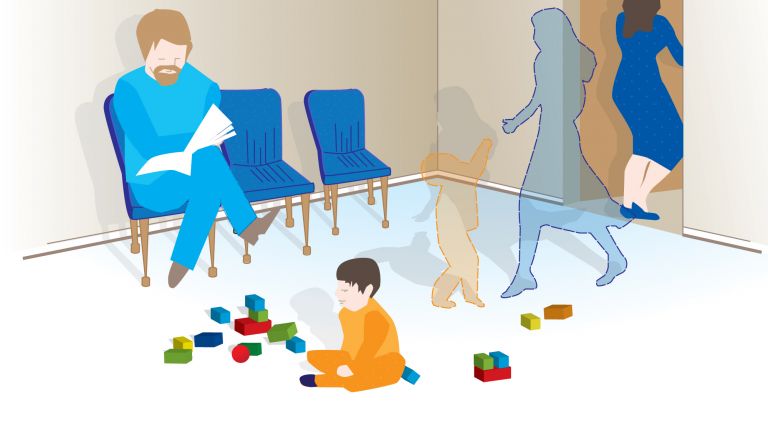
Piaget based his understanding of infants’ knowledge on their actions. Only when, at eight months at the earliest, they specifically searched for a toy where he had hidden it could he be certain that they also remembered the toy when they couldn’t see it. The researcher interpreted this to mean that younger children do not yet understand that they are dealing with one and the same object that always remains the same. “But that’s off the table,” says Schwarzer. She believes Piaget “greatly underestimated children.” After all, even newborns can already sleep, drink, and look – and it is precisely this looking that tells researchers today a great deal about what is already happening in the baby’s brain before their hands can even reach for something intentionally. Researchers therefore analyze the preferences and perceptions of their young subjects using the so-called gaze-tracking method (see info box).
Extremely early interest in faces
Mark H. Johnson of Birkbeck College in London, along with colleagues, studied babies in 1991 who were so young that they had to estimate the babies’ ages in minutes at the start of the study. They showed these newborns large, head-shaped paddles – sometimes blank, sometimes with a face drawn on, and sometimes with a jumble of eyes, a nose, and a mouth. The babies’ gaze lingered longest on the regular face. So they seemed to be able to distinguish at least something about it from the other stimuli. And infants gaze particularly long at their mother’s face, as researchers led by Olivier Pascalis – now at the Laboratoire de Psychologie et NeuroCognition in Grenoble – demonstrated in 1995. Even though Schwarzer is cautious about reading too much into this observation: “If they recognize faces, that means they have an internal representation of them. They know what the face looks like, even when they aren’t seeing it right now.”
Children likely even come into the world with many expectations about their environment. The research of Renée Baillargeon at the University of Illinois in Urbana-Champaign has contributed significantly to this assumption. In a series of experiments, her team exposed babies of various ages to events that are physically impossible in one way or another. Long sticks would disappear into short tubes, balls would remain invisible behind a transparent window, or objects would seem to change their color or pattern. The results showed that infants actually looked at many of these events longer than they did at the physically correct alternative. They were surprised – at least in the sense of paying closer Attention to the unusual events. Even babies, according to Baillargeon, do not live in a fairy-tale world where cups simply turn into pumpkins.
Attention
Attention
Attention serves as a tool for consciously perceiving internal and external stimuli. We achieve this by focusing our mental resources on a limited number of stimuli or pieces of information. While some stimuli automatically attract our attention, we can select others in a controlled manner. The brain also unconsciously processes stimuli that are not currently the focus of our attention.
More, bigger, longer
Infants’ basic understanding of mathematics has also been studied extensively. After all, the question quickly arose: What difference do children actually perceive when they distinguish between different quantities? After all, more circles or squares on a computer screen also have a larger surface area. In a study conducted in 2010, Stella Lourenco of Emory University and Matthew Longo of Birkbeck University of London demonstrated just how closely these two concepts are linked for young children. They trained their nine-month-old participants using two different patterns: for example, the larger rectangles were black and striped, and the smaller ones were white and dotted. They then showed the children a varying number of rectangles – and the babies seemed to expect the stripes to appear in the group with more individual elements. This expectation even extended to the duration of the display: The children looked longer when the pattern for the “larger” elements suddenly appeared on the rectangle they were shown for a shorter time. In 2008, researchers such as Sara Cordes, now at Boston College, and Elizabeth Brannon from Duke University therefore carefully controlled for other variables like area and perimeter. Nevertheless, the seven-month-old infants in their experiment were certainly able to distinguish quantities as such – at least when the difference was large enough.
Infant researcher Schwarzer, however, warns against overinterpreting such results: “It’s easy to get carried away in comparative research. Chimpanzees also have an understanding of quantities.” But arithmetic is more than that. “And I wouldn’t attribute that to children either.” Still: Karen Wynn, now at Yale University, demonstrated rudimentary approaches as early as 1992. In her experiments, five-month-old infants already seemed to expect that one plus one equals two. If a toy was hidden behind a screen and then another placed behind it, the infants looked longer when only one figure subsequently appeared behind the screen than when they saw two there.



From generalist to specialist
In one area, children are already experts before they start crawling: social interactions. “Things that they immediately associate with a caregiver are particularly important,” explains Gudrun Schwarzer. Even at just a few days old, infants prefer photos of people whose gaze is directed straight at them. They can also distinguish between fearful and happy faces and prefer the latter. Both findings come from the team led by Teresa Farroni, who conducts research at the University of London and the University of Padua.
Gudrun Schwarzer finds it particularly fascinating how generalists become specialists in this process: “In the first few months, infants can perceive all differences in social contexts: between all faces, all languages. Then specialization sets in, a narrowing of focus, and children become really good at very specific things. By six months, before they’ve even spoken a single word themselves, they’re experts in their native language.” At the same time, children lose abilities that even surpass those of us adults. “At first, they can distinguish all faces – of humans, monkeys, sheep…,” explains Schwarzer. “From around five months on, this only works for the ethnic group surrounding them.” Similarly, the little ones also specialize in the area of auditory and language development.
Fair and friendly
Socially, too, babies are attuned to life in a community: as early as three months old, infants prefer “helpers” over “disruptors.” In an experiment by Kiley Hamlin of the University of British Columbia and Karen Wynn of Yale University, the young participants watched a hand puppet take a ball away from another puppet or give it back. The researchers interpreted the longer gaze duration toward the “giver” as a preference for that puppet’s social behavior. Another experiment conducted with Paul Bloom, also from Yale, showed similar effects when the children watched social interactions between geometric figures on a computer screen. They preferred to look at the figure that had helped a “climbing” red circle up the mountain rather than at the one that pushed the climber down.
Further reading
- Fantz, Robert L.: Visual Experience in Infants: Decreased Attention to Familiar Patterns Relative to Novel Ones. Science 1964 Oct 30;146(3644):668 – 70 (full text).
- Baillargeon, Renée: Innate Ideas Revisited: For a Principle of Persistence in Infants‘ Physical Reasoning. Perspect Psychol Sci. 2008 Jan;3(1):2 – 13 (full text).
Attention
Attention
Attention serves as a tool for consciously perceiving internal and external stimuli. We achieve this by focusing our mental resources on a limited number of stimuli or pieces of information. While some stimuli automatically attract our attention, we can select others in a controlled manner. The brain also unconsciously processes stimuli that are not currently the focus of our attention.
Originally published on March 17, 2016
Last updated on March 18, 2026