The Secret of Taste Perception
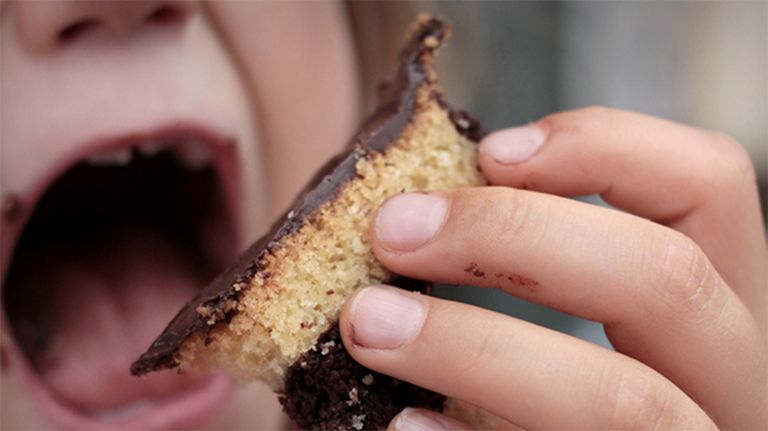
The tongue recognizes at least five taste qualities: sweet, sour, bitter, salty, and umami. The different activities of specific receptors create a taste experience that is also influenced by consistency and smell.
Scientific support: Dr. Maik Behrens
Published: 02.09.2025
Difficulty: intermediate
- Our tongue has receptors for five basic tastes: sweet, sour, salty, bitter, and umami. However, recent studies suggest that there is also at least one Receptor for fatty flavors.
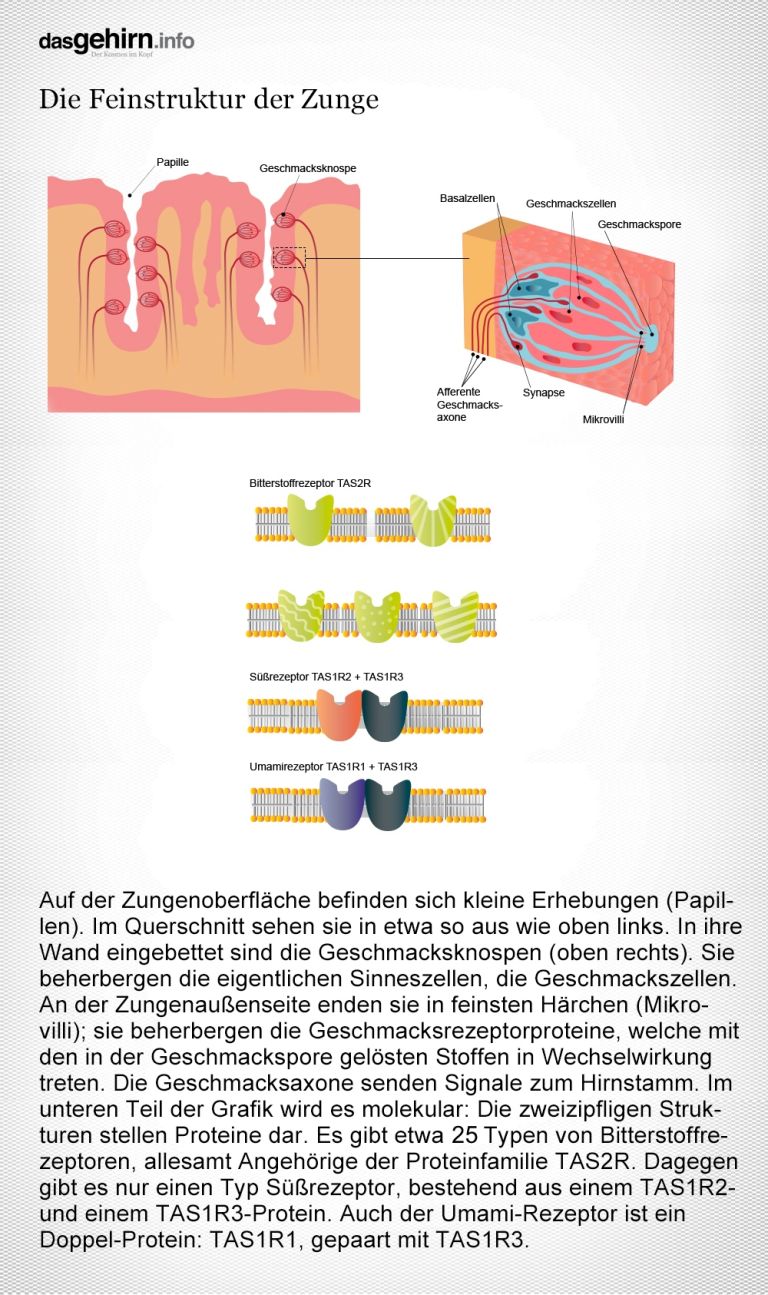
- While there is only one receptor for the sensation of “sweet”, approximately 25 different receptors recognize bitter substances in food.
- When it comes to processing Taste qualities, two principles are discussed, both of which are likely to be partially true. In labeled line wiring, a specific sensory cell processes exactly one taste quality and transmits it to a specific nerve fiber. The across-fiber theory states that gustatory neurons receive input from a wide variety of taste qualities.
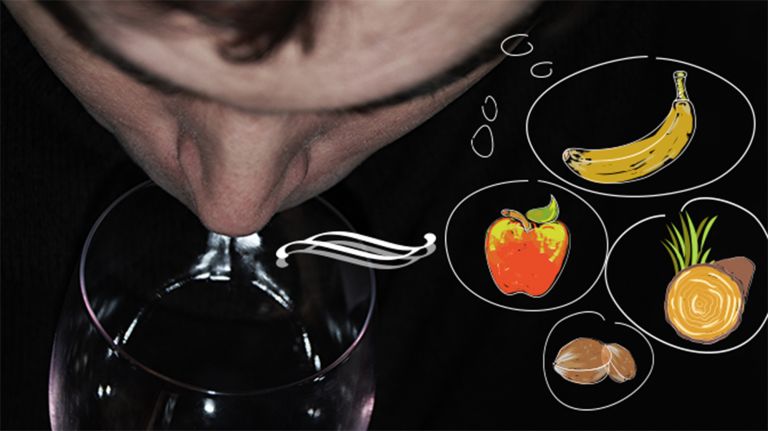
- In addition to taste quality, other sensory information also influences the taste experience. The smell of food in particular contributes to taste perception, but consistency, temperature, and spiciness also play a decisive role.
Receptor
A receptor is a protein, usually located in the cell membrane or inside the cell, that recognizes a specific external signal (e.g., a neurotransmitter, hormone, or other ligand) and causes the cell to trigger a defined response. Depending on the type of receptor, this response can be excitatory, inhibitory, or modulatory.
Taste
The sensory impression we refer to as "taste" results from the interaction between our senses of smell and taste. In terms of sensory physiology, however, "taste" is limited to the impression conveyed to us by the taste receptors on the tongue and in the surrounding mucous membranes. It is currently assumed that there are five different types of taste receptors that specialize in the taste qualities sweet, sour, salty, bitter, and umami. In 2005, scientists also identified possible taste receptors for fat, whose role as a distinct taste quality is still being investigated.
Contrary to popular belief, the various Taste receptors are distributed throughout the tongue – and are not limited to strictly separate areas, as was mistakenly assumed. This is due to a misinterpretation of experimental data: areas with low intensity for a particular taste were interpreted by researchers as areas without any Perception of that taste. This led to the creation of the so-called tongue map in the 1940s, which almost everyone has seen at some point, but which is a myth. It shows the tip of the tongue as the sweet region and only at the very back, at the entrance to the throat, is the bitter area located. However, anyone who tests sugar far away from the tip of their tongue will quickly discover that “sweet” can actually be tasted anywhere on the tongue. Nevertheless, the myth persists.
Taste
The sensory impression we refer to as "taste" results from the interaction between our senses of smell and taste. In terms of sensory physiology, however, "taste" is limited to the impression conveyed to us by the taste receptors on the tongue and in the surrounding mucous membranes. It is currently assumed that there are five different types of taste receptors that specialize in the taste qualities sweet, sour, salty, bitter, and umami. In 2005, scientists also identified possible taste receptors for fat, whose role as a distinct taste quality is still being investigated.
Perception
The term describes the complex process of gathering and processing information from stimuli in the environment and from the internal states of a living being. The brain combines the information, which is perceived partly consciously and partly unconsciously, into a subjectively meaningful overall impression. If the data it receives from the sensory organs is insufficient for this, it supplements it with empirical values. This can lead to misinterpretations and explains why we succumb to optical illusions or fall for magic tricks.
It is amazing what humans can Taste. From the creamy, spicy flavor of a Thai curry to the delicate hint of cinnamon in grandma's apple strudel: the human palate can easily identify every known delicacy. This is remarkable because at the lowest sensory level – in the taste buds on the tongue – only a handful of basic tastes can initially be recognized: sweet, sour, salty, bitter, and umami – and, according to recent evidence, possibly also fatty. It is only through clever interconnection in the brain that these are combined to create the overall taste of “apple strudel” or “Thai curry”.
It took a long time to get to the bottom of this complex sensory experience. The first breakthrough came in the 1990s: In the genetic material of rodents, two US researchers, Charles Zuker and Nicholas Ryba, discovered the blueprint for a protein that they rightly suspected was a taste Receptor. However, it took several more years before the work of numerous research groups proved that this was one of two subunits of the sweet receptor. Its function was deciphered through special experiments on mice, as Wolfgang Meyerhof, a geneticist at the German Institute of Human Nutrition (Dife) near Potsdam, explains: “Mice in which the genes for both subunits have been switched off can no longer taste anything sweet – including glucose and sucrose. This is because all substances that taste sweet activate this receptor.” Its subunits belong to the same protein family, called TAS1R (formerly T1R).
Taste
The sensory impression we refer to as "taste" results from the interaction between our senses of smell and taste. In terms of sensory physiology, however, "taste" is limited to the impression conveyed to us by the taste receptors on the tongue and in the surrounding mucous membranes. It is currently assumed that there are five different types of taste receptors that specialize in the taste qualities sweet, sour, salty, bitter, and umami. In 2005, scientists also identified possible taste receptors for fat, whose role as a distinct taste quality is still being investigated.
Receptor
A receptor is a protein, usually located in the cell membrane or inside the cell, that recognizes a specific external signal (e.g., a neurotransmitter, hormone, or other ligand) and causes the cell to trigger a defined response. Depending on the type of receptor, this response can be excitatory, inhibitory, or modulatory.
Receptors for every taste
Other flavors, on the other hand, are perceived by other types of receptors. Their decoding followed shortly after the discovery of TAS1R. However, it turned out that not every flavor is assigned to a single Receptor type. For example, there are a number of variants of TAS2R that respond to different bitter substances with varying degrees of intensity. Humans have around 25 such Bitter receptors These can be sorted into three different classes according to their activity: "Generalists recognize more than a quarter of the bitter substances presented. Specialists, on the other hand, are activated by less than three percent of bitter molecules. And then there are moderate bitter receptors, which can recognize between three and ten percent of bitter substances," says Meyerhof. This high degree of specialization is vital, because many toxins Taste bitter. The reliable and immediate Perception of bitter substances has thus prevented many cases of poisoning since time immemorial.
A completely different function is attributed to another type of receptor: GPR120. Meyerhof and his colleagues are also conducting intensive research on this. The interesting thing about it is that it is activated by long-chain fatty acids. Previously, it was assumed that the fatty taste was mainly conveyed by the consistency of the food. Now, however, there is much to suggest that there is a gustatory component to fat perception. However, this assumption has not yet been definitively confirmed.
Receptor
A receptor is a protein, usually located in the cell membrane or inside the cell, that recognizes a specific external signal (e.g., a neurotransmitter, hormone, or other ligand) and causes the cell to trigger a defined response. Depending on the type of receptor, this response can be excitatory, inhibitory, or modulatory.
Bitter receptors
One of several groups of sensors that specialize in perceiving a specific taste quality. The sensory cells in which the taste receptors perform their function are located in the taste buds on the tongue and in the surrounding mucous membranes. Bitter receptors belong to the family of G protein-coupled receptors. A single cell can contain several different bitter receptors. As a result, it responds to different bitter substances with the same signal. This makes it very difficult for us to distinguish between individual bitter substances in terms of taste.
Taste
The sensory impression we refer to as "taste" results from the interaction between our senses of smell and taste. In terms of sensory physiology, however, "taste" is limited to the impression conveyed to us by the taste receptors on the tongue and in the surrounding mucous membranes. It is currently assumed that there are five different types of taste receptors that specialize in the taste qualities sweet, sour, salty, bitter, and umami. In 2005, scientists also identified possible taste receptors for fat, whose role as a distinct taste quality is still being investigated.
Perception
The term describes the complex process of gathering and processing information from stimuli in the environment and from the internal states of a living being. The brain combines the information, which is perceived partly consciously and partly unconsciously, into a subjectively meaningful overall impression. If the data it receives from the sensory organs is insufficient for this, it supplements it with empirical values. This can lead to misinterpretations and explains why we succumb to optical illusions or fall for magic tricks.
Taste
The sensory impression we refer to as "taste" results from the interaction between our senses of smell and taste. In terms of sensory physiology, however, "taste" is limited to the impression conveyed to us by the taste receptors on the tongue and in the surrounding mucous membranes. It is currently assumed that there are five different types of taste receptors that specialize in the taste qualities sweet, sour, salty, bitter, and umami. In 2005, scientists also identified possible taste receptors for fat, whose role as a distinct taste quality is still being investigated.
Complex interconnection systems
All receptors – whether TAS1R or TAS2R – are located on different populations of Taste cells. These populations are therefore specific to bitter or sweet substances, for example. A similar specificity exists in the attached nerve fibers. This is because taste cells are so-called secondary sensory cells – meaning they do not form their own nerve fibers. Instead, they are innervated by afferent sensory nerves, which convert the chemical activity of the sensory cells into electrical nerve signals.
However, there is still much debate about when and how exactly the specific qualities are then interconnected. Two processing principles are under discussion: labeled line and across-fiber. A labeled-line connection means that a specific sensory cell processes exactly one taste quality and in turn transmits it to a specific nerve fiber. The central nerve cells that process or represent taste information also exhibit this specificity. The across-fiber theory, on the other hand, states that the gustatory neurons receive input from a wide variety of taste qualities. “Ultimately, none of the theories has yet been confirmed, as there is experimental evidence for both,” says Meyerhof. According to this, there do appear to be specialized sensory cells – but many gustatory nerve cells are stimulated by stimuli of several taste qualities.
Taste
The sensory impression we refer to as "taste" results from the interaction between our senses of smell and taste. In terms of sensory physiology, however, "taste" is limited to the impression conveyed to us by the taste receptors on the tongue and in the surrounding mucous membranes. It is currently assumed that there are five different types of taste receptors that specialize in the taste qualities sweet, sour, salty, bitter, and umami. In 2005, scientists also identified possible taste receptors for fat, whose role as a distinct taste quality is still being investigated.


From tongue to brain stem
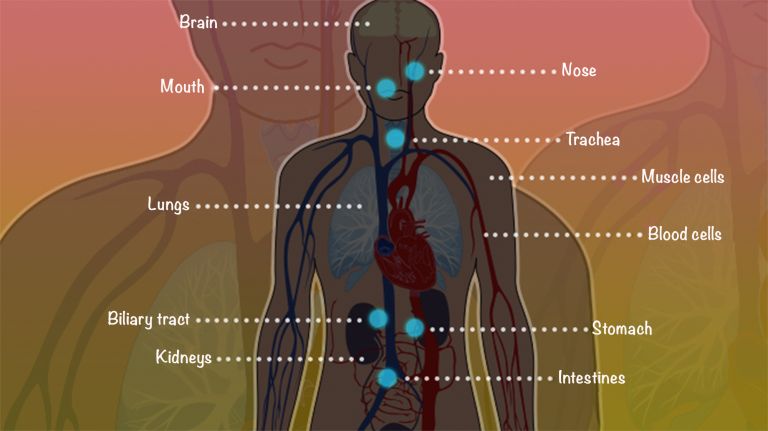
The fibers originate from three of the twelve cranial nerves: the seventh, ninth, and tenth. Their Taste fibers travel up to the brain stem, where they end in the Nucleus tractus solitarius Once there, some of the signals are processed directly on site. The Brain stem controls basic functions such as salivation, swallowing, and the gag reflex. If something tastes very bitter, for example – and is therefore potentially dangerous – the act of spitting it out can be initiated here.
However, most of the taste information is transmitted via the thalamus to the gustatory cortex, the taste center of the brain. It is often said that this area of the brain is divided into areas of different qualities, similar to the Visual cortex However, the spatial representation of taste qualities appears to overlap here, although the exact extent is not known. Meyerhof explains: "While imaging and optogenetic techniques support the existence of spatial maps, most electrophysiological studies show that neurons in the Gustatory cortex respond to more than just one taste quality. However, this is hardly compatible with spatially separate processing of the basic tastes."
cranial
A positional term – cranial means "towards the head." In relation to the nervous system, it refers to a direction along the neural axis, i.e., forward.
In animals (without upright gait), the designation is simpler, as it always means forward. Due to the upright gait of humans, the brain bends in relation to the spinal cord, where cranial also means "upward."
Taste
The sensory impression we refer to as "taste" results from the interaction between our senses of smell and taste. In terms of sensory physiology, however, "taste" is limited to the impression conveyed to us by the taste receptors on the tongue and in the surrounding mucous membranes. It is currently assumed that there are five different types of taste receptors that specialize in the taste qualities sweet, sour, salty, bitter, and umami. In 2005, scientists also identified possible taste receptors for fat, whose role as a distinct taste quality is still being investigated.
Nucleus
In cell biology, the nucleus in a cell is the cell nucleus, which contains the chromosomes, among other things. In neuroanatomy, the nucleus in the nervous system refers to a collection of cell bodies – known as gray matter in the central nervous system and ganglia in the peripheral nervous system.
Nucleus tractus solitarius
nucleus tractus solitarii
A nucleus in the medulla oblongata that serves as an important integration center for visceral information. Among other things, it processes taste stimuli (via nerves VII, IX, and X) and transmits them via the thalamus (ventral posteromedial nucleus, VPM) to the primary gustatory cortex. The NTS is also involved in the motor functions of swallowing, coughing, and respiratory control by transmitting signals to motor nuclei such as the nucleus ambiguus. These reflexes serve to protect the respiratory tract and facilitate food intake.
Brain stem
truncus cerebri
The "trunk" of the brain, to which all other brain structures are "attached," so to speak. From bottom to top, it comprises the medulla oblongata, the pons, and the mesencephalon. It transitions into the spinal cord below. It is a center for vital functions such as breathing and heartbeat and contains ascending and descending pathways between the cerebrum, cerebellum, and spinal cord.
Visual cortex
The visual cortex refers to the areas of the occipital lobe that are involved in processing visual information. These include the primary visual cortex and the associative visual cortices V1 to V5. According to Brodmann, the visual cortex comprises areas 17, 18, and 19.
Gustatory cortex
Here, the brain processes information from the taste receptors. When these are stimulated, the sensory cells in the taste buds send a signal to the thalamus via various intermediate stations. The thalamus then forwards this signal to the insular lobe. This is where the primary gustatory cortex is located, which combines the information from the taste pathways with other sensory impressions. The primary gustatory cortex then forwards the combined data package to its secondary counterpart. This is located in the orbitofrontal cortex, where the final processing of olfactory information also takes place.
Extensive overlaps
However, there are likely to be significant overlaps with other sensory qualities as well. This is because the complex Taste of food in the broader sense is not conveyed solely by taste receptors, but also by olfactory, pain, and mechanoreceptors. Smell, spiciness, and consistency have a major influence on the taste experience. Researchers assume that up to 80 percent is actually conveyed through smell. So it's hardly surprising that when we have a bad cold, we can hardly “taste” anything – we simply miss the smell of our favorite foods. ▸ Neurogastronomy – a new science of taste
But temperature also plays a major role in taste. Cold and heat influence taste in three ways: they change the consistency, the strength of the aroma, and the sensitivity to certain taste qualities. At 10 degrees Celsius, for example, we taste bitter substances particularly well, while at 35 to 50 degrees Celsius, we taste sweet substances better.
Taste
The sensory impression we refer to as "taste" results from the interaction between our senses of smell and taste. In terms of sensory physiology, however, "taste" is limited to the impression conveyed to us by the taste receptors on the tongue and in the surrounding mucous membranes. It is currently assumed that there are five different types of taste receptors that specialize in the taste qualities sweet, sour, salty, bitter, and umami. In 2005, scientists also identified possible taste receptors for fat, whose role as a distinct taste quality is still being investigated.
Further reading
- Chemosensory Systems in Mammals, Fishes and Insects, hg. von Wolfgang Meyerhof und Sigrun Korsching, Berlin 2009.
First published on November 27, 2013
Last updated on September 2, 2025