Multiple sclerosis

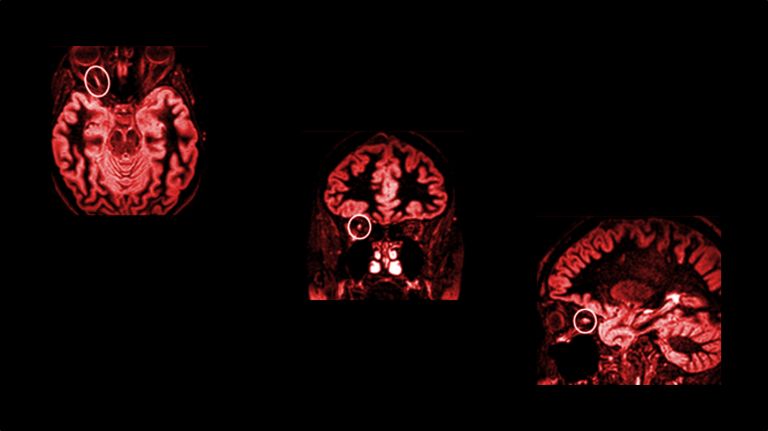
Gray and white are the dominant colors of the nervous system. The neurons are located in the Gray matter Here the impulses from other nerve cells are collected and processed. The result is transmitted to other nerve cells via the white matter, which in turn consists of two components: Firstly, the axons, the long extensions of the nerve cells – they form the output channel in neural communication. But without the second component, the protective Myelin sheath around the axons, this communication is painfully slow. If the White matter is damaged, the complex networks of nerve cells are disrupted.
This is exactly what happens in Multiple sclerosis (MS). The myelin layer of the axons is attacked, slowing down or completely disrupting transmission. The effects – such as visual disturbances, numb fingers, or impaired motor function – depend on the location of the demyelination. This makes MS difficult to diagnose, as no two patients are alike. The exact causes are still not fully understood. However, it is assumed that a combination of genetic, immunological, and environmental factors leads to the development of the disease.
In cooperation with the non-profit Hertie Foundation and thanks to a generous bequest from Heidemarie Hoppe, we discuss one of the most common neurological diseases here – according to current estimates, there are almost three million patients worldwide. Nora Schultz provides an introduction ▸ Disease of a thousand faces.
Gray matter
Grey matter refers to a collection of nerve cell bodies, such as those found in nuclei or in the cortex.
Myelin
Myelin is a fatty substance produced by glial cells. It envelops the axons (long, fiber-like extensions) of nerve cells and insulates them, preventing messages from passing uncontrollably to neighboring nerve cells. This also greatly accelerates conduction velocity.
White matter
The white matter refers to the myelinated fibers of the nervous system that connect one neuron to another. The white color is caused by the myelin sheath surrounding the fibers.
Multiple sclerosis
encephalomyelitis disseminata
A common neurological disease that predominantly occurs in young adults. For reasons that are still unclear, the body's own cells attack and destroy the myelin sheaths of nerve cells. This can happen throughout the central nervous system, which is why two different multiple sclerosis patients can suffer from very different symptoms. Common symptoms include visual disturbances, numbness in the arms and legs, but also coordination problems, muscle weakness, and bladder problems.