In Search of the Mind in the Brain

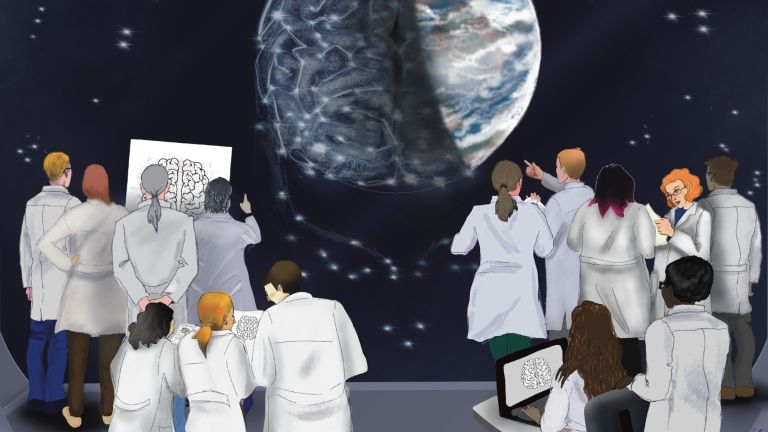
Whether, how, and, if so, where consciousness exists is one of the great questions of humanity. In postmodernism, it is believed to exist in the brain. But where exactly? And in what form? Brain researchers have put forward a number of theories on this subject.
Scientific support: Prof. Dr. Andreas Karl Engel
Published: 16.12.2025
Difficulty: serious
- Brain researchers are increasingly attempting to answer the question of the prerequisites and mechanisms of consciousness.
- Since consciousness occurs on a biological basis, there must be neural correlates of consciousness (NCC) – as is the case with sensory and motor functions. This term was first coined by Francis Crick and Christof Koch.
- Gerald Edelman and Guilio Tononi pursue a systemic, theoretical approach in which information circulates in entire Neuron networks and is thus kept in consciousness.
- Stanislas Dehaene pursues the idea of a global workspace and has implemented it in a computer model, among other things.
- Researching consciousness at the neural level is just as complex as its subject matter. Many fundamental questions remain unanswered.
Neuron
A neuron is a specialized cell in the nervous system that is responsible for processing and transmitting information. It receives signals via its dendrites and transmits them via its axon. Transmission occurs electrically within the neuron and, between neurons, usually chemically via synapses.
Of course, many people, including researchers, are not satisfied with the idea that consciousness can only be found in the brain – after all, reducing the spiritual to the biological and material takes away what makes humans special. In addition, some researchers even consider the self to be a fiction, a dream of the brain. Western scientists find this too Buddhist, and the alternative models are correspondingly diverse.
A good argument for why biology cannot be everything comes from the philosopher and psychiatrist Thomas Fuchs. He explains that without its relationship to the environment, especially to fellow human beings, the brain cannot form consciousness at all. Pure biology is not enough; the social aspect is irreplaceable, and so the brain is a relational organ.
This is true, of course, as Kaspar Hauser demonstrates: humans are pack animals and cannot develop optimally without high-quality interaction with other people. However, this does not change the fact that without the appropriate brain, all the social input in the world will not turn a snail into Schopenhauer. Biology alone does not explain everything, especially not psychologically. But without biology, there would be nothing to explain.
The conduction velocity of nerve cells in adult humans is around 120 meters per second. That is extremely fast, but not so fast that distance would not play a role. Since the hand is closer to the brain than the foot, simultaneous pain stimuli should actually be perceived with a time delay. You don't have to test this yourself – the point is that both pain stimuli arrive in the consciousness at the same time.
The American physiologist Benjamin Libet was the first to investigate this sensory “flexibility” of consciousness and found that consciousness of sensory information is always delayed by 0.5 seconds. Quote from his book Mind Time: “What we are aware of has already taken place half a second earlier.” The reason we don't notice this in everyday life is that the brain backdates these sensory experiences. Subjectively, we feel that we perceived the stimulus at the exact moment it was triggered. This is just one of the many wonders of neural consciousness. ▸ When consciousness fails
For a long time, the world's thinkers believed that mind and matter were two different things. René Descartes convincingly formulated this dualism as a separation between res extensa (the body) and res cogitans (the mind). This separation enabled early scientists to pursue their work undisturbed by the sensitivities of the church. Today, however, few researchers still assume that consciousness exists independently of a biological basis. The causal chain is reasonably conclusive: if certain areas of the brain fail, the person falls into a coma and is no longer conscious. Even in deep sleep – when large parts of the brain reduce their activity – consciousness does not occur.
However, knowing this does not help. Nor does it diminish the wonder of humanity: we still do not know how the brain manages to bring something as complex as us into being. Unanswered questions and pure fascination are leading some brain researchers today to tread philosophical paths. For the first time in human history, they – and their colleagues in the related sciences of psychology and philosophy – are now able to pursue the question of consciousness in a well-founded and empirical manner.
Dualism in cooperation
John C. Eccles ▸ John Eccles: Across the Gap, physician and philosopher, became Sir Eccles because (together with Alan Hodgkin and Andrew Huxley) he was awarded the Nobel Prize in 1963 for his work on the transmission of nerve impulses at the Synapse. Together with the philosopher Karl Popper – to whom scientific theory owes the principle of falsification – he was one of the last brain researchers to take a dualistic position. This fit well with Popper's dualism, the separation of the material world (“World 1”) from the spiritual (“World 2”). In their joint book The Self and Its Brain (1977), both presented the thesis that there is a region in the left Hemisphere of the brain that allows interaction between World 1 and World 2. Later in life, Eccles sought arguments in quantum mechanical processes – a trap that catches many thinkers as soon as they want to put the inexplicable on explainable footing.
Incidentally, one of the last great dualists today is the philosopher David Chalmers, an Australian like Eccles, who sees an easy and a hard problem when it comes to consciousness. The easy problem includes thinking, learning, and remembering – these are partially understood physiologically. The brain processes that occur, for example, when perceiving a red rose or when experiencing pain are also understood. But what the color red triggers subjectively in us, and how it feels to be in pain – we cannot yet explain that. This hard problem is taken very seriously by researchers who approach consciousness from a neuroscientific perspective.
Synapse
A synapse is a connection between two neurons and serves as a means of communication between them. It consists of a presynaptic region – the terminal button of the sender neuron – and a postsynaptic region – the region of the receiver neuron with its receptors. Between them lies the synaptic cleft.
Hemisphere
The cerebrum and cerebellum each consist of two halves – the right and left hemispheres. In the cerebrum, they are connected by three pathways (commissures). The largest commissure is the corpus callosum.
A question of connection
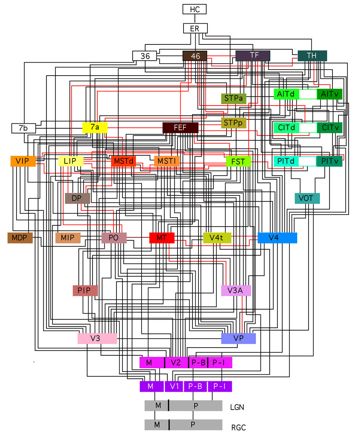
Perhaps just as hard is a problem that can be illustrated by imagining that you are looking at the rose in question. There it stands before you, in all its red splendor, thorny and fragrant. As you look at it, your Visual system detects a wide variety of lines, which are further processed to form the shapes of the individual petals, and a little further back on the visual pathway, the visual impression of a rose is formed. Combined with the olfactory impression, this results in a complete picture, to which your Memory adds the name and the person to whom you want to give it as a marriage proposal. The question, however, is: How do all these individual processing stages ultimately come together again? How can what the sensory system breaks down be reassembled by perception? Anyone who has ever seen a diagram showing the connections between different areas of the brain – many labeled dots and a jumble of lines reminiscent of a ball of wool – can appreciate the problem.
In 1989, Wolf Singer – then director of the Max Planck Institute for Brain Research in Frankfurt – and his colleagues presented evidence that this connection between a wide variety of stimuli can be achieved through the synchronous discharge of nerve cells in the 40-hertz range. According to this model, shape, color, and scent come together to form the concept of a rose when all the neurons involved have coordinated their Oscillation behavior. This answers the question of how Perception can arise. But it does not answer the question of how it becomes conscious.
Visual system
The visual system is the part of the nervous system that processes visual information. It primarily comprises the eye, the optic nerve, the optic chiasm, the optic tract, the lateral geniculate nucleus, the optic radiation, the primary visual cortex, and the visual association cortices.
Memory
Memory is a generic term for all types of information storage in the organism. In addition to pure retention, this also includes the absorption of information, its organization, and retrieval.
Oscillation
Oscillations occur when many neurons fire in synchronized, rhythmic patterns. These phased fluctuations in neural activity form the basis for measurable signals in the EEG. They reflect the coordinated processing of information in the brain.
Perception
The term describes the complex process of gathering and processing information from stimuli in the environment and from the internal states of a living being. The brain combines the information, which is perceived partly consciously and partly unconsciously, into a subjectively meaningful overall impression. If the data it receives from the sensory organs is insufficient for this, it supplements it with empirical values. This can lead to misinterpretations and explains why we succumb to optical illusions or fall for magic tricks.
Visual system
The visual system is the part of the nervous system that processes visual information. It primarily comprises the eye, the optic nerve, the optic chiasm, the optic tract, the lateral geniculate nucleus, the optic radiation, the primary visual cortex, and the visual association cortices.
Dynamic systems
Now, with Gerald Edelman and Francis Crick, two Nobel Prize winners are entering the stage of consciousness research. The former has done groundbreaking work on the immune system, while the latter, together with John Watson, discovered the double helix structure of DNA. Neither of them were experts in neuroscience. And both entered into research collaborations with up-and-coming young scientists.
Edelman teamed up with Italian psychiatrist Giulio Tononi and developed an impressive systemic theory. Roughly simplified, it goes like this: Consider a group of neurons with a defined function as a functional cluster – for example, one for odor Perception. As other clusters for color and shape switch on and small clusters form larger clusters, an integrated process develops that can be scaled up arbitrarily in complexity toward consciousness. There, the perception of a rose arises – and becomes conscious.
Two other factors are important: First, there is a kind of Darwinian selection between the individual clusters. If we no longer look at the red rose, but at the yellow carnation, the “red” cluster no longer has a chance and falls out of perception. The second factor solves the problem that neurons tick on a faster timeline than our consciousness. In order to remain active and permanently integrate the activity of widely separated brain areas, the information must be fed back into the system again and again – a “reentry” that allows neural activity to be synchronized in the first place.
If we take a step back and look at the various clusters and their interactions, we see that, according to Edelman and Tononi, consciousness is a dynamic system. Numerous other researchers share this view. Incidentally, this is why it makes no sense to accuse Wolf Singer of simple determinism, i.e., the simple predictability of behavior. The neural determinism that Singer advocates refers to precisely such highly dynamic systems and is therefore chaotic: if we knew all the initial conditions of the system, we could actually predict its future. But there are far too many influences.
Perception
The term describes the complex process of gathering and processing information from stimuli in the environment and from the internal states of a living being. The brain combines the information, which is perceived partly consciously and partly unconsciously, into a subjectively meaningful overall impression. If the data it receives from the sensory organs is insufficient for this, it supplements it with empirical values. This can lead to misinterpretations and explains why we succumb to optical illusions or fall for magic tricks.
Neural correlates of consciousness
In contrast to their almost mathematical colleagues Edelman and Tononi, Francis Crick and Christof Koch took a very practical approach to the search for the so-called neural correlates of consciousness (NCC). Applied to the rose, this means that when we look at it, certain neurons in our brain are active and enable us to become aware of the rose. To quote Koch: “There must be an explicit correspondence between a mental event and its neural correlates.”
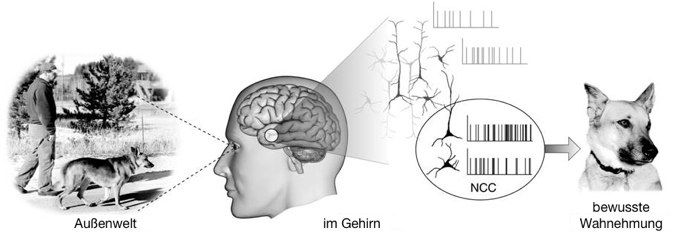
Crick suspected that the actual seat of consciousness was the claustrum, a flat sheet of neurons between the Basal ganglia and the Cortex. Its neurons have some special features, and its connections are so complex that Crick and Koch believed it played the role of a conductor in the brain. But that was some time ago, and it's probably not that simple.
Giulio Tononi, in particular, takes a completely different and very theoretical approach: calculating the degree of consciousness in every conceivable entity. Tononi explains the concept here in the ▸ video about Phi – it's actually not that simple, but it fascinates the field of consciousness researchers.
Basal ganglia
Nuclei basales
The basal ganglia are a group of subcortical nuclei (located beneath the cerebral cortex) in the telencephalon. The basal ganglia include the globus pallidus and the striatum, and, depending on the author, other structures such as the substantia nigra and the subthalamic nucleus. The basal ganglia are primarily associated with voluntary motor function, but they also influence motivation, learning, and emotion.
Cortex
cortex cerebri
Cortex refers to a collection of neurons, typically in the form of a thin surface. However, it usually refers to the cerebral cortex, the outermost layer of the cerebrum. It is 2.5 mm to 5 mm thick and rich in nerve cells. The cerebral cortex is heavily folded, comparable to a handkerchief in a cup. This creates numerous convolutions (gyri), fissures (fissurae), and sulci. Unfolded, the surface area of the cortex is approximately 1,800cm².


Space to work
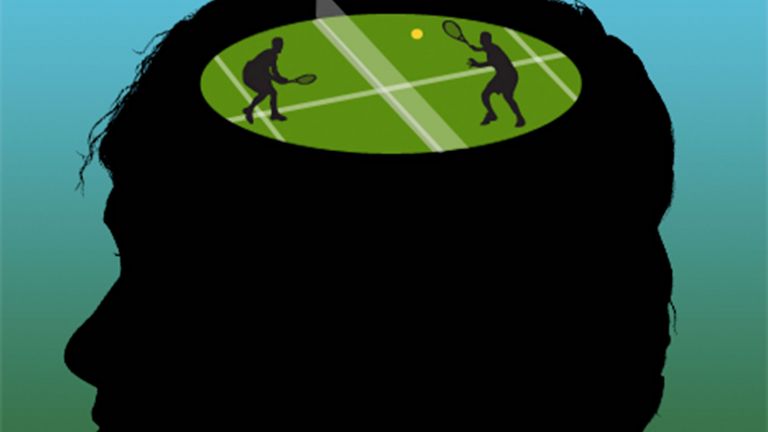
Returning to the brain, consciousness also needs a workplace. Dutch cognitive scientist Bernhard Baars has been pursuing this idea since 1986, calling it the global workspace. ▸ What is consciousness? It is where we find what is currently active in the mind and subjectively experienced. In the case of the rose in our hand, this might include a warning about thorns and the hope of finding a vase, but in any case, it includes whatever is needed to do justice to the interpersonal situation at hand.
There are clear parallels here with working memory – the seven plus/minus two pieces of information that we can hold in our heads at any one time. But there are differences: although the content of working Memory is influenced by unconscious factors, we are always aware of it. So aware, in fact, that some researchers even equate working memory with consciousness. Baars' global workspace, on the other hand, also has room for unconscious information, thus circumventing the problem that consciousness itself only deals with a fraction of the available data.
Stanislas Dehaene – well known for his work on writing and reading –, Jean-Pierre Changeux, and colleagues have studied the global workspace in a neural context for many years and developed a three-stage computer model in 2006: Level 1 maps the activity of individual neurons, Level 2 maps various connections between the thalamus and Cortex. The thalamus is considered the gateway to consciousness because it transmits information to the cortex, and only there can this information become conscious. Level 3 represents a network of distant structures that exchange information in a constant process of feedback and feedforward. In this way, the Dehaene-Changeux model attempts to reproduce higher cognitive functions and, indeed, consciousness. In practical trials, it has proven to be trainable – and even helpful, for example, in the study of inattentional blindness.
working memory
Working memory
A form of memory, often used synonymously with the term "short-term memory." However, many theorists clearly distinguish between the two concepts with regard to the manipulation of information in working memory. It temporarily retains information, including newly acquired information and memory content from long-term memory that is associated with the new information. In the model developed by Alan Baddeley and Graham Hitch, it includes a central executive, a phonological loop, an episodic buffer, and a visuospatial sketchpad.
Memory
Memory is a generic term for all types of information storage in the organism. In addition to pure retention, this also includes the absorption of information, its organization, and retrieval.
Cortex
cortex cerebri
Cortex refers to a collection of neurons, typically in the form of a thin surface. However, it usually refers to the cerebral cortex, the outermost layer of the cerebrum. It is 2.5 mm to 5 mm thick and rich in nerve cells. The cerebral cortex is heavily folded, comparable to a handkerchief in a cup. This creates numerous convolutions (gyri), fissures (fissurae), and sulci. Unfolded, the surface area of the cortex is approximately 1,800cm².
Loud criticism: “Brain research has failed!”
But such successes are rare. Consciousness research using neuroscientific methods is therefore a popular target for neuro-bashing, which is always in vogue from time to time. Brain research is too limited in its search for consciousness, not only in its methods but also – at least according to some critics – in its conceptual approaches. The argument is compelling, because so far, neuroscientists have not really made much progress in their search for consciousness in the brain. However, it overlooks the time factor – and is somewhat reminiscent of a statement made by a former director of the New York Patent Office in 1899: “Everything that can be invented has already been invented.” As we know, this statement was impressively refuted.
It can therefore be assumed that brain researchers will still discover a great deal. When it comes to consciousness, however, it may take a little longer.
Further reading
- Edelman, Gerald M. and Tononi, Giulio: A Universe Of Consciousness: How Matter Becomes Imagination. 2000.
- Koch, Christof: The Quest for Consciousness: A Neurobiological Approach. 2004.
- Libet, Benjamin: Mind Time: The Temporal Factor in Consciousness. Frankfurt 2005.
First published on August 29, 2013
Last updated on December 16, 2025