Ringing in the ears
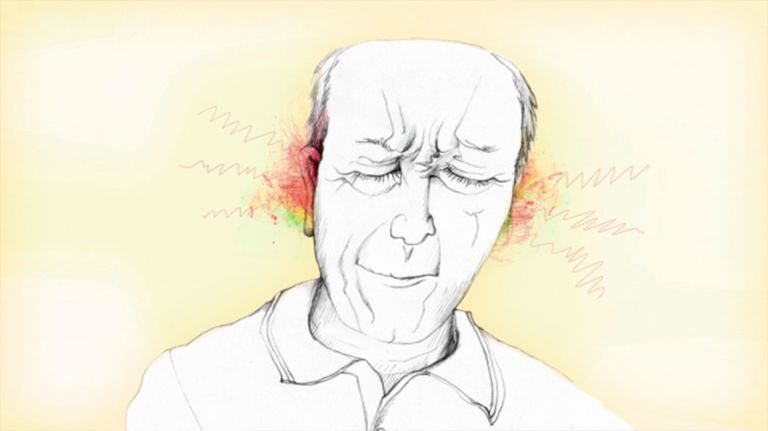
Not only does it get on your nerves, it also comes from there: researchers are increasingly convinced that tinnitus originates in the brain. The cause could be structural changes or overexcited neurons in the auditory cortex.
Wissenschaftliche Betreuung: Prof. Dr. Christo Pantev, Prof. Dr. Christine Köppl
Veröffentlicht: 28.10.2025
Niveau: schwer
- Der Auslöser von Tinnitus ist häufig ein Defekt wie zerstörte Haarzellen im Innenohr. Die eigentliche Ursache suchen Forscher mittlerweile aber im Gehirn.
- Einer weit verbreiteten Theorie zufolge entsteht Tinnitus durch Umbauvorgänge im Gehirn: Die noch intakten Frequenzen im normalen Hörbereich werden in der Hörrinde überrepräsentiert – das Klingeln entsteht.
- Möglicherweise sind neben der Hörrinde noch andere Hirnareale an dem Entstehen des nervtötenden Geräuschs beteiligt. Limbische Regionen etwa könnten zur negativen emotionalen Färbung des Klingelns im Ohr beitragen.
- Zumindest chronischer Tinnitus gilt als unheilbar. Therapien wie das Retraining zielen daher darauf ab, dass sich Betroffene an das Klingeln im Ohr gewöhnen und ihm so weniger Bedeutung geben.
Neben dem Retraining gibt es noch andere Behandlungsmöglichkeiten wie das Biofeedback: Bei Tinnitus-Patienten wird häufig das so genannte Muskel-Biofeedback angewandt. Der Betroffene bekommt optisch oder akustisch den Spannungszustand seiner Muskeln oder Muskelgruppen rückgemeldet und soll versuchen, die Muskeln anhand dieses Feedbacks zu entspannen. Gelingt dies, lässt sich bei einigen Tinnitus-Patienten auch das Ohrgeräusch vermindern. Dies ist insbesondere bei begleitenden Muskelverspannungen im Nacken- oder Kieferbereich oder bei Stress möglich.
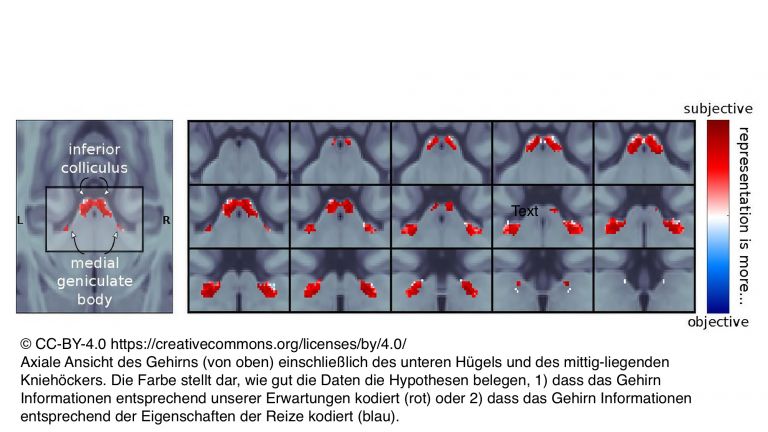
Den subjektiven Tinnitus kann nur der Betroffene selbst wahrnehmen. Vermutlich kommt er durch eine Fehlverarbeitung im Gehirn zustande. Beim objektiven Tinnitus hingegen liegt eine konkrete Erkrankung zu Grunde. Dann kann beispielsweise der Arzt das Pfeifen beim Abhören mit einem Stethoskop erkennen. Beim objektiven Tinnitus handelt es sich allerdings um ein sehr seltenes Phänomen.
Just a moment ago, the music was lively and jubilant. But suddenly it stops and a shrill tone on the violin begins to get on your nerves: in String Quartet No. 1 in E minor, “From My Life,” Bohemian composer Bedřich Smetana (1824–1884) set the noise in his ears that plagued him to music. “The greatest torment for me is the almost incessant noise inside my head, which roars in my ears and sometimes escalates into a stormy clatter,” the composer wrote in a letter.
Like Smetana, around three million people in Germany today suffer from annoying noises in their ears that occur without any external stimuli: Tinnitus, or “ringing in the ears,” often manifests as a shrill whistling sound. Others hear a hissing, screeching, or constant buzzing. If this uninvited acoustic guest stays for more than three months, it is no longer referred to as acute tinnitus, but chronic tinnitus. For many sufferers, the noise in their ears has a massive impact on their body and mind. It can lead to depression, sleep disorders, reduced concentration, or psychological stress. Conversely, stress, for example due to overwork, can also trigger or exacerbate the noise.
Is it caused by changes in the auditory cortex?
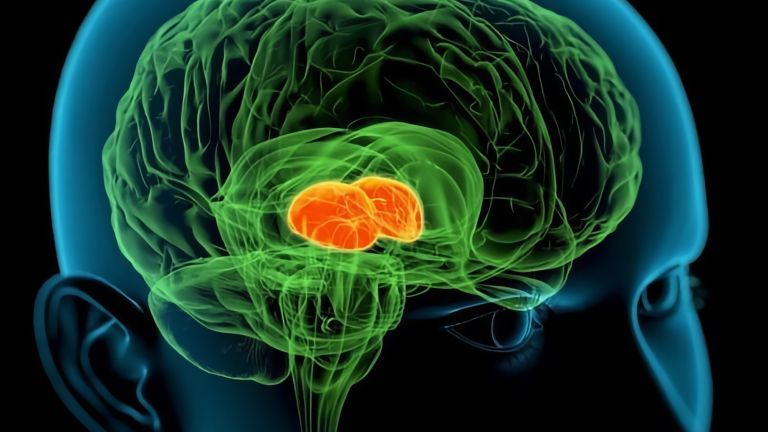
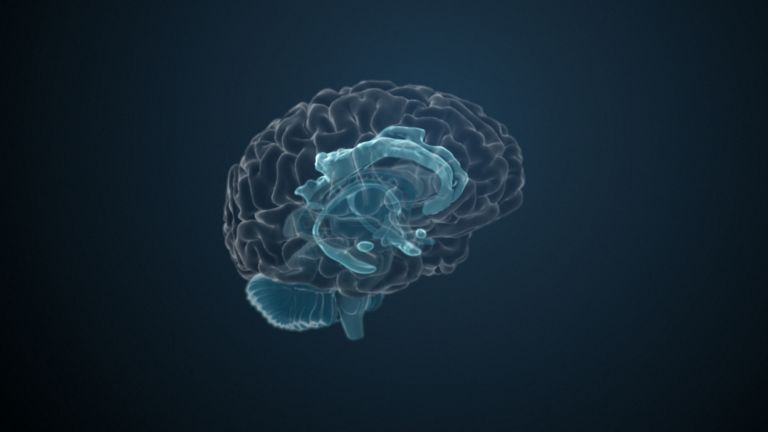
Tinnitus usually begins with a disturbance in the periphery. This can be acoustic trauma caused by a very loud noise or a foreign body in the ear canal. Nevertheless, many researchers increasingly see the central nervous system as the actual cause. According to the widely accepted remapping theory, changes in the auditory cortex could be responsible for tinnitus.
If excessive noise destroys hair cells in the inner ear that are assigned to a specific frequency, the corresponding neurons in the auditory cortex simply receive no or significantly less auditory input. This reduces their inhibitory effect on their neighbors, which represent adjacent frequencies. These frequencies then become overrepresented in the auditory cortex and now form the annoying noise in the ear without an external sound source. So much for the theory.
“However, it is still unclear whether brain reorganization is a causal prerequisite for tinnitus or rather an attempt at compensation,” says Berthold Langguth, former head of the Tinnitus Center at the University of Regensburg. The remapping theory assumes that the cortical response of the normal hearing field increases, causing the whistling sound. However, tinnitus usually occurs precisely in the spectrum that should actually be lost due to the destroyed hair cells, namely in the high-frequency range.
Alternative theory: Overstimulated nerve cells in the auditory cortex
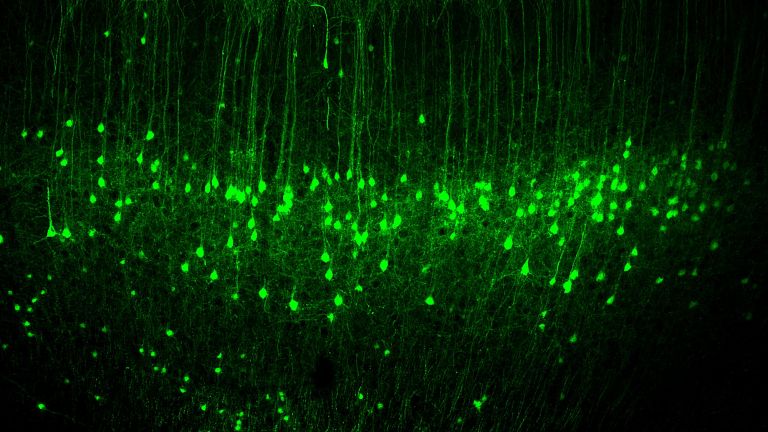
A study by neuroscientists led by Sungchil Yang and Shaowen Bao from the University of California Berkeley in 2011 further highlighted this contradiction. The researchers examined rats suffering from tinnitus and found that inhibitory synaptic transmission in the rodents' auditory cortex was reduced, specifically in the areas that no longer received auditory input. This made the corresponding neurons more easily excitable – maybe a strategy to keep the level of neural activity constant and prevent inactivity despite the lack of input. When the researchers increased the level of the inhibitory neurotransmitter GABA in their animal subjects by administering medication, they could no longer detect tinnitus – completely independently of the reorganization in the auditory cortex.
Alternative theory: Overstimulated nerve cells in the auditory cortex
A study by neuroscientists led by Sungchil Yang and Shaowen Bao from the University of California Berkeley in 2011 further highlighted this contradiction. The researchers examined rats suffering from tinnitus and found that inhibitory synaptic transmission in the rodents' auditory cortex was reduced, specifically in the areas that no longer received auditory input. This made the corresponding neurons more easily excitable – maybe a strategy to keep the level of neural activity constant and prevent inactivity despite the lack of input. When the researchers increased the level of the inhibitory neurotransmitter GABA in their animal subjects by administering medication, they could no longer detect tinnitus – completely independently of the reorganization in the auditory cortex.
Instead of the reorganization processes, the increased excitability of neurons that have become unemployed could therefore be the trigger for the ringing in the ears. “This would be consistent with the clinical experience that tinnitus is perceived precisely in the frequency range where the greatest hearing loss occurs,” says Langguth.
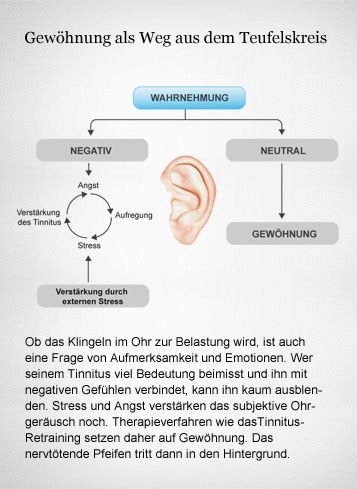
Aufmerksamkeit
Aufmerksamkeit/-/attention
Aufmerksamkeit dient uns als Werkzeug, innere und äußere Reize bewusst wahrzunehmen. Dies gelingt uns, indem wir unsere mentalen Ressourcen auf eine begrenzte Anzahl von Reizen bzw. Informationen konzentrieren. Während manche Stimuli automatisch unsere Aufmerksamkeit auf sich ziehen, können wir andere kontrolliert auswählen. Unbewusst verarbeitet das Gehirn immer auch Reize, die gerade nicht im Zentrum unserer Aufmerksamkeit stehen.
Brain areas beyond the auditory cortex also appear to be involved
Other researchers, such as neurophysiologist Josef Rauschecker from Georgetown University Medical Center in Washington, D.C., consider a remodeled auditory cortex to be a necessary condition for tinnitus, but by no means a sufficient one. “After all, only 20 to 40 percent of people with noise-induced hearing loss develop the annoying ringing,” he says. “A model developed by my research group therefore attributes an equally decisive role to the limbic system.”
According to Rauschecker and his colleagues, the medial prefrontal cortex in particular – which some scientists consider part of the extended limbic system – is normally able to suppress tinnitus signals from the auditory cortex. However, as the researchers were able to show using imaging techniques, the volume of this brain region is reduced in tinnitus patients. Put simply, the switch for noise suppression in the limbic system is obviously not working properly.
The approach taken by Rauschecker's team answers some open questions. “However, I don't think it is suitable for explaining all the different forms of tinnitus,” says Berthold Langguth. He and his colleagues suspect that several networks in the brain contribute to ringing in the ears. “With our model, we want to take into account the clinical experience that tinnitus is extremely diverse.” Different networks in the brain are simultaneously active in the various “types” of tinnitus patients.
Those affected only consciously perceive the overstimulation of the auditory system when it is associated with activity in attention networks in the frontal and parietal areas. According to Langguth, the so-called salience network – which includes the anterior cingulate cortex – encodes the significance of the tinnitus signal. “This network may also be the reason why tinnitus patients differ in their ability to block out the noise in their ears,” he says. “If it is activated, the subjective significance of the tinnitus is high, and it is difficult or even impossible to distract from it.”
The limbic system, which includes the amygdala, then provides the emotionally negative coloring. “We also attribute a decisive role to the memory network around the hippocampus – especially in chronic tinnitus.” Langguth's working group assumes a kind of tinnitus memory. Since there is no new input in the frequency range of the destroyed hair cells, the memory trace can no longer be overwritten by the disturbing noise. “This is how we explain the persistence of tinnitus perception.”
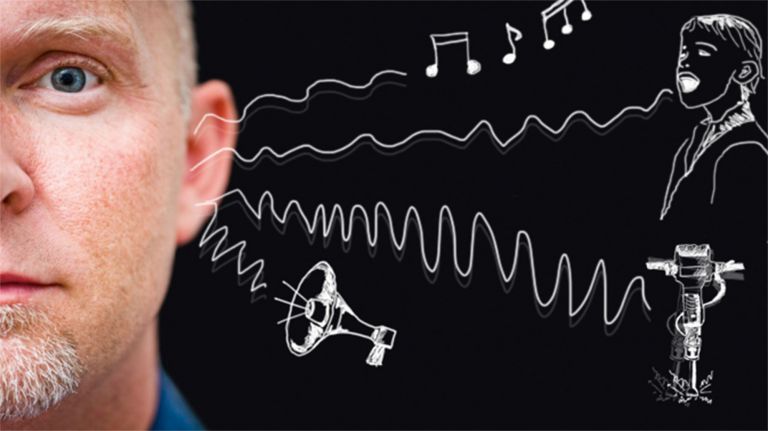
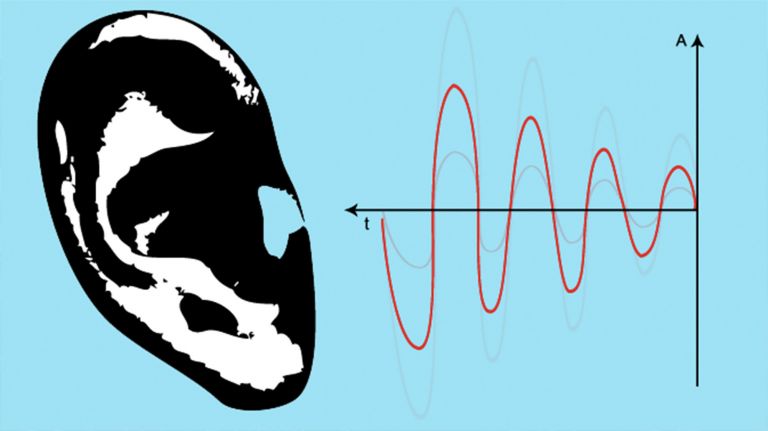

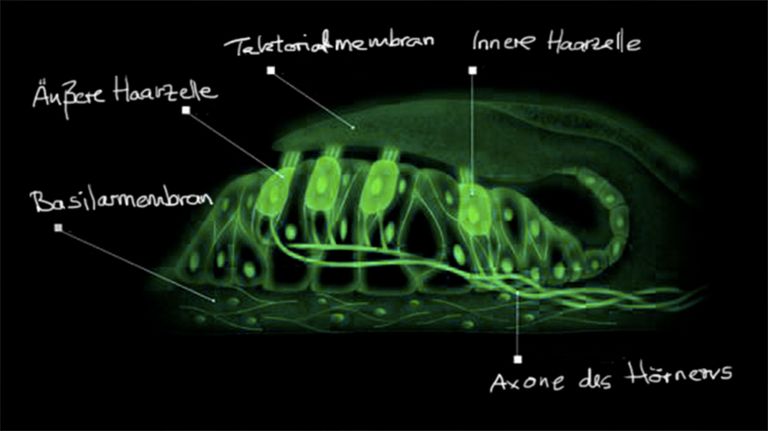


Re-learning is the order of the day
Since at least chronic tinnitus is considered incurable and drug treatments are controversial, some therapies focus on the subjective perception of the annoying ringing. Tinnitus retraining, for example, is a treatment based on several components that includes hearing therapy as well as education and counseling about the condition and psychological support. “As far as can be measured, tinnitus is not actually a loud noise,” says physician Birgit Mazurek from the Tinnitus Center at Berlin's Charité hospital, who offers this treatment to her patients herself. Nevertheless, many sufferers perceive the noises in their ears as particularly loud. “This subjective perception is quite obviously the result of a negative learning process, in the course of which the perception of tinnitus becomes increasingly prominent.”
Habituation instead of cure
Tinnitus retraining is ultimately aimed at patients for whom the ringing is a real burden. A process of relearning is intended to reduce or eliminate the perception of the noise in the ear. The aim is for those affected to become accustomed to the tinnitus and to manage it in their everyday lives. “Retraining is about improving quality of life – it does not promise a cure,” emphasizes Mazurek. “After all, the cause of tinnitus often cannot be determined.” Furthermore, damage to the peripheral and central structures cannot be reversed. “For example, it is not possible to form new hearing cells.” Pharmacological intervention, on the other hand, carries a very high risk of side effects such as speech disorders.
Retraining is a long-term process. “After about six months, the degree of stress is reduced, and it can decrease even further after that,” says Birgit Mazurek. Patients feel better not only in terms of their tinnitus, but also psychologically. And even if there is no real cure for chronic tinnitus yet, therapies can at least help patients come to terms with their uninvited guest.
Publication: July 27, 2012
Update: December 18, 2016