Search
-
- Basics
- Anatomy
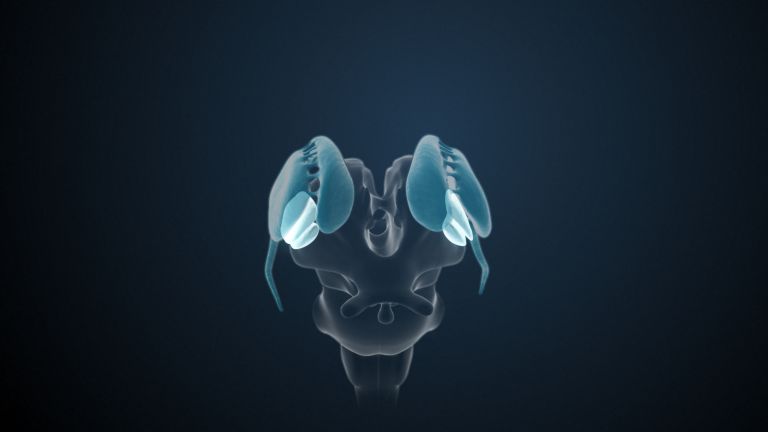
The Pallidum
The palladium provides a prime example of a highly complex feedback loop.
23.11.2025
-
- Basics
- Anatomy
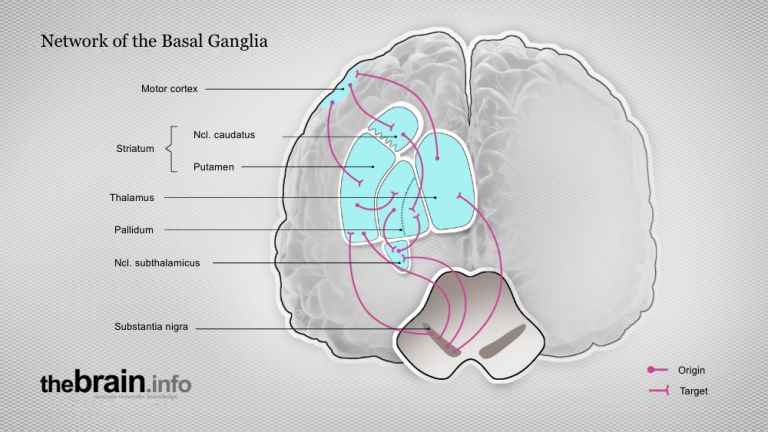
Network of the Basal Ganglia
One nucleus inhibits the other, only so that the cortex can ultimately be stimulated.
13.07.2015
-
- Glossary
Pallidum
The globus pallidus, also known as the pallidum, is an important nucleus of the basal ganglia. It is a motor nucleus of the extrapyramidal system involved in the regulation of movement. The pallidum has an inhibitory and an excitatory part. The Latin name pallidus – pale – refers to the color of this nucleus.
-
- Basics
- Anatomy
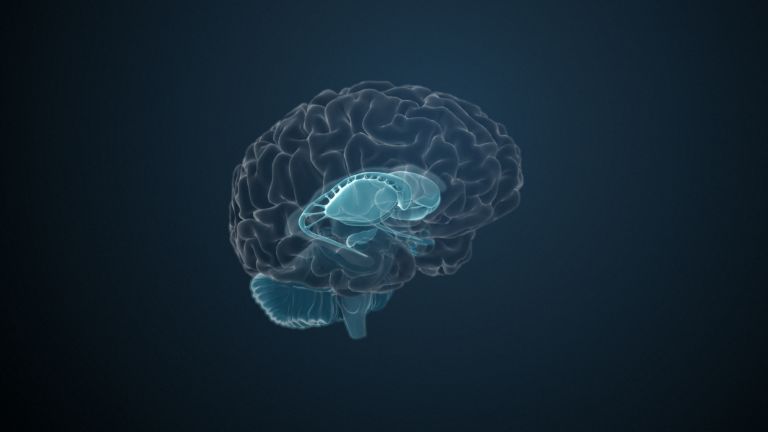
The Basal Ganglia
Whenever we perform a deliberate movement, core areas deep within the brain are involved.
23.08.2011
-
- Glossary
Pallidum
The "pale nucleus" (pallidum = pale) is classified as part of the basal ganglia due to its functional integration and, in terms of evolutionary development, belongs to the telencephalon. It has an inner (medial) and an outer (lateral) segment, which mainly transmit inhibitory impulses to modulate the activity of other parts of the basal ganglia and thalamus.
-
- Basics
- Anatomy
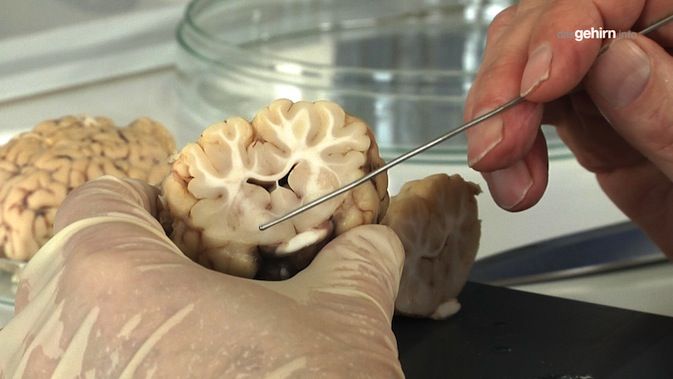
The Sheep Brain: Basal Ganglia
The basal ganglia control motor function and happiness – but in sheep, only unhappiness has been proven.
29.06.2013
-
- Glossary
Extrapyramidal system
The extrapyramidal system refers to a series of structures in the brain that play a key role in influencing motor function but are not part of the pyramidal tract. It consists of multisynaptic neuron chains. The extrapyramidal system includes numerous nuclei such as the striatum, pallidum, nucleus ruber, and substantia nigra.
-
- Basics
- Anatomy
The Subthalamus
A pale nucleus and an excitatory lens, and the zone of uncertainty – that is the subthalamus.
01.10.2025
-
- Page
Glossary
15.03.2017