Heat makes you sick, and the brain is particularly affected
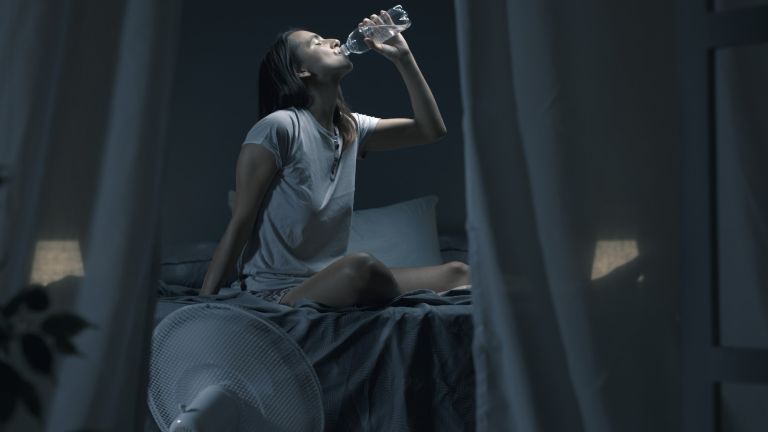
It is well known that heat waves increase the risk of neurological events such as strokes. Furthermore, people with neurological conditions such as MS, Parkinson’s disease, migraines, or dementia are a particularly vulnerable group; rising temperatures lead to a noticeable worsening of their symptoms. The German Society of Neurology therefore supports the position paper of the German Alliance on Climate Change and Health [1] regarding the Heat Action Day on June 11, 2026, and calls for the implementation of the measures outlined therein to effectively protect people with neurological diseases from heat in particular. A personalized “stroke warning app” could be helpful.
Published: 04.06.2026
Heat is a significant risk factor for various neurological conditions. The data on stroke, in particular, is highly revealing: high temperatures—and especially very warm nights—increase the risk of stroke. A study [2] from Germany showed that as the frequency of nighttime heat events increased, the number of heat-related strokes rose significantly, and that mortality following strokes increases during heat waves.
In Parkinson’s disease, motor and non-motor symptoms worsen during heat waves. A study [3] published in April 2026 showed that extreme heat is associated with an increased rate of Parkinson’s-related hospital admissions, particularly among older patients. In multiple sclerosis, it is well documented [4] that high ambient temperatures worsen neurological symptoms and increase the likelihood of hospital admissions. The occurrence of delirium, which can be life-threatening in individual cases, is frequently observed in patients with Dementia during heat waves.
stroke
Cerebral apoplexy
In a stroke, the brain or parts of it are no longer supplied with sufficient blood, which impairs the supply of oxygen and glucose. The most common cause is a blockage in an artery (ischemic stroke), less commonly a hemorrhage (hemorrhagic stroke). Typical symptoms include sudden visual disturbances, dizziness, paralysis, speech or sensory disturbances. Long-term consequences can include various sensory, motor, and cognitive impairments.
Dementia
Dementia
Dementia is an acquired deficit of cognitive, social, motor, and emotional abilities. The most well-known form is Alzheimer's disease. "De mentia" means "without mind" in English.
Cool emergency shelters and heat-resilient health and care facilities
“Even though heat is not the direct cause of dementia, Parkinson’s disease, and multiple sclerosis, these data demonstrate the great potential of heat protection measures for secondary prevention. Deaths could be prevented, and many hospitalizations could be avoided for those affected and the healthcare system,” explains Prof. Dr. Peter Berlit, Secretary General of the German Society of Neurology (DGN). “We therefore expressly support the position paper by the German Alliance on Climate Change and Health (KLUG) on crisis resilience during extreme heat.” Berlit particularly emphasizes the paper’s call to make the health, nursing, and social care sectors heat-resilient: “Non-air-conditioned neurological rehabilitation and nursing facilities should be a thing of the past—and, of course, non-air-conditioned hospitals as well. This increases the disease burden on neurological patients.”
The expert also points to the great potential of heat protection for primary and secondary prevention: “Numerous strokes and their recurrence could be entirely avoided.” A study published in “Nature Communications” in January 2026 [5] calculated that during heat waves, stroke mortality in the general population rose by 13.8%; among older adults, the increase was as high as 16.4%. Christian Thielscher, a member of the DGN’s Young Neurologists group and the KLUG Neurology Working Group, as well as the lead author of a groundbreaking recent review on stroke prevention [6], also emphasizes: “The risk of stroke is closely linked to climate protection.”
Accordingly, the DGN also supports the call outlined in the KLUG position paper to protect particularly vulnerable people from heat and to set up accessible, cool emergency shelters. But how can people be warned about heat-related strokes?
stroke
Cerebral apoplexy
In a stroke, the brain or parts of it are no longer supplied with sufficient blood, which impairs the supply of oxygen and glucose. The most common cause is a blockage in an artery (ischemic stroke), less commonly a hemorrhage (hemorrhagic stroke). Typical symptoms include sudden visual disturbances, dizziness, paralysis, speech or sensory disturbances. Long-term consequences can include various sensory, motor, and cognitive impairments.
The future of primary prevention: personalized, real-time “stroke prediction”
The Chinese researchers behind the *Nature* study [5] developed a “Stroke Heat Risk Prediction Model” and demonstrate that such a heat-specific warning system could prevent a significant proportion of heat-related stroke deaths. By using GPS for location tracking and evaluating basic personal data such as age, gender, risk factors, and medication use, the tool predicts heat-related health risks for strokes for the current day and the next seven days. In addition, the app provides personalized recommendations on diet, physical activity, time spent outdoors, temperature control at home, and medical consultations.
“We believe that such an individualized ‘stroke prediction app,’ if sufficiently validated, could indeed be an effective prevention tool. People who are told by an app on their phone that their personal stroke risk on a given day is high or even extremely high will adapt their behavior to the heat and follow the advice—unlike with general calls to action.” People often underestimate their own risks; scientists call this the optimism bias.
However, the experts also point out that a warning alone is of little use without a heat protection infrastructure: “If those at risk have no way of seeking out a cool environment, the alert is not effective.”
stroke
Cerebral apoplexy
In a stroke, the brain or parts of it are no longer supplied with sufficient blood, which impairs the supply of oxygen and glucose. The most common cause is a blockage in an artery (ischemic stroke), less commonly a hemorrhage (hemorrhagic stroke). Typical symptoms include sudden visual disturbances, dizziness, paralysis, speech or sensory disturbances. Long-term consequences can include various sensory, motor, and cognitive impairments.
Sources
[1] KLUG. Positionspapier zur Krisenresilienz bei Extremhitze
[2] He C, Breitner S, Zhang S, Huber V, Naumann M, Traidl-Hoffmann C, Hammel G, Peters A, Ertl M, Schneider A. Nocturnal heat exposure and stroke risk. Eur Heart J. 2024 Jun 28;45(24):2158-2166. doi: 10.1093/eurheartj/ehae277. PMID: 38768958; PMCID: PMC11212822.
[3] Dinehart C, Delaney SW, Mock L, Racette BA, Miller GW, Kioumourtzoglou MA, Braun D, Zanobetti A, Mork D. Extreme heat and hospitalization with Parkinson's disease among older adults. J Expo Sci Environ Epidemiol. 2026 Apr 13. doi: 10.1038/s41370-026-00882-7. Epub ahead of print. PMID: 41974975.
[4] Berntsson SG, Reis J, Zjukovskaja C, Tulek Z, Kristoffersson A, Landtblom AM. Climate change impacts the symptomology and healthcare of Multiple sclerosis patients through fatigue and heat sensitivity - A systematic review. J Neurol Sci. 2025 Jul 15;474:123526. doi: 10.1016/j.jns.2025.123526. Epub 2025 May 6. PMID: 40359743.
[6] Zhang J, Zhang M, Sun Q, Ma R, Zhang C, Lu K, Dong Q, Li T. Interventional applications of a Stroke Heat Risk Prediction Model produce health benefits. Nat Commun. 2026 Jan 27;17(1):2058. doi: 10.1038/s41467-026-68815-4. PMID: 41593072; PMCID: PMC12949070.
[6] Thielscher CS, Montellano FA, Saur D, Flöel A, Petzold GC, Haeusler KG. Prevention in stroke - Current state, present gaps and probable next steps. Neurol Res Pract. 2026 Apr 22;8(1):31. doi: 10.1186/s42466-026-00479-3. PMID: 42021367; PMCID: PMC13101267.
stroke
Cerebral apoplexy
In a stroke, the brain or parts of it are no longer supplied with sufficient blood, which impairs the supply of oxygen and glucose. The most common cause is a blockage in an artery (ischemic stroke), less commonly a hemorrhage (hemorrhagic stroke). Typical symptoms include sudden visual disturbances, dizziness, paralysis, speech or sensory disturbances. Long-term consequences can include various sensory, motor, and cognitive impairments.
Parkinson's disease
Morbus Parkinson
Parkinson's disease is one of the most common neurological disorders, caused by the death of dopamine-producing neurons in the substantia nigra, leading to a neurotransmitter imbalance in the basal ganglia. Symptoms usually begin late in life with mild tremors (resting tremor), increasing stiffness of the limbs, and slowed voluntary movements (bradykinesia). Later, postural instability, balance disorders, and difficulty walking occur. Other typical features include rigid facial expressions (hypomimia), a shuffling gait, and muscle stiffness (rigor). The disease is incurable, but its symptoms can be treated with medication (e.g., L-dopa, dopamine agonists) or surgery involving deep brain stimulation (brain pacemaker).
Multiple sclerosis
encephalomyelitis disseminata
A common neurological disease that predominantly occurs in young adults. For reasons that are still unclear, the body's own cells attack and destroy the myelin sheaths of nerve cells. This can happen throughout the central nervous system, which is why two different multiple sclerosis patients can suffer from very different symptoms. Common symptoms include visual disturbances, numbness in the arms and legs, but also coordination problems, muscle weakness, and bladder problems.