Multiple Sclerosis – How to support your loved Ones

A diagnosis of multiple sclerosis (MS) is not easy for patients' family members and friends to come to terms with. However, your behavior can be a great source of support. Don't lose heart; stay positive.
Scientific support: Prof. Dr. Ralf Gold
Published: 15.10.2025
Difficulty: easy
- Multiple sclerosis is a disease of the nervous system that requires some changes in everyday live.
- It is a chronic disease of the nervous system that usually begins between the ages of 20 and 40. There is currently no cure, but the relapsing-remitting course of the disease can now be managed very well with a variety of treatment options.
- Learn about MS, treatment strategies, and therapy options, as well as the highly active therapies that have been used by now much more extensively. This can help you better understand your loved one's behavior. Knowledge also reduces fear.
- MS changes your loved one's needs, but not your loved one as a person. Be careful not to patronize them or constantly tiptoe around them. Instead, respect their autonomy and help whenever your loved one wants you to.
- Plan for the future together with your loved one. Even though multiple sclerosis may be barely noticeable in the early stages, daily limitations can increase over time. Planning early can save a lot of stress in the future.
- Don't lose sight of your own needs, and take time for hobbies or other things that bring you joy. You can best help your loved one by taking care of yourself.
Multiple sclerosis (MS) is a serious neurological disease, but patients are no longer helplessly at its mercy. In addition to medication and medical care, family members also play an important role in coping. Be there for your affected family member and support him or her emotionally. Your care and courage can mean a lot, especially because it takes a lot of time and energy to come to terms with an MS diagnosis.
Become an “MS expert”!
The first step should be to find out as much as you can about multiple sclerosis. This will give you a better understanding of what your loved one is going through and how they may be feeling. It can often help you to interpret the symptoms of the disease correctly and thus better understand your loved one's behavior. For example, many MS patients experience increased daytime tiredness (known as fatigue), which often makes social contact exhausting. Rather than misunderstanding spontaneous cancellations as rejection or rudeness, try to see it from your loved one's perspective.
There is no such thing as “the MS.” MS is a very multifaceted disease that progresses differently in virtually every person. In general, however, three forms of multiple sclerosis can be distinguished:
Relapsing-remitting multiple sclerosis
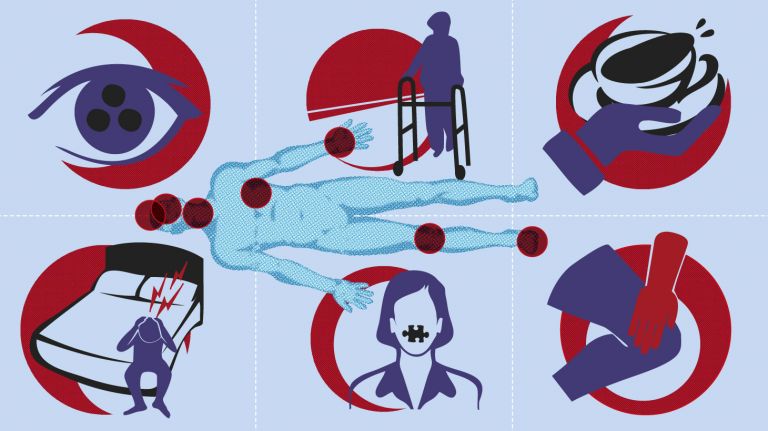
In nine out of ten patients, MS begins with a relapsing-remitting course. This is characterized by sudden attacks (e.g., paralysis or tingling in one leg), which in many cases subside again – at least partially – within a short period of time (days to weeks). However, some limitations may remain. The disease is active despite the absence of symptoms. In about half of patients, relapsing multiple sclerosis progresses to secondary progressive multiple sclerosis after ten or more years if left untreated or not adequately treated.
Secondary progressive multiple sclerosis
This form of multiple sclerosis is characterized by a progressive worsening of symptoms, limited remission between individual relapses, and an increase in disability even during relapse-free intervals. However, clearly recognizable relapses may also be completely absent. Unfortunately, this is often accompanied by increasing psychological and intellectual changes.
Primary progressive multiple sclerosis
In 10 to 15 percent of all MS patients, there is a continuous worsening of symptoms without separable episodes from the onset of the disease. Remission phases are usually absent, and stabilization of the disease is rare.








How can you support your loved one?
A diagnosis of MS changes many things, but it does not change your loved one as a person. Do not patronize them but try to “behave as usual.” Family members often think that they have to treat people with MS with kid gloves and take even the smallest tasks off their hands, but that would be wrong. Instead, encourage your loved one to do as many things as possible on their own, but without being overly reluctant to ask for help when they need it. Help them wherever you can, as long as they want you to. But be sure to respect their autonomy.
Of course, you can also take the initiative and make suggestions. For example, you could offer to accompany your loved one to doctor's appointments. Especially in the beginning, everything is very confusing and it is difficult for anyone to keep track of all the facts, forms of therapy, and medications. You could suggest to your loved one that you collect his or her (and your) questions together and discuss them with the doctor. This way, you can be a source of support without imposing your care on them.
Don't forget to start planning for the future together with your loved one now, although relapsing-remitting MS in particular responds well to treatment, and life in the early stages of MS is often only minimally restricted, especially with adequate highly active therapy. Nevertheless, it is possible that the disabilities will increase over the years. You should take this into account in your plans and also discuss openly which responsibilities will be taken on by whom. You should also discuss together the extent to which external help, such as a domestic helper, could be useful in helping you cope with everyday life.
Open and honest communication between you and your loved one is essential. Especially in difficult times of the disease, patients are often withdrawn and depressed. Try to always be there for your loved one and respect their wishes, fears, and concerns. Let them know that you are there for them, in good times and bad!
What can help you cope with MS?
A diagnosis of multiple sclerosis is often a great shock, not only for those affected, but also for their loved ones – you. Therefore, share your thoughts and feelings and discuss your expectations and fears. Try to see MS as a challenge that you want to face as a team. This will bring you closer together and can give you both support and courage.
Take care of yourself and seek help if you feel overwhelmed. Tensions often rise, especially when symptoms worsen (relapse). Build a close social network of acquaintances and friends you can rely on in an emergency. Look for connections outside your family circle.
If you notice that you are very worried and anxious, it can also help to discuss this with an expert, such as a psychotherapist. You should never ignore feelings of overwhelm, stress, or depression, but seek help immediately. Joining a support group for relatives of MS patients can often be a great relief. There you can exchange experiences with others in the same situation and gather strength, ideas, and advice. You should also discuss this with your relative and encourage them to join a support group, as well.
Don't lose sight of your own needs and don't forget to do what you want to do from time to time. It is important for both you and your loved one that you recharge your batteries. Exhausting yourself beyond your own strength is of no use to anyone and can become a great burden for the whole family. After all, you can be there for your loved one best when you also take care of yourself.
Expert advice from Dr. Judith Bellmann-Strobl (specialist in neurology), head of the University Outpatient Clinic for Neuroimmunology, Charité Universitätsmedizin Berlin.
Further reading
- T. J. Murray & Nancy J. Holland: Multiple Sclerosis: A Guide for the Newly Diagnosed.
- Rosalind Kalb: MS for Dummies.
- Multiple Sclerosis Trust (UK). URL: https://mstrust.org.uk/ [as of 06/15/2025]
First published on January 30, 2017
Last updated on October 15, 2025