
Making up for lost time: Inhibitory neurons catch up during brain development
New insights into the emergence of brain cells that keep neural activity in balance
Published: 08.07.2025
- The brain in balance: Excitatory neurons increase activity, while inhibitory neurons prevent cells from firing too much.
- Published in Nature Neuroscience: A team at the Max Planck Institute for Biological Intelligence explored the development of inhibitory neurons in mice and discovered a mechanism that helps maintain balance in the brain.
- New insights: Cells that are formed later in development mature significantly faster after they are produced than those that emerge earlier.
- Further research needed: The study may shed light on the origins of neurodevelopmental disorders.
Intelligence
Intelligence
Collective term for human cognitive performance. According to British psychologist Charles Spearman, cognitive performance in different areas correlates with a general factor (g factor) of intelligence. This means that intelligence can be expressed as a single value. American psychologist Howard Gardner, among others, has developed a counter-concept to this, known as the "theory of multiple intelligences." According to this theory, intelligence develops independently in the following eight areas: linguistic, logical-mathematical, musical-rhythmic, visual-spatial, bodily-kinesthetic, naturalistic, intrapersonal, and interpersonal.
The human brain is made up of billions of nerve cells, or neurons, that communicate with each other in vast, interconnected networks. For the brain to function reliably, there needs to be a fine balance between two types of signals: excitatory neurons that pass on information and increase activity, and inhibitory neurons that limit activity and prevent other neurons from becoming too active or firing out of control. This balance between excitation and Inhibition is essential for a healthy, stable brain.
excitatory
Exciting synapses are described as excitatory when they depolarize the subsequent cell membrane and can thus lead to the formation of an action potential. An excitatory effect is usually produced by an exciting transmitter (messenger substance), such as glutamate. The opposite is an inhibitory synapse.
Inhibition
Neuronal inhibition describes the phenomenon whereby a sender neuron sends an impulse to a receiver neuron, causing the latter's activity to decrease. The most important inhibitory neurotransmitter is GABA.
Inhibitory neurons born later mature quicker
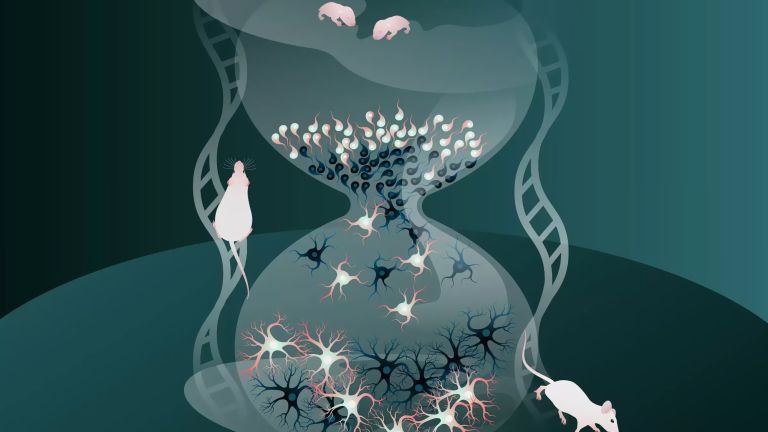
Inhibitory neurons are generated during brain development through the division of progenitor cells – immature cells not yet specialized but already on the path to becoming neurons. The new study, led by researchers at the Max Planck Institute for Biological Intelligence, uncovered a surprising feature of brain development based on findings in mice: During this essential process, cells born later in development mature much more quickly than those produced earlier.
“This faster growth helps later-born neurons catch up to those produced earlier, so that by the time all these neurons are incorporated into neural networks, they are at a similar stage of development,” said Christian Mayer, research group leader at the Max Planck Institute for Biological Intelligence. “This is important, as otherwise, earlier-born neurons—having had more time to form connections—could end up with far more synaptic links than those created later. Without this adjustment, the network could be thrown off balance, and individual cells would have too many or too few connections.”
Intelligence
Intelligence
Collective term for human cognitive performance. According to British psychologist Charles Spearman, cognitive performance in different areas correlates with a general factor (g factor) of intelligence. This means that intelligence can be expressed as a single value. American psychologist Howard Gardner, among others, has developed a counter-concept to this, known as the "theory of multiple intelligences." According to this theory, intelligence develops independently in the following eight areas: linguistic, logical-mathematical, musical-rhythmic, visual-spatial, bodily-kinesthetic, naturalistic, intrapersonal, and interpersonal.
Genetic control and disease
In the study, the researchers also explored how the accelerated maturation of later-born inhibitory neurons is regulated. They identified specific genes involved in this process and uncovered how they control when and to what extent a cell reads and uses different parts of its genetic code. They found that the faster development of later-born inhibitory neurons turns out to be linked to changes in the developmental potential of the precursor cells that generate them—changes which are, in turn, triggered by a reorganization of the so-called ‘chromatin landscape.’ In simple terms, this means that cells adjust the accessibility of certain regions of DNA in the cell nucleus, making key instructions on how and when to develop more readable.
Genetic changes, such as mutations or altered Gene regulation, in these genes or processes may alter the developmental pathways of the brain during early embryonic stages, which could contribute to the development of conditions such as Autism or epilepsy. Therefore, this study could ultimately offer insights into how developmental disorders of the brain can begin so early in life.
Gene
Information unit on DNA. Specialized enzymes translate the core component of a gene into ribonucleic acid (RNA). While some ribonucleic acids perform important functions in the cell themselves, others specify the order in which the cell should assemble individual amino acids into a specific protein. The gene thus provides the code for this protein. In addition, a gene also includes regulatory elements on the DNA that ensure that the gene is read exactly when the cell or organism actually needs its product.
Autism
A serious developmental disorder that often manifests itself in reduced social skills, impaired communication, and stereotypical behavior. Today, it is understood to be part of the autism spectrum disorders.
Developmental timing in humans and other mammals
In the study, the researchers also explored how the accelerated maturation of later-born inhibitory neurons is regulated. They identified specific genes involved in this process and uncovered how they control when and to what extent a cell reads and uses different parts of its genetic code. They found that the faster development of later-born inhibitory neurons turns out to be linked to changes in the developmental potential of the precursor cells that generate them—changes which are, in turn, triggered by a reorganization of the so-called ‘chromatin landscape.’ In simple terms, this means that cells adjust the accessibility of certain regions of DNA in the cell nucleus, making key instructions on how and when to develop more readable.
Genetic changes, such as mutations or altered Gene regulation, in these genes or processes may alter the developmental pathways of the brain during early embryonic stages, which could contribute to the development of conditions such as Autism or epilepsy. Therefore, this study could ultimately offer insights into how developmental disorders of the brain can begin so early in life.
Gene
Information unit on DNA. Specialized enzymes translate the core component of a gene into ribonucleic acid (RNA). While some ribonucleic acids perform important functions in the cell themselves, others specify the order in which the cell should assemble individual amino acids into a specific protein. The gene thus provides the code for this protein. In addition, a gene also includes regulatory elements on the DNA that ensure that the gene is read exactly when the cell or organism actually needs its product.
Autism
A serious developmental disorder that often manifests itself in reduced social skills, impaired communication, and stereotypical behavior. Today, it is understood to be part of the autism spectrum disorders.
More research needed
The newly discovered mechanisms highlight just how important both genetic factors and the correct pace of development are for a healthy brain. They may also open up new approaches to studying the causes of neurodevelopmental disorders, and potentially one day help to inform the development of treatments.
Original publication
Ann Rose Bright*, Yana Kotlyarenko*, Florian Neuhaus*, Diana Rodrigues, Chao Feng, Christian Peters, Ilaria Vitali, Elif Dönmez, Michael H. Myoga, Elena Dvoretskova, Christian Mayer
*these authors contributed equally; Temporal control of progenitor competence shapes maturation in GABAergic Neuron development in mice; Nature Neuroscience, online July 8, 2025
DOI
Neuron
A neuron is a specialized cell in the nervous system that is responsible for processing and transmitting information. It receives signals via its dendrites and transmits them via its axon. Transmission occurs electrically within the neuron and, between neurons, usually chemically via synapses.