Forced Right-Handedness
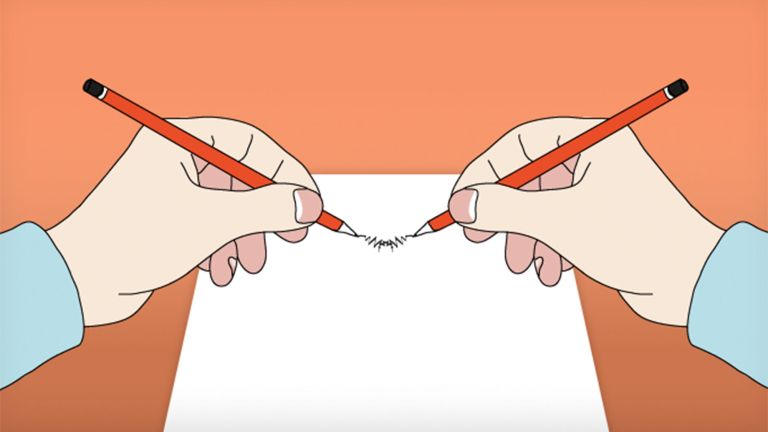
In right-handed people, the left hemisphere of the brain is responsible for writing, while in left-handed people, it is the right hemisphere. But what happens in the brain when someone is retrained to use their right hand instead of their left? The brain is retrained too. At least partially.
Scientific support: Prof. Dr. Onur Güntürkün
Published: 25.10.2025
Difficulty: intermediate
- According to estimates, around one in ten people are left-handed. For a long time, left-handed children were retrained to use their right hand when learning to write at school.
- In right-handed people, the left Hemisphere of the brain is responsible for writing, while in left-handed people, the right hemisphere is dominant. This is due to the crossed nerve pathways. Each hemisphere of the brain controls the opposite side of the body.
- Retraining handedness also leads to some retraining of the brain: movement control is shifted from the right to the left hemisphere. However, planning and coordination in retrained left-handers still takes place in the right hemisphere – as in normal left-handers.
Hemisphere
The cerebrum and cerebellum each consist of two halves – the right and left hemispheres. In the cerebrum, they are connected by three pathways (commissures). The largest commissure is the corpus callosum.
- Among cats, half prefer to scratch with their right paw, while the other half prefer to scratch with their left paw.
- Monkeys show only a slight tendency toward right-handedness.
- Parrots are more likely to be left-footed than right-footed.
- Zebrafish prefer to look at other zebrafish with their left Eye rather than their right eye.
- In humans, the ratio of right-handed to left-handed people is nine to one. The reasons for this imbalance remain unclear.
- One theory assumes that most people have their language center on the left side of the brain and that it is therefore practical for the fine motor skills required for writing to be controlled in the same hemisphere.
- Another explanation assumes that the preference for one hand is inherited. However, this is contradicted by the fact that there are identical twins, i.e., genetically identical siblings, one of whom is right-handed and the other left-handed.
- About eight months after birth, children begin to prefer using one hand over the other. By the age of three, most children's handedness is very clear. However, some children still switch hands constantly at the age of six.
Eye
bulbus oculi
The eye is the sensory organ responsible for perceiving light stimuli – electromagnetic radiation within a specific frequency range. The light visible to humans lies in the range between 380 and 780 nanometers.
Hemisphere
The cerebrum and cerebellum each consist of two halves – the right and left hemispheres. In the cerebrum, they are connected by three pathways (commissures). The largest commissure is the corpus callosum.
“Are you left-handed? Then you must be particularly creative!” Which left-hander has not heard these phrases? Which right-hander has never said them? The fact is: there is no clear evidence for this myth.
People like to list famous left-handers: Douglas Adams, author of The Hitchhiker's Guide to the Galaxy; Marie Curie, the only woman to date to have won two Nobel Prizes; Barack Obama, the first black president of the United States; rapper Eminem; soccer player Mesut Özil; and the British heir to the throne, Prince William.
This raises the question: how many celebrities are right-handed? Chris McManus, a leading authority among left-handed researchers, once said, “Most popular literature cites anecdotes about Leonardo da Vinci, Holbein, and Paul McCartney, ignoring the fact that for every McCartney, there are probably nine talented right-handed rock musicians.”
The right-handed left-handed researcher also found in a study of 11,000 children in the UK that there were significantly more left-handed children among the highly gifted children – but at the same time, there were also more left-handed children among the challenged, slow-learning children. After all, the average Intelligence quotient was almost identical for right-handed and left-handed people.
Intelligence
Intelligence
Collective term for human cognitive performance. According to British psychologist Charles Spearman, cognitive performance in different areas correlates with a general factor (g factor) of intelligence. This means that intelligence can be expressed as a single value. American psychologist Howard Gardner, among others, has developed a counter-concept to this, known as the "theory of multiple intelligences." According to this theory, intelligence develops independently in the following eight areas: linguistic, logical-mathematical, musical-rhythmic, visual-spatial, bodily-kinesthetic, naturalistic, intrapersonal, and interpersonal.
Intelligence quotient
A measure intended to express a person's intellectual capacity. Tests designed to determine intelligence are based on the concept that there is a general factor of intelligence that is normally distributed across the population. The first IQ tests were developed in the early 20th century by Alfred Binet, who wanted to use them to determine the relative intelligence age of schoolchildren. According to his definition, IQ is the quotient of intelligence age and chronological age multiplied by 100. This is also the average IQ of a person. Modern tests often use standard deviations for normalization, which means that IQ is still scaled to average = 100, SD = 15, without directly calculating intelligence age. 95 percent of the population has IQ scores between 70 and 130. If someone scores below 70, they are considered to have intellectual disability, while a score above 130 is considered gifted.
“Use your good hand!” my grandmother always said – meaning: use your right hand, not your left! “But I had always done everything with my left hand: writing, painting, shot put,” says Anneliese Meier, who does not want to give her real name for professional reasons. “Then I would get a slap on the fingers,” recalls the 62-year-old. An estimated one in ten people is left-handed; some surveys assume there are even more left-handed people. In the past, these people were retrained, as was Anneliese Meier. When she started school, she had to write with her right hand: left-handed people were considered abnormal, and teachers were vigilant. “My right hand was constantly cramped. That's why I sometimes built a screen for myself. Then the teacher couldn't see that I was writing with my left hand in between.”
If the teacher had looked at the sheet of paper, he might not even have noticed which sentences the student had written with which hand: The handwriting of left-handers who were retrained at an early age usually looks just as uniform and delicate as that of a typical right-hander.
Stefan Klöppel is not surprised by this, at least not anymore. At the University Medical Center Freiburg in 2007, he discovered that left-handed people who have been retrained to use their right hand have also had their brains retrained, at least partially (to study).
Each hand is controlled by the opposite hemisphere of the brain
Generally speaking, the left Hemisphere of the brain is responsible for writing in right-handed people, while the right hemisphere is responsible in left-handed people. The nerve pathways from the motor and sensory centers of the two hemispheres are criss-cross-connected to the two sides of the body. However, it was long unclear how this works in left-handed people who have been retrained to use their right hand.
Stefan Klöppel had 16 ordinary right-handed people, 16 ordinary left-handed people, and 16 retrained left-handed people complete three tests: First, they were asked to pantomime situations such as throwing, brushing their teeth, and playing tennis – this was to test how left-handed they were. Then the test subjects were asked to write small double Ls, i.e., thus two loops, by hand for several seconds, once with their left hand and once with their right hand – this was to test their handwriting. They were also placed in a Functional magnetic resonance imaging (fMRI) scanner, where they were shown various symbols and asked to press a button for certain images, for example, a sun with their left index finger and a star with their right index finger. This was to find out whether the brains of retrained left-handers work differently.
The pantomime test revealed that the retrained left-handers in the test group wrote with their right hand, sometimes with both hands – but most of them used their left hand for other activities. This made it easy to identify the retrained left-handers among those who wrote with their right hand. The situation was different in the handwriting sample and symbol test: "The handwriting of the retrained left-handers and the pure right-handers looks very similar. And in the fMRI test, both groups were equally quick and made a similar number of typing errors," says Stefan Klöppel. The fMRI showed that the areas of the brain responsible for movement control were dominant in the left hemisphere of the retrained left-handers – as in normal right-handers and unlike normal left-handers.
The retrained area of the brain is the primary sensorimotor Cortex. “This is where movement is controlled. The more successful the retraining was, the more the movement was controlled by the actually non-dominant left hemisphere of the brain,” says Stefan Klöppel.
Hemisphere
The cerebrum and cerebellum each consist of two halves – the right and left hemispheres. In the cerebrum, they are connected by three pathways (commissures). The largest commissure is the corpus callosum.
Functional magnetic resonance imaging
Functional magnetic resonance imaging (fMRI) is a modification of MRI that allows brain activity to be measured indirectly via regional blood flow and oxygen consumption. BOLD (blood oxygen level dependent) contrast is often used, which exploits differences in the magnetic behavior of oxygen-rich and oxygen-poor blood. An increase in the BOLD signal indicates increased neural activity. fMRI provides good spatial resolution and allows detailed conclusions to be drawn about the activity of specific areas of the brain, while the temporal resolution is in the range of seconds.
Cortex
cortex cerebri
Cortex refers to a collection of neurons, typically in the form of a thin surface. However, it usually refers to the cerebral cortex, the outermost layer of the cerebrum. It is 2.5 mm to 5 mm thick and rich in nerve cells. The cerebral cortex is heavily folded, comparable to a handkerchief in a cup. This creates numerous convolutions (gyri), fissures (fissurae), and sulci. Unfolded, the surface area of the cortex is approximately 1,800cm².

Control like a right-handed person, plan like a left-handed person
However, the brain was not completely reorganized. “The planning and control of movements still took place in the right hemisphere,” says Stefan Klöppel. In the fMRI images, two regions lit up more strongly in the right Hemisphere than in the left: the dorsal Premotor cortex and the supramarginal gyrus. "The dorsal premotor Cortex is the classic region for controlling motor function. And although the supramarginal gyrus is responsible for many different things, one of its functions is to serve as an alternative region when the dorsal premotor cortex is already busy," says Stefan Klöppel. And retrained left-handers need a lot of computing power in these areas of the right hemisphere; they don't just have to coordinate their usual left hand, but also their unfamiliar right hand. This was also evident in the fMRI: both brain regions were more active in retrained left-handers than in pure right-handers and pure left-handers.
When retraining to become right-handed, only some of the brain activity is shifted to the left hemisphere, while other activity remains in the right hemisphere. This may be because planning and coordinating a movement is cognitively more demanding than simply executing the movement. It is also conceivable that the planning of a movement can be easily decoupled from the motor execution of the action, and that there is therefore little pressure to transfer these planning regions to the left hemisphere of the brain as well.
The brain regions responsible for planning and coordination are superior to those responsible for immediate control. Retrained left-handers have to cross-route their input from the right to the left hemisphere of the brain, while also overcoming the natural impulse there. This requires more work from the brain. Perhaps this even explains why Anneliese Meier was so unsuccessful in her attempts to learn instruments. “My older sister is right-handed and had a guitar and an accordion. I wanted so much to play them, but I just couldn't,” says the retrained left-hander. Stroking strings and pressing keys was something her right hand could do poorly at best – the coordination was too difficult.
In a follow-up study, Stefan Klöppel found another difference between the brains of retrained left-handers and pure left- or right-handers: “The retrained left-handers had less Gray matter in the middle part of the left putamen,” says Stefan Klöppel. The Putamen is part of the Basal ganglia The front part near the forehead is responsible for cognitive tasks, while the rear part controls movement – the tasks overlap in the middle. “It is completely normal for the volume of the basal ganglia to decrease in the first years of life, as this is probably due to the breakdown of unnecessary nerve connections,” says Stefan Klöppel. However, this effect was particularly strong in retrained left-handers in the transition area between the cognitive putamen region and the movement-controlling putamen region. “That really surprised us,” recalls Stefan Klöppel. “We had actually expected the gray matter to increase in this area, just like muscles do during exercise. After all, it's a kind of training when left-handers constantly use their unaccustomed right hand.” The neurologist does not know the reason for this strange research result.
However, he has gained an important insight: “In retrained left-handers, even simple movements place greater demands on the brain. However, there is no question of excessive strain, nor of underuse in the now less active regions of the brain.” Stefan Klöppel thus contradicts those who claim that in retrained left-handers, the brain is sometimes overstrained and sometimes underused, and that this is what makes people ill.
There are retrained left-handers who attribute their psychological problems to retraining. Bedwetting, poor concentration, Memory problems, and fear of failure are most commonly cited.
However, there is no scientific evidence for this, says psychologist Alan Searleman from St. Lawrence University in the US. He has conducted extensive research on left-handed people. "A few years ago, we became aware that Johanna Barbara Sattler in Germany was complaining that there were very negative consequences for left-handed people who had to write with their right hand. Her claims surprised us, and we have no data to support them." So far, the question of how retraining from the left to the right hand affects the psyche has apparently not been empirically investigated. There is also no study on this topic in the PubMed database for medical publications.
Stefan Klöppel does not believe that retraining itself is responsible for psychological distress: “It is more likely the psychological stress that one is exposed to when forced to use the right hand, even though it feels wrong.”
Anneliese Meier no longer holds a grudge against her grandmother. “It was just a different time.” Today, left-handed children in Germany are hardly ever retrained. On the contrary, parents and teachers are encouraged to place spoons, pens, and other utensils in front of the child so that they can decide for themselves which hand to use. Left-handedness is no longer a Stigma but is now considered a sign of particularly clever minds (see info box on myths about left-handed people). How the brains of retrained left-handed people work is therefore no longer something that can be studied in this country.
Hemisphere
The cerebrum and cerebellum each consist of two halves – the right and left hemispheres. In the cerebrum, they are connected by three pathways (commissures). The largest commissure is the corpus callosum.
dorsal
The positional term dorsal means "towards the back." In relation to the nervous system, it refers to a direction perpendicular to the neural axis, i.e., upwards towards the head or backwards.
In animals that do not walk upright, the term is simpler, as it always means toward the back. Due to the upright posture of humans, the brain bends in relation to the spinal cord, making dorsal mean "upward."
Premotor cortex
Part of the motor cortex in the frontal lobe. It is connected to the primary motor cortex and numerous other brain regions and is involved in the planning, preparation, and coordination of complex, voluntary movements. Examples of its functions include reaching for an object or the sequence of movements involved in targeted actions.
Cortex
cortex cerebri
Cortex refers to a collection of neurons, typically in the form of a thin surface. However, it usually refers to the cerebral cortex, the outermost layer of the cerebrum. It is 2.5 mm to 5 mm thick and rich in nerve cells. The cerebral cortex is heavily folded, comparable to a handkerchief in a cup. This creates numerous convolutions (gyri), fissures (fissurae), and sulci. Unfolded, the surface area of the cortex is approximately 1,800cm².
Gray matter
Grey matter refers to a collection of nerve cell bodies, such as those found in nuclei or in the cortex.
Putamen
A nucleus of the basal ganglia that, together with the caudate nucleus, forms the striatum. As part of the extrapyramidal motor system, it is involved in voluntary motor function (intentional movement).
Basal ganglia
Nuclei basales
The basal ganglia are a group of subcortical nuclei (located beneath the cerebral cortex) in the telencephalon. The basal ganglia include the globus pallidus and the striatum, and, depending on the author, other structures such as the substantia nigra and the subthalamic nucleus. The basal ganglia are primarily associated with voluntary motor function, but they also influence motivation, learning, and emotion.
Memory
Memory is a generic term for all types of information storage in the organism. In addition to pure retention, this also includes the absorption of information, its organization, and retrieval.
Stigma
The term refers to a characteristic that is viewed negatively by society or a group and leads to the discrediting of individuals who possess this characteristic. Stigmas can refer, for example, to members of certain ethnic groups or marginalized social groups. Even a diagnosis of a mental disorder or an illness such as AIDS can be accompanied by stigmatization, depending on the social environment.
Further reading
- Klöppel, S. et al.: Can Left-Handedness be Switched? Insights from an Early Switch of Handwriting. In: Journal of Neuroscience, 2007; 27 (29), pp. 7847–7853 (to the text).
- Klöppel, S. et al.: Nurture versus Nature: Long-Term Impact of Forced Right-Handedness on Structure of Pericentral Cortex and Basal ganglia In: Journal of Neuroscience, 2007; 30 (9), pp. 3271–3275 (to the text).
- Ocklenburg, S. and Güntürkün, O., The Lateralized Brain: The Neuroscience and Evolution of Hemispheric Asymmetries, London: Academic Press, second print, 2024.
Cortex
cortex cerebri
Cortex refers to a collection of neurons, typically in the form of a thin surface. However, it usually refers to the cerebral cortex, the outermost layer of the cerebrum. It is 2.5 mm to 5 mm thick and rich in nerve cells. The cerebral cortex is heavily folded, comparable to a handkerchief in a cup. This creates numerous convolutions (gyri), fissures (fissurae), and sulci. Unfolded, the surface area of the cortex is approximately 1,800cm².
Basal ganglia
Nuclei basales
The basal ganglia are a group of subcortical nuclei (located beneath the cerebral cortex) in the telencephalon. The basal ganglia include the globus pallidus and the striatum, and, depending on the author, other structures such as the substantia nigra and the subthalamic nucleus. The basal ganglia are primarily associated with voluntary motor function, but they also influence motivation, learning, and emotion.
First published on February 22, 2013
Last updated on October 25, 2025