The Night Side of Consciousness

I dream, therefore I am – or am I? What is this “I” that dreams? What happens in the brain during this process? Neuroscience is making progress in answering these questions, but a little philosophy can't hurt, either.
Scientific support: Prof. Dr. Björn Rasch
Published: 03.09.2025
Difficulty: intermediate
- Consciousness is not an all-or-nothing thing. At night, we go through several stages of consciousness.
- The connections between the individual regions of our brain change significantly.
- In dreams, we are similar to “naive realists” when we are awake: we experience a world that we believe to be reality.
- Only in lucid dreams is the sleeper aware that they are dreaming.
- Whether we dream all night long or whether there are breaks in between is still a matter of debate.
- An elegant experiment with lucid dreamers has provided evidence that the Perception of time in dreams is similar to that of our waking consciousness.
Perception
The term describes the complex process of gathering and processing information from stimuli in the environment and from the internal states of a living being. The brain combines the information, which is perceived partly consciously and partly unconsciously, into a subjectively meaningful overall impression. If the data it receives from the sensory organs is insufficient for this, it supplements it with empirical values. This can lead to misinterpretations and explains why we succumb to optical illusions or fall for magic tricks.
Michael Czisch from the Max Planck Institute of Psychiatry in Munich has not only studied lucid dreams using Magnetic resonance imaging but has also carried out sophisticated time series analyses of the fMRI signals of sleepers together with his colleague Victor Spoormaker. This enabled the researchers to identify how the activity of the entire brain varies during different Sleep phases and while awake.
The following picture emerges: when awake, the centers of the human brain are interconnected in such a way that signals are transmitted optimally in individual regions, i.e., in a small space, but at the same time can be transmitted over longer distances in rapid steps. Technicians refer to this as a small-world network. It is also characteristic of social networks, such as social media acquaintances.
When falling asleep, i.e., in light sleep, global networking increases, but the connections take on a more random, chaotic character. In deep sleep, on the other hand, researchers observe increased local clustering, as if the individual regions were preoccupied with themselves. This fits in with the deep sleep task of consolidating memories. When archiving, we don't like to be disturbed by external impressions. However, the loss of communication over long periods of time leads to a sharp reduction in the brain's capacity to bundle information – a state of unconsciousness similar to that which occurs under anesthesia.
In certain phases of REM sleep, the connection between the thalamus and the Cortex is strengthened again, which could explain why a rudimentary consciousness arises during dream sleep.
Magnetic resonance imaging
Magnetic resonance imaging scanner
A device used by medical professionals for magnetic resonance imaging (MRI). MRI is an imaging technique used to diagnose malformations in various tissues or organs of the body. This method is particularly effective for imaging parts of the body that contain a lot of water. Patients are placed in a tube (scanner) and exposed to a strong magnetic field. However, they are not exposed to X-rays or other forms of ionizing radiation.
Sleep phases
During sleep, we go through several non-REM/REM cycles, each lasting around 90 minutes. The non-REM phases consist of stages N1, N2, and N3, with slow delta waves with frequencies of 0.5–2 Hz dominating in N3 (deep sleep). REM sleep is characterized by rapid eye movements, low-amplitude, mixed-frequency brain activity, and greatly reduced muscle tone. Deep sleep predominates at the beginning of the night, while the proportion of REM sleep increases in later cycles.
Cortex
cortex cerebri
Cortex refers to a collection of neurons, typically in the form of a thin surface. However, it usually refers to the cerebral cortex, the outermost layer of the cerebrum. It is 2.5 mm to 5 mm thick and rich in nerve cells. The cerebral cortex is heavily folded, comparable to a handkerchief in a cup. This creates numerous convolutions (gyri), fissures (fissurae), and sulci. Unfolded, the surface area of the cortex is approximately 1,800cm².
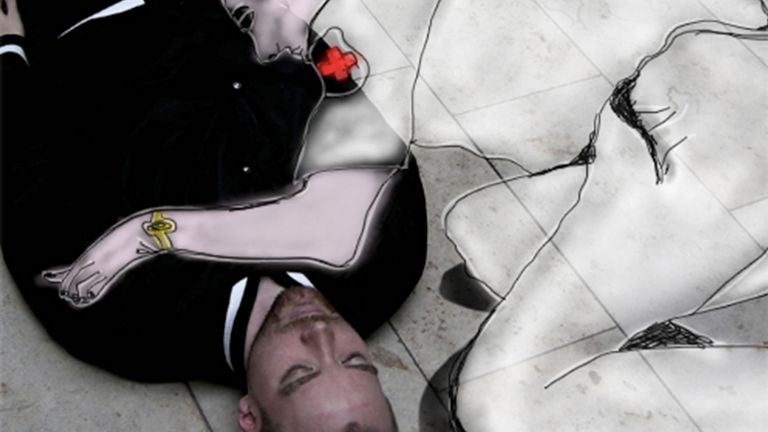
I can't stop the locomotive. The brakes are failing. The machine jumps off the tracks and continues on the curb in front of the station instead. There, an obstacle! It looks like a large dumpster. I steer towards it. And now, finally, the locomotive comes to a halt. I get out and steal away as quickly as possible, weaving my way through a crowd of passers-by who have witnessed the collision. No one stops me.
A dream. One that gives me pause for thought after I wake up. What have I just done? I committed a hit-and-run, albeit on foot. I would never do such a thing in real life! Especially not after an accident with such a conspicuous vehicle. How did I even get hold of this locomotive? I don't even like driving. But in the dream, my vehicle didn't seem implausible at all. There was a backstory. But now that I've woken up, I can only vaguely remember it.
You could almost say that my dream self and my daytime self are two different people. But they're not that different – they share the same brain. The same brain in two different states of consciousness.
Consciousness is not an all-or-nothing thing
Jennifer Michelle Windt agrees. In her doctoral thesis under Thomas Metzinger in Mainz, the philosopher dealt with dream consciousness. Unlike her American predecessor Norman Malcolm, who in the 1950s categorically claimed that anyone who sleeps cannot be conscious for logical reasons, Jennifer Windt believes that this is indeed possible. Consciousness is not a matter of all or nothing.
After all, we experience things in our dreams; we find ourselves in a world that can be experienced: there is a small-town train station, there is a locomotive, a garbage container, and there are people on the street. We experience this world very subjectively as our here and now, argues Windt. Even if it is only a construct of our brain.
However, isn't the world we experience in our waking consciousness also a construct of our brain? On thebrain.info, you can read dozens of times that, for example, seeing is a complicated process that creates a visual impression from physical signals (light waves hitting the Retina) in many neural steps. “What we experience is never the real world,” says the philosopher. “We always generate a model.” Nevertheless, we believe in the reality of our models and go through the world as “naive realists” – both when awake and when dreaming.
One exception is people who Lucid dream These enviable individuals become aware that they are dreaming while they are dreaming. Some even control their dreams, for example, they can fly or walk through walls, have sex with Brad Pitt, or intimidate the terrifying figures in their nightmares so convincingly that they flee.
Retina
The retina is the inner layer of the eye covered with pigment epithelium. The retina is characterized by an inverse (reversed) arrangement: light must first pass through several layers before it hits the photoreceptors (cones and rods). The signals from the photoreceptors are transmitted via the optic nerve to the processing areas of the brain. The reason for the inverse arrangement is the evolutionary development of the retina, which is a protrusion of the brain.
The retina is approximately 0.2 to 0.5 mm thick.
Lucid dream
During a lucid dream, the dreamer is aware of their state and able to control their actions. Although Aristotle reported on this phenomenon and up to 80 percent of all people say they have had lucid dreams, sleep researchers doubted the existence of this phenomenon until the end of the 1960s. Most observations of lucid dreams originate from the REM sleep phase. Scientists have found that lucid dreams are associated with altered activity in the prefrontal cortex, which is responsible for the critical evaluation of events. Lucid dreaming can be learned and is now also used in therapy, for example in the treatment of nightmares.
Lucid dreamers advance brain research
Such abilities are not so rare: a representative survey conducted by dream researcher Michael Schredl in Germany in 2010 found that 51 percent of respondents were familiar with lucid dreaming from their own experience. One in five even has lucid dreams once a month. As a result, lucid dreamers have been the subject of increasingly detailed research in recent years. Psychologists, sleep and brain researchers, and philosophers such as Jennifer Windt consider them to be a guide to the fundamentals of our consciousness.
Unfortunately, I am not one of these elite sleepers – I am at the mercy of my dreams. And I am often plagued by boring dreams in which I make entries on websites over and over again and threaten to forget something important – it's as if my working life continues seamlessly in my sleep. Do I actually dream all night long? Are there no breaks?
For a long time, sleep researchers assumed that humans only dream during REM sleep These are the Sleep phases characterized by rapid Eye movements (REM) and noticeable signals in the EEG. During these sleep phases, only the eye and respiratory muscles function, while the rest of the voluntary muscles are completely paralyzed.
Aggressive dreamers and sleepwalkers who eat
This is a good thing, otherwise we might act out our dreams, run around the apartment in our pajamas, and beat up our bed neighbor because we think he is a pursuer. In the case of a certain disease – REM sleep behavior disorder – this is exactly what happens in real life. This is no laughing matter for those affected and their families, especially since the disease, also known as Schenck syndrome, can be a sign of early-stage Parkinson's disease.
It is known that these patients can often remember the content of their nightmares – usually involving being pursued by some evil force – for a long time. However, they do not remember their own very real acts of aggression – a special form of consciousness distortion.
Sleepwalkers, on the other hand, are now known to begin their nocturnal wanderings from non-REM sleep. In their case, the body takes control, so to speak, while the consciousness continues to sleep. Their behavior does not necessarily have anything to do with the content of their dreams, and they usually do not remember their nocturnal excursions at all, even though some of them even eat meals during them.
However, scientists now assume that we all dream even during non-REM sleep, also known as deep sleep. Corrado Cavallero from the University of Bologna deliberately woke up test subjects in the sleep laboratory during these phases – and two-thirds of them remembered recent dream experiences. “Today, most sleep researchers assume that we actually dream constantly,” says science journalist Peter Spork in his book about sleep, “that we just remember our dreams differently when we are awakened from different stages of sleep.” This would confirm my worst nightmare – that my nighttime experiences know no respite. Jennifer Windt, on the other hand, finds it credible when people say they haven't been dreaming at all after being awakened.
REM sleep
"REM" stands for "rapid eye movement" – and rapid eye movements are also characteristic of REM sleep. During the course of a night, we go through several such REM phases, which are interrupted by non-REM phases. REM sleep is characterized by rapid eye movements, low-amplitude brain activity of mixed frequencies, and reduced muscle tone. Pulse and respiratory rate, on the other hand, are increased. In addition, we dream particularly vividly and intensely during these phases. People who are awakened from REM sleep often report vivid, concrete, and emotional dreams, while those awakened from non-REM sleep tend to report more abstract dreams that resemble thoughts.
Sleep phases
During sleep, we go through several non-REM/REM cycles, each lasting around 90 minutes. The non-REM phases consist of stages N1, N2, and N3, with slow delta waves with frequencies of 0.5–2 Hz dominating in N3 (deep sleep). REM sleep is characterized by rapid eye movements, low-amplitude, mixed-frequency brain activity, and greatly reduced muscle tone. Deep sleep predominates at the beginning of the night, while the proportion of REM sleep increases in later cycles.
Eye
bulbus oculi
The eye is the sensory organ responsible for perceiving light stimuli – electromagnetic radiation within a specific frequency range. The light visible to humans lies in the range between 380 and 780 nanometers.
EEG
An electroencephalogram, or EEG for short, is a recording of the brain's electrical activity (brain waves). Brain waves are measured on the surface of the head or using electrodes implanted in the brain itself. The time resolution is in the millisecond range, but the spatial resolution is very poor. The discoverer of electrical brain waves and EEG is the neurologist Hans Berger (1873−1941) from Jena.




Aggressive dreamers and sleepwalkers who eat
This is a good thing, otherwise we might act out our dreams, run around the apartment in our pajamas, and beat up our bed neighbor because we think he is a pursuer. In the case of a certain disease – REM sleep behavior disorder – this is exactly what happens in real life. This is no laughing matter for those affected and their families, especially since the disease, also known as Schenck syndrome, can be a sign of early-stage Parkinson's disease.
It is known that these patients can often remember the content of their nightmares – usually involving being pursued by some evil force – for a long time. However, they do not remember their own very real acts of aggression – a special form of consciousness distortion.
Sleepwalkers, on the other hand, are now known to begin their nocturnal wanderings from non-REM sleep. In their case, the body takes control, so to speak, while the consciousness continues to sleep. Their behavior does not necessarily have anything to do with the content of their dreams, and they usually do not remember their nocturnal excursions at all, even though some of them even eat meals during them.
However, scientists now assume that we all dream even during non-REM sleep, also known as deep sleep. Corrado Cavallero from the University of Bologna deliberately woke up test subjects in the sleep laboratory during these phases – and two-thirds of them remembered recent dream experiences. “Today, most sleep researchers assume that we actually dream constantly,” says science journalist Peter Spork in his book about sleep, “that we just remember our dreams differently when we are awakened from different stages of sleep.” This would confirm my worst nightmare – that my nighttime experiences know no respite. Jennifer Windt, on the other hand, finds it credible when people say they haven't been dreaming at all after being awakened.
REM sleep
"REM" stands for "rapid eye movement" – and rapid eye movements are also characteristic of REM sleep. During the course of a night, we go through several such REM phases, which are interrupted by non-REM phases. REM sleep is characterized by rapid eye movements, low-amplitude brain activity of mixed frequencies, and reduced muscle tone. Pulse and respiratory rate, on the other hand, are increased. In addition, we dream particularly vividly and intensely during these phases. People who are awakened from REM sleep often report vivid, concrete, and emotional dreams, while those awakened from non-REM sleep tend to report more abstract dreams that resemble thoughts.
The perception of time in dreams
It is difficult to prove either of these theories,and there are also completely different views. The well-known psychologist Jan Born, to whom we owe many insights into learning during sleep, is convinced, for example, that our dreams are not remembered nighttime experiences at all, but pure constructs: stories that the brain concocts after waking up from the nerve signals of the last, restless minutes of sleep.
Daniel Erlacher considers this theory to be an “old myth” that has now been dispelled by experimental research. The sports scientist from the University of Heidelberg is one of the pioneers of Lucid dream research in Germany. He has written a “guide to lucid dreaming” and maintains the website www.klartraum.de. Erlacher has conducted experiments with people who are not only capable of lucid dreaming, but can also signal to the experimenter in the sleep laboratory that they are about to have a lucid dream by rolling their eyes in a specific way. Before going to bed, he asked some of them to count from one to ten in their lucid dream and then give another Eye signal. Erlacher found that the time that passed was comparable to that which passes when counting while awake. The lucid dreamers also needed the usual amount of time to complete certain gymnastic exercises that they dutifully performed for the researcher while asleep. “Time passes no differently in dreams than it does when awake,” Erlacher concludes. His findings do not fit with the idea of a scene that is only invented after waking up.
Michael Czisch from the Max Planck Institute of Psychiatry in Munich even put lucid dreamers in an fMRI scanner. According to his research, it appears that the “awakening” of meta-consciousness – precisely when the sleeper begins to become aware of their situation as a sleeper – can also be understood in terms of brain physiology: activity increases in an entire network of brain regions. These include areas that earlier researchers have already associated with self-reflection: the dorsolateral Prefrontal cortex at the front of the head (especially the right side) and the precuneus at the back of the head.
I will try to remember this when I have another train wreck.
Lucid dream
During a lucid dream, the dreamer is aware of their state and able to control their actions. Although Aristotle reported on this phenomenon and up to 80 percent of all people say they have had lucid dreams, sleep researchers doubted the existence of this phenomenon until the end of the 1960s. Most observations of lucid dreams originate from the REM sleep phase. Scientists have found that lucid dreams are associated with altered activity in the prefrontal cortex, which is responsible for the critical evaluation of events. Lucid dreaming can be learned and is now also used in therapy, for example in the treatment of nightmares.
Eye
bulbus oculi
The eye is the sensory organ responsible for perceiving light stimuli – electromagnetic radiation within a specific frequency range. The light visible to humans lies in the range between 380 and 780 nanometers.
Prefrontal cortex
Prefrontal cortex
The prefrontal cortex (PFC) forms the front part of the frontal lobe and is one of the brain's most important integration and control centers. It receives highly processed information from many other areas of the cortex and is responsible for planning, controlling, and flexibly adapting one's own behavior. Its central tasks include executive functions, working memory, emotion regulation, and decision-making. In addition, the PFC plays an important role in the cognitive evaluation and modulation of pain.
First published on August 27, 2013
Last updated on September 3, 2025