Search
-
- Discover
- The Fly
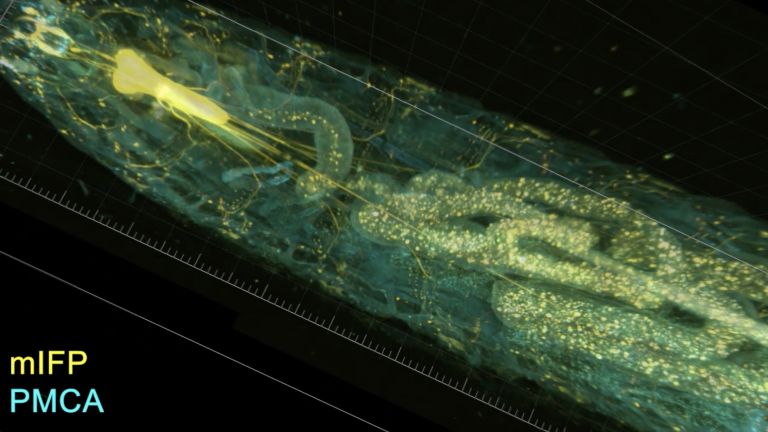
Learning on a Pinhead
When it comes to learning, fruit flies are true masters of association.
19.01.2026
-
- Basics
- Structure and Function
The Nervous System – A Master of Adaptation
The adult brain, too, is constantly restructuring itself, thereby enabling lifelong learning.
05.05.2026
-
- Basics
- The Developing Brain
Where on Earth did She get that from?
Nature or nurture – which has a greater influence on our children?
18.03.2026
-
- Act
- Motor Skills
Learn to Juggle: Train your Brain
The brain changes depending on the demands placed on it—for example, juggling. Join in!
30.08.2011
-
- Topic
Motor Skills
Without movement, life is meaningless. We are made for it, from head to toe.
-
- Glossary
Dendritic spines
Mushroom- or button-shaped protrusions on dendrites, at the tip of which there is usually a synapse, which is the site of communication between two nerve cells. The spines increase the surface area of dendrites, which thus have space for additional synapses. They play an important role in synaptic plasticity. The dendritic spines can swell and shrink depending on activation.
-
- Glossary
NMDA receptor
NMDA receptors are specialized receptor channels in the membrane of nerve cells that only open under very specific conditions. First, the neurotransmitter glutamate must bind to the receptor, and second, the receptor needs a cofactor such as glycine or D-serine. In addition, the postsynaptic cell membrane must be depolarized so that the magnesium ion (Mg²⁺) normally located in the channel pore is removed. If these conditions are met, an ion channel opens in the center of the receptor and allows calcium ions (Ca²⁺) in particular, but also sodium ions (Na⁺), to flow into the cell, while potassium ions (K⁺) flow out of the cell. The cell can respond to the influx of calcium in a variety of ways. NMDA receptors enable the brain to modify synaptic connections throughout life. They are crucial for forms of synaptic plasticity such as long-term potentiation (LTP) and long-term depression (LTD) and thus play a central role in the formation and storage of memory content.
-
- Glossary
Pain memory
Acute pain can become chronic if it persists for a long time or if the nervous system becomes permanently sensitized. Due to its plasticity, the nervous system can then react to even slight stimuli with pain, even if these would normally be harmless.
-
- News
- Question to the brain
Do we only use a Fraction of our Brain?
I read that we only use 10 or 25 percent of our brain capacity. Is that true?
12.08.2025
-
- News from the Institutes
A surprising discovery: songbirds have lost the ”hunger hormone” ghrelin
Groundbreaking work on bird physiology with important findings for humans
28.03.2025