Search
-
- Glossary
Eye
The eye is the sensory organ responsible for perceiving light stimuli – electromagnetic radiation within a specific frequency range. The light visible to humans lies in the range between 380 and 780 nanometers.
-
- Glossary
Eyeball layers
The layers of the eye form the wall of the eyeball. They can be roughly divided into three areas: the outer membrane with the cornea and sclera, the middle membrane with the iris, choroid, and ciliary body, and the inner membrane with the photoreceptive and blind parts of the retina.
-
- Glossary
Outer hair cell
Outer and inner hair cells are sensory cells for acoustic signals in the organ of Corti. At their tips, they have hair-like projections called stereocilia, which are connected to each other and, in the case of the outer hair cells, also to the tectorial membrane. The three rows of outer hair cells filter acoustic signals and act as a cochlear amplifier: without them, our hearing sensitivity would be reduced by about 50 dB.
-
- Glossary
Autism
A serious developmental disorder that often manifests itself in reduced social skills, impaired communication, and stereotypical behavior. Today, it is understood to be part of the autism spectrum disorders.
-
- Glossary
Autonomic nervous system
The part of the nervous system that primarily controls unconscious vital functions such as breathing, heartbeat, and blood pressure. The autonomic nervous system is divided into the sympathetic nervous system, which is active in performance and stress situations, and the parasympathetic nervous system, which is active during rest and recovery phases. In some cases, the enteric nervous system, which is responsible for gastrointestinal functions, is also considered part of the autonomic nervous system.
-
- Glossary
Axon
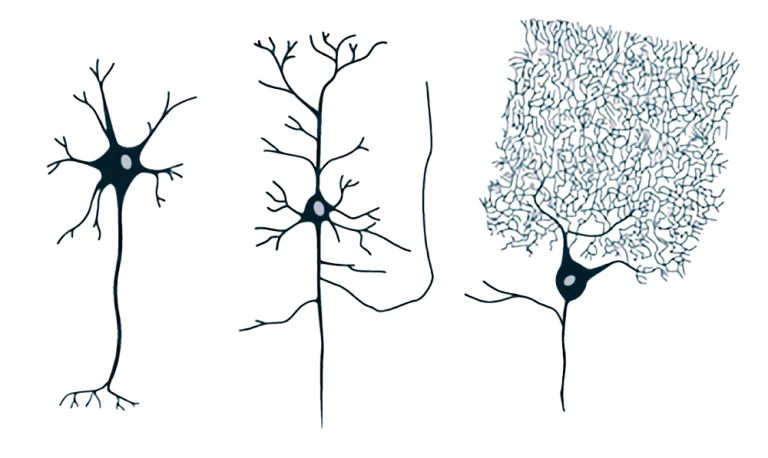
The axon is the extension of the nerve cell that is responsible for conducting nerve impulses to the next cell. An axon can branch out many times, reaching a large number of downstream nerve cells. It can be more than a meter long. The axon ends in one or more synapses.
-
- Glossary
Basal ganglia
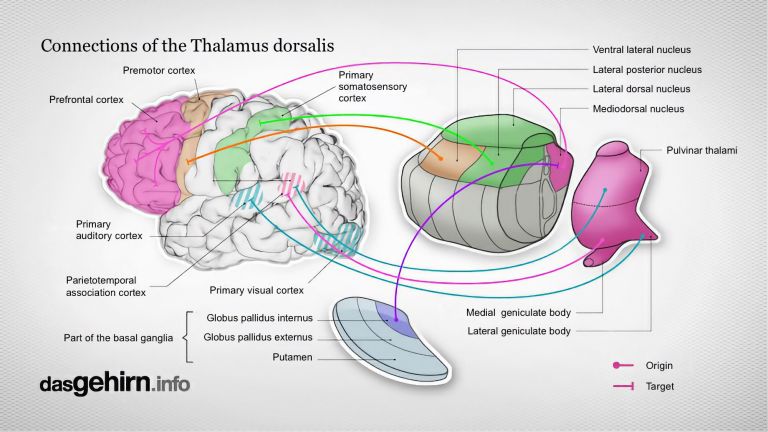
The basal ganglia are a group of subcortical nuclei (located beneath the cerebral cortex) in the telencephalon. The basal ganglia include the globus pallidus and the striatum, and, depending on the author, other structures such as the substantia nigra and the subthalamic nucleus. The basal ganglia are primarily associated with voluntary motor function, but they also influence motivation, learning, and emotion.
-
- Glossary
Basilar membrane
The basilar membrane runs through the cochlea for a length of approximately 34 mm. It is stretched like the string of a violin, narrow and stiff at the base and wider and more flexible at the apex. Incoming sound frequencies cause it to vibrate. This movement is picked up by the hair cells in the organ of Corti and converted into nerve impulses.
-
- Glossary
Basic emotions
Some theories assume that all emotions can be broken down into a few basic emotions. These are also referred to as primary emotions. According to Ekman, these classically include fear, anger, joy, sadness, disgust, and surprise. Primary emotions arise very quickly in response to an event and sometimes subside just as quickly. Over time, they can transition into secondary emotions (e.g., shame, guilt, or pride).
-
- Glossary
Stress disorder
In psychology, stress disorder refers to the pathological reaction to prolonged or short-term extreme stress, such as trauma. A distinction is made between acute stress disorder, also known as a nervous breakdown, and post-traumatic stress disorder. In both cases, the symptoms are the same, although in acute stress disorder they do not last longer than four weeks.