The Anatomy of Fragrance
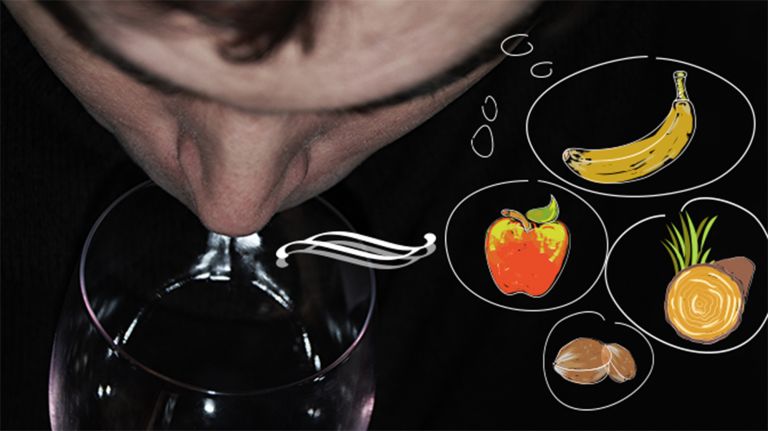
It couldn't be more direct: When a scent reaches the nose, it travels directly to the olfactory bulb in the brain. Here, various scent information is blended into an overall impression.
Wissenschaftliche Betreuung: Prof. Dr. Frank Zufall, Prof. Dr. Marc Spehr
Veröffentlicht: 06.08.2018
Niveau: mittel
- Duft setzt sich aus chemischen Molekülen zusammen, die sich an die Geruchsrezeptoren der Riechzellen im Riechepithel der Nasenhöhle heften.
- Die Riechzellen reichen bis in den Riechkolben des Gehirns. Die Geruchsinformation rast daher auf direktem Weg dorthin.
- Im Riechkolben wird die Geruchsinformation, vieler einzelner Duftmoleküle zu einem Gesamteindruck zusammengesetzt. Dabei entstehen charakteristische räumliche Aktivierungsmuster, so genannte sensorische Karten.
In der Tierwelt geht es auch in Sachen Sex immer der Nase nach. Viele Wirbeltiere besitzen dafür ein eigenes Organ, das sich im olfaktorischen System befindet: Das Vomeronasalorgan, auch “Jacobson-Organ” genannt. Es handelt sich dabei um eine separate chemisch sensitive Region in der Nasenhöhle, deren Sinneszellen mit speziellen Geruchsrezeptoren bestückt sind. Die Sinneszellen des Vomeronasalorgans werden von Pheromonen stimuliert, bestimmte Geruchssignale, die der Kommunikation dienen. Sie signalisieren beispielsweise, in welcher hierarchischen Position sich ein Tier befindet oder ob es paarungsbereit ist. Die Informationen gelangen dann über den akzessorischen Riechkolben zum Hypothalamus.
Beim Menschen entsteht das Vomeronasalorgan im Verlauf der Embryonalentwicklung, bildet sich dann aber bis auf einen rudimentären Rest zurück. Bei manchen lassen sich die Überbleibsel dieses Organs als winzige Einbuchtung rechts und links der Nasenscheidewand ausmachen, die in einen blinden Schlauch münden. Bei anderen findet man diese Öffnungen nicht. Die Funktion eines solchen Organs ist beim Menschen höchst umstritten – was nicht heißt, dass wir für Duftbotschaften völlig unempfänglich sind: Sehr junge Säuglinge erkennen etwa ihre Mutter und deren Brust am Geruch. Außerdem zeigen Versuche, bei denen sich der Zyklus von Frauen allein über – nicht einmal wahrnehmbare – Duftproben von Geschlechtsgenossinnen mit deren Zyklus synchronisiert, dass auch beim Menschen Pheromone eine gewisse Wirkung tun. Ein Vomeronasalorgan ist dafür offensichtlich nicht nötig, die Riechschleimhaut genügt.
Mmm, what a wonderful smell – a piece of fresh bread, accompanied by a mature French cheese and a glass of dark red wine. The smell of food we like alone awakens our desire for it. It helps us to identify it, but also to recognize whether it is digestible or perhaps harmful to our health. Anything that smells rotten or like spoiled meat evokes disgust and warns us not to eat it. An unpleasant smell can also be a warning if there is danger in a room, for example if there is smoke in the air or a foul smell of feces.
The smell itself – whether pleasant or disgusting – is a chemical stimulus. It consists of small molecules in the air that encounter our olfactory organ when we inhale. Incidentally, this is not, as is often mistakenly assumed, the nose. Rather, the nose is a gateway to the world of smell: when we inhale, it draws in air from the environment and transports it to the olfactory epithelium, a fine layer of cells at the top of the main nasal cavity. The human olfactory epithelium measures around 10 square centimeters. This is comparatively small: dogs, for example, have up to 170 square centimeters, depending on the breed, and also have over 100 times more receptor cells per square centimeter than Homo sapiens.
![Der Mensch riecht nicht mit der ganzen Nase. Sie ist nur ein Kamin, der die eingeatmete Luft zum eigentlichen Sinneszentrum leitet – dem Riechepithel. Grafikerin: Meike Ufer [nach Bear, Connors, Paradiso 2009]](https://www.thebrain.info/sites/default/files/styles/scale_768_w/public/images/1_6_2_Anatomie_des_Duftes_Download.jpg?itok=XZtQ8Ovl)
Three cell types for scent
The olfactory epithelium consists mainly of three different cell types: in addition to the actual olfactory cells, there are supporting cells and basal cells, from which a constant supply of new olfactory cells matures. These cells only have a lifespan of a few weeks, then die and are replaced by new olfactory cells.
Contrary to what the name suggests, the supporting cells also play an important role in smelling. Among other things, they determine the composition of the mucus in which the scent molecules from the inhaled air dissolve before they reach the olfactory receptors. In addition, the mucus protects the brain from bacteria and viruses that could enter via the olfactory epithelium thanks to the antibodies it contains.
However, the main players are the olfactory cells, also known as olfactory receptor neurons, which transmit odor information directly to the central nervous system (CNS). They have long, thin cilia at one end, which originate from a terminal thickening. The cilia are covered with odor receptors and protrude into the mucus of the olfactory epithelium. There, they come into contact with the scent molecules dissolved in it. When these molecules attach themselves to the odor receptors, depolarization of the membrane occurs: positively charged sodium and calcium ions flow into the cell, while negatively charged chloride ions flow out. This changes the electrical properties of the cell. The chemical stimulus becomes an electrical one, which races through the axon toward the CNS in the form of an action potential.
US researchers Linda Buck and Richard Axel, who were awarded the 2004 Nobel Prize in Physiology or Medicine for their research on the olfactory system, discovered in 1991 that rats have more than 1,000 different genes for odor receptors. Each gene encodes the blueprint for a receptor that differs from all other scent receptors and recognizes only very specific scent molecules. The human olfactory organ is less well equipped, with around 380 different functional receptor genes and a corresponding number of receptor types. The rest were lost in the course of evolution and are now only found in the genome in the form of non-functional pseudogenes.
Only one of these genes is expressed in each olfactory cell, so that the olfactory epithelium has a whole range of different sensory cells, each responsible for a small group of scent molecules.




Direct line to the brain
The olfactory axons of all olfactory cells together form the olfactory nerve. However, unlike other nerve cells, they do not bundle together, but instead penetrate the cribriform plate, a fine porous layer of bone bordering the olfactory epithelium, as small groups of axons. From here, they continue to the two olfactory bulbs (bulbi olfactori, singular bulbus olfactorius), protrusions of the brain. The entry points into the olfactory bulbs are the glomeruli, spherical structures. In rats, each olfactory bulb contains around 2,000 glomeruli – in humans, there are even more, although the exact number is unknown. This is where the primary olfactory neurons converge and transmit their odor information to the secondary olfactory neurons, the so-called mitral cells – strictly separated according to receptor type. Each glomerulus therefore selectively receives information about a very specific type of odor molecule.
The mitral cells then sort the odor information and project it directly to the olfactory cortex and several neighboring structures in the temporal lobe, including the emotional center, the amygdala. The olfactory information then reaches downstream brain regions, which link the scent to emotions, pleasure, or motivational functions and store it in memory.
But how is it possible that only 380 genes can lead us into such a rich and diverse sensory world of scents? After all, humans also recognize an almost infinite variety of different smells. Nobel Prize winners Buck and Axel, as well as many other research groups, have contributed to finally solving this mystery: they have discovered that the olfactory bulb acts as a kind of mixing console where scent combinations are put together. This is referred to as the ensemble code.
At the scent mixing console
Most natural scents are composed of several components. When we smell an apple, various molecules float through the air, combining to create this scent. They dock onto the corresponding receptors in the olfactory epithelium and send the information to the associated glomeruli in the olfactory bulb. This creates characteristic spatial activation patterns, known as sensory maps. The scent of an apple clearly differs from the patterns for the scent of roses, vanilla crescent cookies, or the stench of rotten fish.
“The olfactory bulb creates a fingerprint for each smell, which is then processed in the higher regions of the brain,” explains Amir Madany, who studies odor perception at the Institute for Neuro- and Bioinformatics at the University of Lübeck. “The olfactory bulb serves as an amplifier of olfactory information and synchronizes its individual components.” This is because when the scent of apples reaches the nose, the individual scent molecules do not dock onto the corresponding receptors at the same time. “The stimulus is kept active in the olfactory bulb for a while so that the brain can process the overall impression.”
Madany himself is working on olfactory maps of a completely different kind. He creates so-called perception maps. To do this, he has test subjects sniff different scent samples and describe them using a predefined list of words. Is the smell pleasant or unpleasant? Does it smell fruity? And if so, does it smell more like apple or banana? In this way, he was able to prove that around 30 factors are necessary to describe all the smell categories in which humans consciously perceive smells.
“First and foremost is the category ‘pleasant or unpleasant’, which allows a quick decision to be made about ‘edible or inedible’ – but that was already clear to the philosophers of antiquity,” he says with a laugh. Madany is fairly certain that the second category is “nutty” or “not nutty,” which also helps to locate certain food sources. However, a lot of research still needs to be done to establish a definitive ranking that covers all categories.
First published on November 27, 2013
Last updated on July 3, 2025