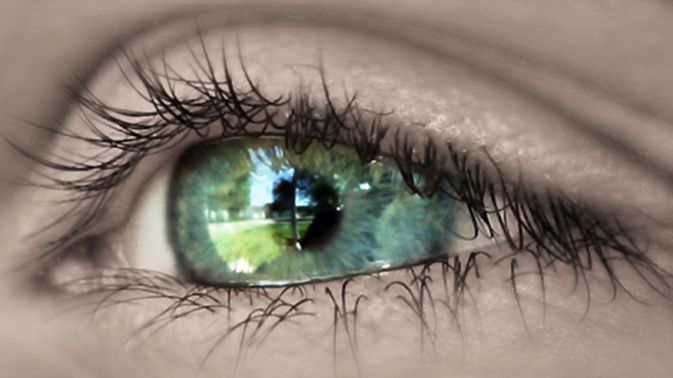
Vision - The gateway to the world
Thus the sense of sight is the most important sensory system of the human being. And also the one that science pays the most Attention to. Although the operation of the enormously complex Visual system has not yet been understood down to the last detail, our focus shows what we know.
There you will learn everything about the eye, Retina and the brain areas in which visual Perception ultimately develops. If you want to know why colours do not look the same for everyone, then this is the right place for those interested in the history of science, because our author Tanja Krämer has embarked on a journey through visual theories. For cineasts we reveal the secret of moving images - and with moving images we present the different modalities of seeing. Or would you like to become acquainted with the astonishing phenomenon of afterimages? You can get this and more in the lab.
Seeing - (not) a natural wonder. An introduction.
Attention
Attention
Attention serves as a tool for consciously perceiving internal and external stimuli. We achieve this by focusing our mental resources on a limited number of stimuli or pieces of information. While some stimuli automatically attract our attention, we can select others in a controlled manner. The brain also unconsciously processes stimuli that are not currently the focus of our attention.
Visual system
The visual system is the part of the nervous system that processes visual information. It primarily comprises the eye, the optic nerve, the optic chiasm, the optic tract, the lateral geniculate nucleus, the optic radiation, the primary visual cortex, and the visual association cortices.
Retina
The retina is the inner layer of the eye covered with pigment epithelium. The retina is characterized by an inverse (reversed) arrangement: light must first pass through several layers before it hits the photoreceptors (cones and rods). The signals from the photoreceptors are transmitted via the optic nerve to the processing areas of the brain. The reason for the inverse arrangement is the evolutionary development of the retina, which is a protrusion of the brain.
The retina is approximately 0.2 to 0.5 mm thick.
Perception
The term describes the complex process of gathering and processing information from stimuli in the environment and from the internal states of a living being. The brain combines the information, which is perceived partly consciously and partly unconsciously, into a subjectively meaningful overall impression. If the data it receives from the sensory organs is insufficient for this, it supplements it with empirical values. This can lead to misinterpretations and explains why we succumb to optical illusions or fall for magic tricks.