Charles Darwin: Icon of Evolutionary Research
“Nothing in biology makes sense except in the light of evolution” – this quote is not from Charles Darwin, but from Theodosius Dobzhansky. However, our brain is a product of evolution as well, and so the father of evolutionary theory cannot be left out. As the gravedigger of creationism, he had stubborn opponents and a turbulent life.
Scientific support: Prof. Dr. Staffan Müller-Wille
Published: 04.01.2018
Difficulty: easy
- Charles Darwin's father wanted him to become a doctor or a clergyman. However, he was bored at school and turned to the natural sciences through self-study.
- At the age of 22, he embarked on a five-year voyage around the world. This journey was decisive for the development of the theory of evolution after Darwin made various observations of the animal world on the Galapagos Islands.
- Darwin had ten children, three of whom died at an early age. This fact, along with his observations of slavery and poverty during his voyage, possibly caused him to lose his Christian faith, but this actually benefited the development of his theory of evolution.
- He was well aware of the controversial potential of his theory with regard to the role of humans in the Bible. As a result, Darwin hesitated for many years to publish the hypotheses he had developed as early as 1839. He finally did so in 1859 with his famous work On the Origin of Species by Means of Natural Selection.
- After the publication of his most important work, Darwin had to contend with harsh criticism, as expected. However, his courage paid off, and his theories are now supported by numerous pieces of evidence.
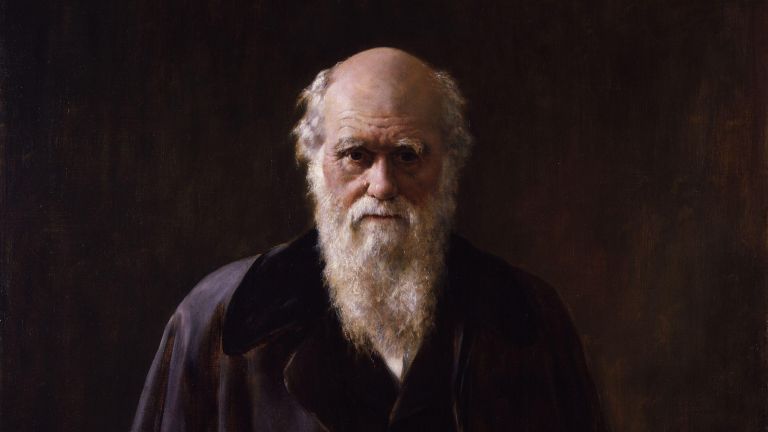
Charles Robert Darwin appears marked by life and slightly concerned in the photo that most likely comes to mind when one hears his name. The expansive white beard and deep furrows on his forehead reveal a man who must have experienced a great deal – and this can rightly be said of the man who shaped our current understanding of evolution and the origin of species like no other.
Childhood and youth
Born on February 12, 1809, in Shrewsbury near Birmingham, England, to physician Robert Darwin and Susannah Wedgwood Darwin (who died when Charles was eight years old), he wanted for nothing in his early childhood. An unremarkable and rather lazy elementary school student, he was raised in a religious household from an early age, which he liked to demonstrate to his fellow passengers on his later research voyage with the HMS Beagle by constantly reciting Bible verses. Even during his school days, he spent a lot of time in nature collecting insects, stones, and shells. Since his father would have liked to see him become a doctor or pastor, Darwin studied medicine and theology in Edinburgh and Cambridge from the age of 16, but also studied natural history and Alexander von Humboldt's descriptions of his travels in South America. Ultimately, the career options suggested by his father did not appeal to him.
Voyage with the HMS Beagle
From 1831 to 1836, he embarked on his fateful voyage with the HMS Beagle, a Royal Navy sailing ship just 28 meters long that had been converted for surveying purposes. Darwin traveled at his own expense, although Captain Robert FitzRoy had previously expressed a desire to have a geologist on board. The stated goal of the expedition was to survey the South American coast for military and commercial nautical charts, which was originally planned to take two years; in the end, it took five. The voyage began in Plymouth, took them via the Azores to South America and around the entire continent, to the Galapagos, around Australia and South Africa, and back to Falmouth, England.
Along the way, Darwin encountered Galapagos tortoises and finches (which are now named after him), whose adaptive radiation – that is, Adaptation to different habitats through slight species differences – particularly fascinated him. Darwin not only made observations about animals and plants but also explored geological formations. On his first shore leave after 20 days on the Cape Verde island of Santiago, he saw evidence of Charles Lyell's theories on the formation of the Earth in the form of layers of shells in the rock. Darwin had taken Lyell's book Principles of Geology with him on the voyage.
In the living environment, however, finches, mockingbirds, and turtles later gave him particular food for thought. This was because, according to anecdotes from Galapagos residents, they differed slightly from island to island and could be precisely assigned to a specific island based on their characteristics (e.g., plumage color or shell shape). At this point, Darwin began to doubt the idea of his contemporary Jean-Baptiste de Lamarck, according to which different species merged into one another through “transmutation” and the inheritance of acquired characteristics.
Darwin began to develop the concept of natural selection, according to which the various species he observed must have evolved from a common ancestor through evolutionary pressure. Unfortunately, during the voyage, it became apparent that Darwin would not become a great fan of sea travel – from the outset, he was uncomfortable with the ship's motion, and the dangerous passage around Cape Horn, which is still considered a test of courage for sailors today, made him severely seasick and was probably one of the reasons why he did not undertake a second major research voyage by ship.
Adaptation
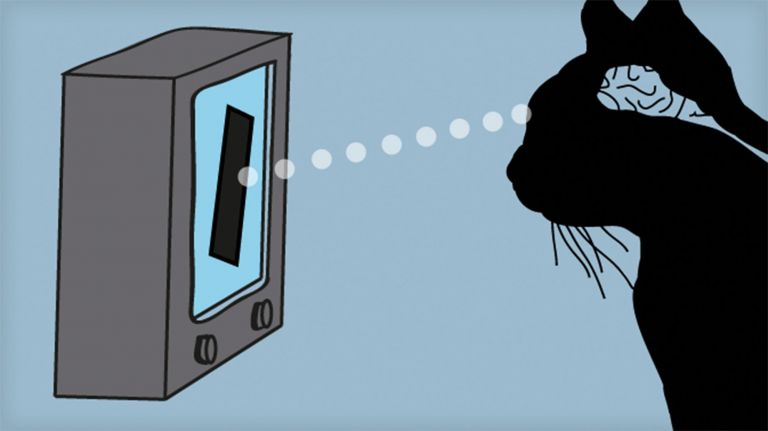
Adaptation refers to the process by which the sensory organs, the perceptual system, or the entire organism adjusts to the intensity and quality of stimuli and to changes in environmental conditions. In visual adaptation, for example, the pupil and the sensitivity of the photoreceptors regulate themselves according to the prevailing light conditions.
Publications and recognition of his work
Fortunately, this was not necessary: based on his numerous collections and experiences, Darwin published the travelogue The Voyage of the Beagle in 1839, which earned him initial recognition for his work and early fame. In the same year, he married his cousin Emma Wedgwood, with whom he fathered an impressive ten children – three of whom died at an early age, however. The death of his ten-year-old daughter Anne in 1851 due to illness shook his Christian faith in particular. In addition, his observations of slavery and the miserable living conditions of the inhabitants of various parts of the world led Darwin to take a more critical look at his religiosity. For a long time, his observations on the origin of species, together with his dwindling faith, seemed too risky to publish, and he struggled with self-doubt about writing a new book.
Nevertheless, in 1859 he finally published his (r)evolutionary treatise On the Origin of Species by Means of Natural Selection, which became an overnight bestseller. It turned the role of humans in nature and the history of creation upside down. Caricatures and ridicule from his contemporaries were therefore inevitable. In a well-known drawing, Darwin himself was depicted as a monkey, among other things. But his courage paid off. Today, Darwin's theory of evolution is the most widely accepted explanation among scientists for the origin and diversity of species.
Death and aftermath
Darwin died of a heart attack in London on April 19, 1882. In 2006, a Galapagos tortoise named Harriet, possibly the last contemporary witness, followed him. According to controversial reports, the great explorer is said to have personally collected her and brought her to England.
What is undisputed, however, is Darwin's significance as one of the most important scientists of all time. This reverence is reflected, for example, in the name of the Australian city of Darwin, which was named after him by former traveling companions. Numerous newly discovered species also bear Darwin's name in their genus or species designation, such as the Darwin's frog Rhinoderma darwinii or the Darwin's finches, whose beak shape, adapted to their respective food sources, provides important evidence for the theory of evolution.
Darwin would probably have taken even greater satisfaction in a statement by the Anglican Church of England, published shortly before his 200th birthday. In it, the church relativized its earlier rejection of Darwin's theory, describing it as regrettable, similar to the demonization of Galileo Galilei's findings. Even the Vatican has since announced that the theory of evolution is not incompatible with the values of the Church, since key Christian figures such as Augustine of Hippo and Thomas Aquinas had already made observations similar to those of Darwin in the Middle Ages and before.
The “Darwin Awards” might also have amused the forefather of evolutionary theory: this sarcastic award is given on a website to people who injure or even kill themselves through outstanding stupidity, thereby “contributing to the improvement of our Gene pool by removing themselves from it.”
Gene
Information unit on DNA. Specialized enzymes translate the core component of a gene into ribonucleic acid (RNA). While some ribonucleic acids perform important functions in the cell themselves, others specify the order in which the cell should assemble individual amino acids into a specific protein. The gene thus provides the code for this protein. In addition, a gene also includes regulatory elements on the DNA that ensure that the gene is read exactly when the cell or organism actually needs its product.