The Challenge of Caring for Dementia Patients
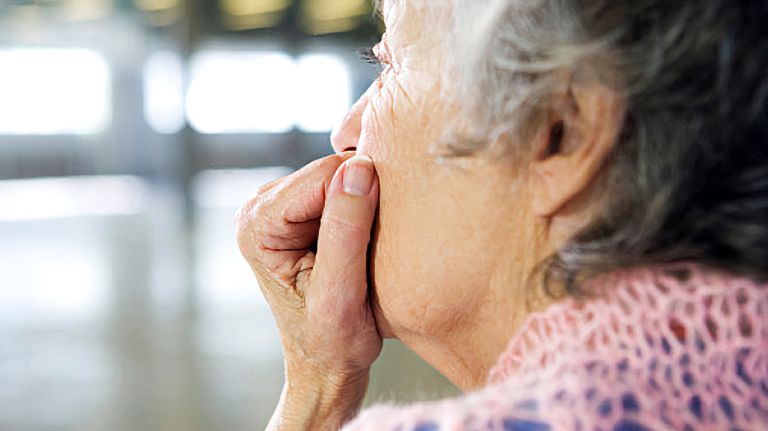
There are currently about 1.8 million people with dementia in Germany, and this number will continue to rise as the population ages. Providing them with appropriate care in hospitals poses significant challenges. A radical shift in thinking is necessary.
Scientific support: Dr. Oliver H. Peters
Published: 11.01.2012
Difficulty: intermediate
- There are currently about 1.8 million people living with Dementia in Germany; by 2050, this number is expected to reach about 2.5 million.
- In hospitals today, one in two patients is already in the 65-plus age group, and the proportion of patients with dementia is estimated at 15 percent, with an upward trend.
- General hospitals are still inadequately equipped to handle the specific needs of dementia patients: While the business-oriented flat-rate payment system has been adjusted and a care budget introduced, critics argue that the increased need for care is still not sufficiently addressed.
Dementia
Dementia
Dementia is an acquired deficit of cognitive, social, motor, and emotional abilities. The most well-known form is Alzheimer's disease. "De mentia" means "without mind" in English.
When an emergency patient is admitted to the hospital where Thomas Wichterei works as a nurse, everything has to happen very quickly: The ambulance pulls up with sirens blaring and lights flashing, the patient is rushed on a stretcher into a treatment room, and doctors and nursing staff shout instructions to one another. This is stressful for everyone involved – and especially for people with dementia, says Wichterei: “For them, it’s an absolute disaster to arrive at a neon-lit emergency room where dozens of unfamiliar faces are rushing around them and people who haven’t introduced themselves start undressing them.” More and more people with Dementia are having this experience. That’s because their share as hospital patients is growing.
Estimates put the figure at around 15 percent at present. Exact numbers are not yet available, partly because dementia is often only a secondary diagnosis that is not documented. But the trend is clear: it is rising rapidly. According to the German Alzheimer’s Association, 1.8 million people in Germany currently live with dementia. By 2050, forecasts predict this number will reach 2.5 million. The reason for the increase is rising life expectancy. Dementia typically begins to appear between the ages of 60 and 65, but from that point on, the likelihood of developing the disease increases with each passing year, rising sharply after age 80. And because people are living longer and longer, the number of people with dementia will also grow. Are hospitals – where already one in two patients belongs to the 65-plus age group – prepared for this development?
Dementia
Dementia
Dementia is an acquired deficit of cognitive, social, motor, and emotional abilities. The most well-known form is Alzheimer's disease. "De mentia" means "without mind" in English.
Zero minutes for people with dementia
Thomas Wichterei, who is increasingly caring for patients with a secondary diagnosis of Dementia in the cardiac intensive care unit, doesn’t have to think long to answer that question. He spends seven of his eight-hour daily shift on basic care, nutrition, and medical tasks such as administering medication or organizing tests for all his patients. Another hour goes toward documenting his work. “That leaves zero minutes to address the specific needs of a dementia patient.”
Irmtraud Schmidt can confirm this. Her late husband suffered from dementia.
She witnessed the various stages of the disease firsthand – from the initially gradual decline in mental capacity to the almost complete breakdown of Memory and personality. At first, she recalls, he simply couldn’t find the right words now and then during conversations. “We others would just quickly finish his sentences without giving it much thought.”
But her husband became increasingly “forgetful” and more helpless in daily life. Then came the diagnosis: dementia. After that, things went rapidly downhill: He lost his sense of place and time, got lost more and more often, confused night and day, and increasingly forgot how to speak. His wife cared for him at home, at first alone, then with the help of a home care service, “because it was no longer manageable otherwise.” But Mr. Schmidt had to go to the hospital twice, once to adjust his medication and once because of a high fever. “Those hospital stays were the worst thing we’ve ever experienced,” says Irmtraud Schmidt.
Dementia
Dementia
Dementia is an acquired deficit of cognitive, social, motor, and emotional abilities. The most well-known form is Alzheimer's disease. "De mentia" means "without mind" in English.
Memory
Memory is a generic term for all types of information storage in the organism. In addition to pure retention, this also includes the absorption of information, its organization, and retrieval.
Dementia
Dementia
Dementia is an acquired deficit of cognitive, social, motor, and emotional abilities. The most well-known form is Alzheimer's disease. "De mentia" means "without mind" in English.
Increased care demands
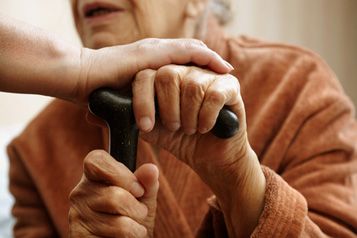
For hospital staff, Dementia patients are problematic, especially the severe cases. The patients no longer know what an alarm bell is and cannot communicate. They forget to drink. Simply placing a glass of water on the nightstand isn’t enough – they don’t see the liquid; it must be colored with orange juice. Especially at night, when the wards are even more understaffed than usual, dementia patients become active and wander through the building. The unfamiliar surroundings frighten them; some become aggressive and resist treatment. Patience is required. “Feeding, for example, takes five times longer than with other patients,” says nurse Thomas Wichterei.
But he doesn’t have that time, nor is it allocated. Because although the business-oriented flat-rate payment system has been adjusted and a care budget introduced, the problem remains unsolved. The result: The patient must be adapted to the procedures. In severe cases, this means: “He is given medication that sedates him,” reports Wichterei.
Sabine Kirchen-Peters, who studies the care of people with dementia in acute care hospitals at the Saarbrücken Institute for Social Research and Social Economics, also draws a somewhat negative conclusion: “The problems encountered during treatment are sometimes addressed with sedation and restraints in order to maintain the routines of daily ward life,” the researcher noted as early as 2012 in a report to the German Alzheimer’s Association. “For those affected, this generally means a further loss of independence, a deterioration in cognitive status, and the onset or intensification of secondary dementia symptoms.”
Because people with dementia need plenty of mental and physical stimulation and activity – otherwise, their condition deteriorates even faster. Irmtraud Schmidt’s husband, too, lost the daily living skills he had previously possessed while in the hospital. Going to the bathroom, for example. “We were there as often as possible and took care of him. We showered him and brushed his teeth, and took him to the bathroom because that wasn’t being done.” But the family members couldn’t always be there – not at night, for example. And so the nursing staff put diapers on Mr. Schmidt – and within two weeks, he became incontinent. The relationship between the family and the nursing staff was correspondingly tense: While both sides had a certain degree of understanding for one another, Irmtraud Schmidt, who cared for her husband at home around the clock, was outraged by the shortcomings, and the nurses – constantly under time pressure – were at times annoyed by the concerned wife.
Dementia
Dementia
Dementia is an acquired deficit of cognitive, social, motor, and emotional abilities. The most well-known form is Alzheimer's disease. "De mentia" means "without mind" in English.
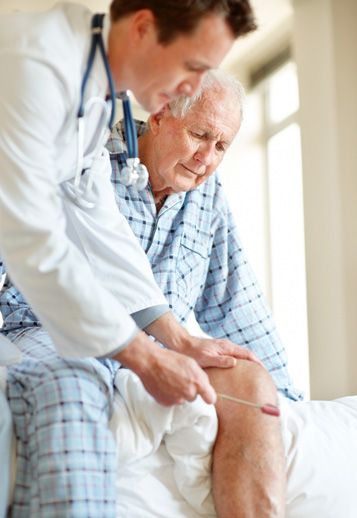
Dementia
Dementia
Dementia is an acquired deficit of cognitive, social, motor, and emotional abilities. The most well-known form is Alzheimer's disease. "De mentia" means "without mind" in English.


There is another way
Better involvement of family members could be a way out of this dilemma, says Albert Diefenbacher, chief physician at the Evangelical Queen Elisabeth Herzberge Hospital in Berlin. For years, he has been exploring how to address the growing challenge of Dementia in hospitals – an issue that few hospitals are currently tackling: “In many cases, it’s still like a rabbit facing a snake – people deny the problem.” Diefenbacher heads two geriatric psychiatric wards with many patients suffering from dementia. Here, he is trying to implement on a small scale what he considers the foundation for solving the problem: greater understanding of the unique aspects of caring for people with dementia. For example, photos of the caregivers are hung on the walls to foster a more familiar relationship. And there is a so-called “Snoezelen room” with a waterbed, soft music, and warm lighting – for relaxation and calm. Although 17 patients are cared for by just two or three nurses here as well, they – like the attending physicians – are specialized in this clinical picture. To ensure that this expertise reaches the rest of the hospital, a so-called consultation service has been established: The geriatric psychiatrists visit the traditional wards and advise surgeons or internists on patients with dementia.
In the medium term, however, Diefenbacher is banking on a more far-reaching concept: the establishment of specialized wards. The key feature of these specialized wards is that they are interdisciplinary. “There, the surgeon can treat the surgical patient, and the internist the medical one. But the foundation and heart of such a ward is the nursing staff specially trained to care for patients with dementia.” A common objection: the costs. Diefenbacher only partially accepts this: his two wards, for example, were financed by converting beds from traditional wards into geriatric ones. Where there’s a will, there’s a way. In the long term, demographic trends could profoundly change the hospital as we know it today. Diefenbacher cautiously articulates a vision: “To the extent that younger patients will likely be treated on an outpatient basis much more frequently than is currently the case, perhaps a goal could be to say: Hospitals are essentially there for older patients and must therefore fundamentally adapt to the needs of the elderly – and then perhaps offer a few special services for the younger ones.” But that is really still a long way off.
Dementia
Dementia
Dementia is an acquired deficit of cognitive, social, motor, and emotional abilities. The most well-known form is Alzheimer's disease. "De mentia" means "without mind" in English.
“We must learn to live with dementia”
Dementia
Dementia
Dementia is an acquired deficit of cognitive, social, motor, and emotional abilities. The most well-known form is Alzheimer's disease. "De mentia" means "without mind" in English.
Further reading
- Demenz-Report des Berlin-Institut für Bevölkerung und Entwicklung; URL: http://www.berlin-institut.org/fileadmin/user_upload/Demenz/Demenz_online.pdf [Stand: 2011]; zur Webseite.