
The Spinal Cord
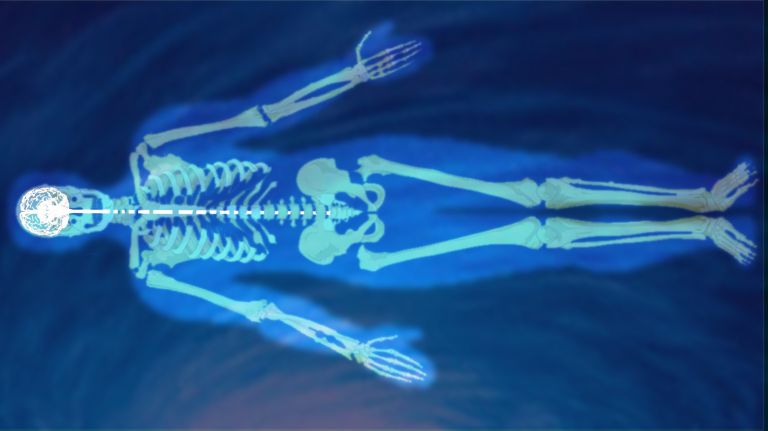
Perceiving, thinking, acting – what defines us are the abilities of our brain. These are important abilities, no question, but reducing Perception and action to the brain borders on discrimination. Even we reveal ourselves to be brain snobs with our name, thebrain.info. This is a fact that Spinal cord expert Nobert Weidner gently pointed out to us.
After all, the central nervous system comprises the brain AND the spinal cord. This is where all connections to and from the brain run: whenever the stomach growls or the foot hits the ball, i.e., when sensory and motor functions are involved, nothing works without the spinal cord. And it's not just a matter of cables running up and down – the spinal cord can do much more than that...
Nora Schulz provides an initial insight into the fascinating anatomy of the centipede with a horse's tail, and Christian Wolf reports on the often fatal consequences when the bridge between the head and the bodybecomes fragile.
Perception
The term describes the complex process of gathering and processing information from stimuli in the environment and from the internal states of a living being. The brain combines the information, which is perceived partly consciously and partly unconsciously, into a subjectively meaningful overall impression. If the data it receives from the sensory organs is insufficient for this, it supplements it with empirical values. This can lead to misinterpretations and explains why we succumb to optical illusions or fall for magic tricks.
Spinal cord
medulla spinalis
The spinal cord is the part of the central nervous system located in the spine. It contains both the white matter of the nerve fibers and the gray matter of the cell nuclei. Simple reflexes such as the knee-jerk reflex are already processed here, as sensory and motor neurons are directly connected. The spinal cord is divided into the cervical, thoracic, lumbar, and sacral spinal cord.