The Heart-Brain Connection

The brain and heart have a massive influence on each other. Our perception – and even our tendency to form prejudices – changes with our heartbeat. Conversely, emotional distress and neurological disorders affect heart health.
Scientific support: Prof. Dr. Hugo Marti
Published: 01.10.2022
Difficulty: easy
- The heart and brain communicate with each other via the Autonomic nervous system and neurotransmitters.
- There is a representation of the heart in the brain: The heartbeat is represented there via the heartbeat-evoked potential (HEP).
- The heartbeat influences the Perception of tactile stimuli and our tendency toward prejudice.
- Neurological disorders can also impair heart health.
- Psychological stress can sometimes also affect heart function.
Autonomic nervous system
The part of the nervous system that primarily controls unconscious vital functions such as breathing, heartbeat, and blood pressure. The autonomic nervous system is divided into the sympathetic nervous system, which is active in performance and stress situations, and the parasympathetic nervous system, which is active during rest and recovery phases. In some cases, the enteric nervous system, which is responsible for gastrointestinal functions, is also considered part of the autonomic nervous system.
Perception
The term describes the complex process of gathering and processing information from stimuli in the environment and from the internal states of a living being. The brain combines the information, which is perceived partly consciously and partly unconsciously, into a subjectively meaningful overall impression. If the data it receives from the sensory organs is insufficient for this, it supplements it with empirical values. This can lead to misinterpretations and explains why we succumb to optical illusions or fall for magic tricks.
“It is only with the heart that one can see rightly,” as stated in the story The Little Prince by Antoine de Saint-Exupéry. Medically speaking, however, the statement seems paradoxical at first; after all, we perceive visual impressions with our eyes. Ultimately, though, the author was using a metaphor, not discussing physiology. And yet there is also a grain of medical truth in the statement. The heartbeat influences blood flow to the brain and thus the processing of all sensory perceptions. Nerve cells have the highest nutrient and oxygen consumption in the body and are particularly dependent on the heart for their supply. People with heart failure therefore always suffer cognitively as well. They have more difficulty concentrating and tire more quickly. Sometimes their eyes close while they’re reading a book.
The 85 men had no idea they’d agreed to an experiment that would later find its way into psychology textbooks. Some of them crossed the Canadian Capilano Canyon on a sturdy wooden bridge. Another group had to reach the other side via a swaying suspension bridge. During this terrifying crossing, they could hold on to only two steel cables. To the left and right, the drop was 70 meters.
An attractive woman was waiting in the middle of each of the two bridges. The participants were asked to fill out a questionnaire and write a text in her presence. The woman offered her personal phone number in case of further questions.
With this experiment, Donald Dutton and his colleague Arthur Aron from the University of British Columbia in Vancouver sought to determine whether the thrilling bridge crossing influenced participants’ perceptions of, and behavior toward, the attractive woman.
Weak knees or butterflies in the stomach?
In 1974, the psychologists published their experiment in the Journal of Personality and Social Psychology – with results that still bring a smile to our faces today: One-third of the men the woman encountered on the swaying suspension bridge later called her. After crossing the stable bridge, however, only 11 percent of the men made contact. Apparently, the participants projected their excitement onto the woman and imagined themselves attracted to her. This was also revealed by the texts the men wrote: On the swaying bridge, the messages contained more sexual references.
Psychologists refer to the incorrect attribution of a feeling to an event as “misattribution.” The reason is that weak knees and butterflies in the stomach actually feel similar: In both cases, the heart beats faster and the pulse quickens. One might break out in a sweat.
Now, we don’t fall in love every day, and we certainly don’t regularly walk across a swaying suspension bridge. Yet the communication between the heart and the brain constantly influences our lives.
A consistently steady heartbeat is dangerous
Both organs are, in a sense, connected via a dedicated line: the Autonomic nervous system It’s called “autonomous” because it cannot be directly influenced by our will. It consists of the sympathetic and parasympathetic nervous systems. These two systems are primarily controlled by the brainstem and act as opposites.
The Sympathetic nervous system activates us and triggers the necessary physical responses for fight or flight. For example, it makes our heart beat faster when we’re threatened and increases muscle tone. It causes our face to flush in an embarrassing situation or makes us break into a sweat during a presentation.
The parasympathetic nervous system, on the other hand, calms us down. It slows our breathing and makes our heart beat at a leisurely pace. In this way, relaxation and tension are constantly balanced in a healthy person. As a side effect, the heartbeat is variable. It constantly adapts to the situation at hand. High heart rate variability is considered a sign of a vital heart-brain connection and, ultimately, of good health. “A rigid heart function, on the other hand, is life-threatening and can lead to sudden death,” says neurologist Arno Villringer of the Max Planck Institute for Cognitive and Neuroscience in Leipzig.
Autonomic nervous system
The part of the nervous system that primarily controls unconscious vital functions such as breathing, heartbeat, and blood pressure. The autonomic nervous system is divided into the sympathetic nervous system, which is active in performance and stress situations, and the parasympathetic nervous system, which is active during rest and recovery phases. In some cases, the enteric nervous system, which is responsible for gastrointestinal functions, is also considered part of the autonomic nervous system.
Sympathetic nervous system
Part of the autonomic nervous system, whereby the sympathetic nervous system primarily transmits excitatory impulses – in contrast to its counterpart, the parasympathetic nervous system. For example, the sympathetic nervous system activates respiration, the heart, and circulation, but it also affects the smooth muscles of all internal organs. The sympathetic nervous system uses the neurotransmitters acetylcholine and norepinephrine.
A reflection of the heart in the brain
Villringer is interested in the finely tuned communication between the brain and the heart. To this end, researchers in his group analyze the electrocardiogram and brain waves simultaneously. They compare the patterns of electrical excitation in both organs in detail. It is striking that certain regions of the brain are activated in sync with the heart. A certain harmony emerges between the two organs. This can be measured using what is known as the heartbeat-evoked potential (HEP). As electrical excitation spreads through the heart tissue, leading to contraction of the heart muscle, an electrical voltage is generated. This voltage can be measured in the brain as neural activity. Villringer observed this rhythmic correlation with the heart particularly in the Insula region of the brain. It is, so to speak, a reflection of the beating heart in the brain.
The neurologist believes, however, that the HEP reveals much more. Its amplitude varies from person to person. “We suspect that the brain has two distinct modes. When the HEP is high, one focuses on one’s own body, the inner world. In the second mode, the HEP is low: one turns toward the external world. In an evolutionary context, this involved activities such as foraging and defense,” says Villringer. Another finding supports this interpretation: when the HEP is high, test subjects perceive an external electrical stimulus on their finger as weaker. Conversely, they perceive it more intensely when the HEP is lower. Villringer’s team described this in 2020 in the journal PNAS.
Insula
lobus insularis
The insula is a recessed part of the cortex (cerebral cortex) that is covered by the frontal, temporal, and parietal lobes. This overlay is called the opercula (lid). The insula influences the motor and sensory functions of the intestines and is considered to be the link between cognitive and emotional elements in pain processing. It is also involved in processes such as taste and physical self-awareness.
How heart rate changes thinking and feeling
It is still unclear whether the level of the HEP, and thus the size of the heart’s representation in the brain, depends solely on the situation or is also a personality trait. The only thing that is certain is that the heart’s influence on the brain is so pronounced that even the heartbeat affects Perception and thinking.
Once again, Villringer’s team investigated how strongly participants perceived an electrical stimulus on their finger. When the heart contracts and pumps blood into the body – that is, during the so-called systolic phase – they do not feel the stimulus as intensely. The researchers suspect this may be because, at precisely this moment, receptors in the large blood vessels transmit information about blood pressure to the brain. The flood of information from these so-called baroreceptors apparently takes up a significant portion of the brain’s processing capacity. Impressions from the outside world reach us only in a muted form at this moment. In the subsequent diastolic phase, however, participants register an external electrical stimulus more intensely. During this phase, the heart refills with blood.
This was not the first finding of its kind. According to Villringer, a psychology experiment led by Ruben Azevedo at the University of London yielded what is arguably the most disturbing result regarding the influence of the heartbeat. Azevedo showed 30 participants a rapid succession of photos of faces – either of Black or White men – followed by a weapon or a tool. The participants were asked to determine as quickly as possible whether a tool or a weapon followed a light-skinned or dark-skinned man. The experimenters also monitored the participants’ heartbeats. When the heart contracted and blood flowed into the vessels, the participants significantly more often acted on their prejudice: they attributed a weapon to a Black man. In this phase, the brain is so completely occupied by the baroreceptors that there isn’t enough brain capacity left for critical self-reflection, Azevedo argued in 2016 in Nature Communications.
Perception
The term describes the complex process of gathering and processing information from stimuli in the environment and from the internal states of a living being. The brain combines the information, which is perceived partly consciously and partly unconsciously, into a subjectively meaningful overall impression. If the data it receives from the sensory organs is insufficient for this, it supplements it with empirical values. This can lead to misinterpretations and explains why we succumb to optical illusions or fall for magic tricks.


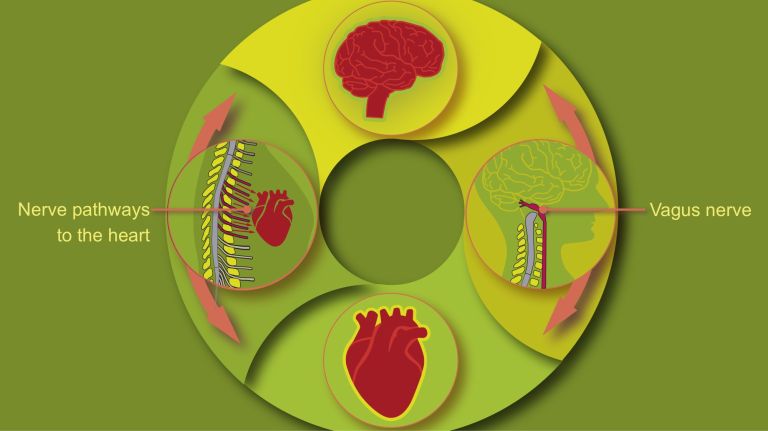

When the brain suffers, the heart weakens
The heart and brain are intimately connected. From this perspective, it is not surprising that many neurological disorders can affect the heart. For example, people suffering from Depression have twice the risk of having a heart attack or sudden cardiac death. Nearly 62 percent of stroke patients have Plaques in their coronary arteries. And a heart attack following a stroke is a feared complication in intensive care units.
Even in response to stress, perfectly healthy people can develop heart failure. A Japanese doctor described this condition in the 1990s and named it “Takotsubo syndrome.”
“Patients arrive at the emergency room frightened, with chest pain and shortness of breath,” explain Victor Schweiger and Julien Mereier from the research group led by cardiologist Christian Templin at the University Hospital of Zurich. “Sometimes they mention that their husband died the day before. During catheterization, however, all the vessels are found to be open.” The left ventricle, however, is pumping less efficiently than usual. The apex of the heart is balloon-like in its dilation, while the aorta is narrowed. The two aspiring cardiologists warn that stress-induced heart failure should not be taken lightly. Those affected need rehabilitation to recover. Their risk of death is elevated. “It’s not just a psychological issue, as many believe, but a physical illness,” Schweiger emphasizes.
Depression
A mental illness whose main symptoms are sadness and a loss of joy, motivation, and interest. Current classification systems distinguish between different types of depression.
stroke
Cerebral apoplexy
In a stroke, the brain or parts of it are no longer supplied with sufficient blood, which impairs the supply of oxygen and glucose. The most common cause is a blockage in an artery (ischemic stroke), less commonly a hemorrhage (hemorrhagic stroke). Typical symptoms include sudden visual disturbances, dizziness, paralysis, speech or sensory disturbances. Long-term consequences can include various sensory, motor, and cognitive impairments.
Plaques
Senile plaques
Senile plaques accumulate in the gray matter of the brain when a protein – known as amyloid precursor protein – is not broken down correctly. Inflammation and disorders of fat or sugar metabolism can promote plaque formation. On average, the deposits reach a diameter of 50 micrometers. The appearance of plaques is one of several anatomical changes in the brain that pathologists can use to diagnose Alzheimer's disease after death.
A broken heart with consequences
This is also suggested by a study of patients’ brains using functional magnetic resonance imaging, which Templin presented to the scientific community in 2019. According to the study, the processing of emotional stimuli is less pronounced in various brain regions among those affected. This reduced connectivity was particularly noticeable in the amygdala, the hippocampus, and the cingulate gyrus, which are crucial for regulating Emotions. The Amygdala and Cingulate gyrus are also involved in controlling the Autonomic nervous system and can thereby influence heart function.
However, it is not yet fully understood how the brain stresses the heart during an emotional event. The stress Hormone Adrenaline likely plays a key role. Administering adrenaline artificially can trigger heart failure in animals. In patients, the levels of certain catecholamines – which include the neurotransmitters adrenaline, dopamine, and norepinephrine – are significantly higher one to three days after the onset of Takotsubo syndrome than in healthy individuals. It is well known that an excess of catecholamines damages the heart over time.
Catecholamine levels are also elevated after a stroke. This is where the circle closes: a failing heart may not only be a reaction to intense heartbreak or a death. In 7.6 percent of cases neurological events precede Takotsubo syndrome. Templin’s team identified this pattern in data from the world’s largest registry, which now includes more than 4,000 patients. “Usually, only one to two – at most ten – days elapse between the initial event in the brain and the stress-induced heart failure,” says Schweiger.
The young discipline of psychocardiology seeks to uncover how neurological disorders and emotional distress affect the heart. “It’s truly astonishing,” says Schweiger. “Grief, anger, and joy can cause organic changes in such a vital organ.” It’s as if Johann Wolfgang von Goethe had already sensed this two hundred years ago when he wrote about love: “Heart, my heart, what is this? What troubles you so much? What a strange new life! I no longer recognize you.”
Emotions
Neuroscientists understand "emotions" to be complex response patterns that include experiential, physiological, and behavioral components. They arise in response to personally relevant or significant events and generate a willingness to act, through which the individual attempts to deal with the situation. Emotions typically occur with subjective experience (feeling), but differ from pure feeling in that they involve conscious or implicit engagement with the environment. Emotions arise in the limbic system, among other places, which is a phylogenetically ancient part of the brain. Psychologist Paul Ekman has defined six cross-cultural basic emotions that are reflected in characteristic facial expressions: joy, anger, fear, surprise, sadness, and disgust.
Amygdala
corpus amygdaloideum
An important core area in the temporal lobe that is associated with emotions: it evaluates the emotional content of a situation and reacts particularly to threats. In this context, it is also activated by pain stimuli and plays an important role in the emotional evaluation of sensory stimuli. Inaddition, it is involved in linking emotions with memories, emotional learning ability, and social behavior. The amygdala is part of the limbic system.
Cingulate gyrus
gyrus cinguli
The cingulate gyrus is an important part of the limbic system in the cerebrum. This strip of cortex runs medially in the cerebrum, directly above the corpus callosum. Among other things, it is involved in emotions and memory. Through its connections to limbic and autonomic centers, it can also influence autonomic responses (e.g., heart rate, blood pressure). The anterior (front) region in particular is also associated with attention, motivation, error monitoring, and emotion regulation.
Autonomic nervous system
The part of the nervous system that primarily controls unconscious vital functions such as breathing, heartbeat, and blood pressure. The autonomic nervous system is divided into the sympathetic nervous system, which is active in performance and stress situations, and the parasympathetic nervous system, which is active during rest and recovery phases. In some cases, the enteric nervous system, which is responsible for gastrointestinal functions, is also considered part of the autonomic nervous system.
Hormone
Hormones are chemical messengers in the body. They serve to transmit information between organs and cells, usually slowly, e.g., to regulate blood sugar levels. Many hormones are produced in glandular cells and released into the blood. At their destination, e.g., an organ, they dock at binding sites and trigger processes inside the cell. Hormones have a broader effect than neurotransmitters; they can influence various functions in many cells of the body.
Adrenaline
Along with dopamine and norepinephrine, it belongs to the catecholamines. Adrenaline, also known as epinephrine, is the classic stress hormone. It is produced in the adrenal medulla and causes an increase in heart rate and heartbeat strength, thus preparing the body for increased stress. In the brain, adrenaline also acts as a neurotransmitter (messenger substance), where it binds to so-called adrenoreceptors.
stroke
Cerebral apoplexy
In a stroke, the brain or parts of it are no longer supplied with sufficient blood, which impairs the supply of oxygen and glucose. The most common cause is a blockage in an artery (ischemic stroke), less commonly a hemorrhage (hemorrhagic stroke). Typical symptoms include sudden visual disturbances, dizziness, paralysis, speech or sensory disturbances. Long-term consequences can include various sensory, motor, and cognitive impairments.
Further reading
- Donald D, et al.: Some evidence for heightened sexual attraction under conditions of high anxiety. Journal of Personality and Social Psychology, 1974, 30 (4). (to the abstract)
- Azevedo R, et al.: Cardiac afferent activity modulates the expression of racial stereotypes. Nature Communications, January 2016, 8 (13854). (Full text)
- Templin C, et al.: Altered limbic and autonomic processing supports the brain-heart axis in Takotsubo syndrome. European Heart Journal, April 2019, 40 (15): 1183–1187. (Full text)
- Al E, et al.: Heart–brain interactions shape somatosensory Perception and evoked potentials. PNAS, May 2020, 117 (19): 10575–10584. (Full text)
Perception
The term describes the complex process of gathering and processing information from stimuli in the environment and from the internal states of a living being. The brain combines the information, which is perceived partly consciously and partly unconsciously, into a subjectively meaningful overall impression. If the data it receives from the sensory organs is insufficient for this, it supplements it with empirical values. This can lead to misinterpretations and explains why we succumb to optical illusions or fall for magic tricks.