
How Mental Stress Harms the Heart

Whether it’s stress, lack of sleep, or grief – the brain and heart react together – and sensitively – to stressors. This can have harmful effects on our health. Relaxation techniques can help.
Scientific support: Prof. Dr. Erik M. Müller
Published: 11.10.2022
Difficulty: easy
- Workplace stress is associated with a significantly increased risk of atrial fibrillation. Atrial fibrillation is one of the most common heart rhythm disorders.
- In general, strong Emotions that take a toll on our mental health can also take a toll on our heart. Grief is one example.
- People who experienced trauma, abuse, or Neglect as children struggle with strong negative emotions. They have a significantly higher likelihood of having a heart attack or stroke.
- Chronic sleep problems are associated with an increased risk of heart failure.
- People who meditate regularly have a lower risk of coronary heart disease.
Emotions
Neuroscientists understand "emotions" to be complex response patterns that include experiential, physiological, and behavioral components. They arise in response to personally relevant or significant events and generate a willingness to act, through which the individual attempts to deal with the situation. Emotions typically occur with subjective experience (feeling), but differ from pure feeling in that they involve conscious or implicit engagement with the environment. Emotions arise in the limbic system, among other places, which is a phylogenetically ancient part of the brain. Psychologist Paul Ekman has defined six cross-cultural basic emotions that are reflected in characteristic facial expressions: joy, anger, fear, surprise, sadness, and disgust.
Neglect
Neglect is a perceptual disorder in which parts of the body or stimuli are ignored due to a brain lesion. The disorder affects the sides opposite the brain lesion. It usually occurs after lesions in the right parietal lobe. Accordingly, visual, auditory, and somatosensory stimuli on the left side are ignored.
stroke
Cerebral apoplexy
In a stroke, the brain or parts of it are no longer supplied with sufficient blood, which impairs the supply of oxygen and glucose. The most common cause is a blockage in an artery (ischemic stroke), less commonly a hemorrhage (hemorrhagic stroke). Typical symptoms include sudden visual disturbances, dizziness, paralysis, speech or sensory disturbances. Long-term consequences can include various sensory, motor, and cognitive impairments.
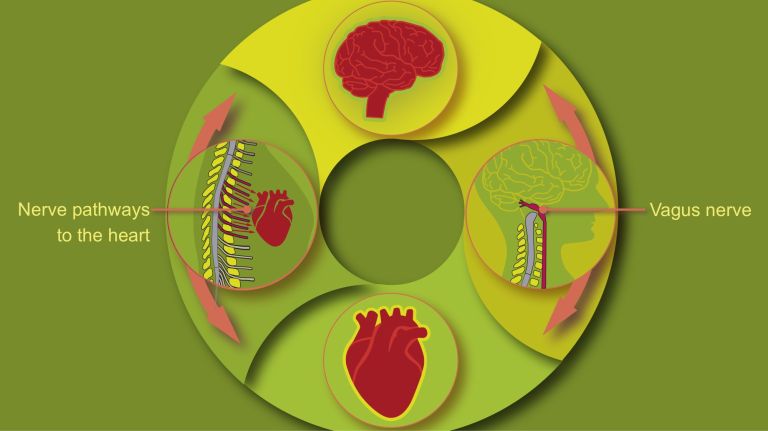
Should we listen to our head or our heart? The question is often the same – whether it’s a matter of love or choosing a career. But when stress, grief, or lack of sleep become our constant companions, we should listen to both organs. They form the neurocardiological axis. What seems like a mental issue that weighs on us psychologically has a very strong effect not only on the brain but also on the heart. Both organs are highly sensitive. With dangerous consequences if we don’t listen to them and take action.
“I’m pretty stressed out.” We hear this phrase all the time these days. In fact, many people feel under pressure, especially at work: tight deadlines, back-to-back video conferences, or juggling three jobs at once. As part of a study, epidemiologist Eleonor Fransson from Jönköping University and her colleagues examined work-related stress. The researchers define work-related stress as high psychological demands combined with little control over the work situation. Examples include assembly line workers, bus drivers, secretaries, and nurses. The study found that workplace stress was associated with a nearly 50 percent higher risk of atrial fibrillation. Atrial fibrillation is a heart rhythm disorder. In this condition, the heart beats irregularly for prolonged periods and often so rapidly that it pumps less blood throughout the body. Atrial fibrillation is not immediately life-threatening, but it increases the risk of blood clots forming. Over time, this also raises the risk of suffering a stroke.
Bereavement and lost soccer games
The phrase “broken heart” suggests that strong Emotions can also take a toll on our heart. The grief one feels upon the loss of a loved one is arguably one of the most intense negative emotions of all. It can even lead directly to the next death. A study by British scientists showed that, following the death of a spouse, people aged 60 and older had more than twice the risk of a stroke or heart attack within 30 days compared to people who had not suffered such a loss. Admittedly, it cannot be ruled out that there are systematic differences between study participants who had lost a partner and those who had not. For example, it could be that older adults who have just lost their partner were already in poorer health than their peers whose partners are still alive. However, the researchers attempted to account for these differences in their calculations and believe that a better understanding of these correlations could open up new avenues for prevention.
The brain’s role is that, during grief, the wiring of the Gray matter can change in such a way that the person becomes trapped in a permanent stress response. Stress hormones surge through the body. The heart begins to race, blood pressure rises, and breathing rate increases. In the long run, this is not good for our heart.
As far as the effects on the heart are concerned, mourning the loss of a loved one can, surprisingly, have physical consequences similar to those of a loss by one’s favorite soccer team. True fans take such a loss literally to heart, as cardiologists at the University of Bialystok in Poland report. In their study, poor results by the local professional soccer team correlated with more cases of acute coronary syndrome in men. These are cardiovascular conditions involving severe narrowing or even blockage of a coronary artery. This includes heart attacks. It’s possible that the mental and emotional stress of a defeat can trigger heart attacks. The researchers write that watching sporting events leads to increased activation of the Sympathetic nervous system and the stress Hormone axis. The sympathetic nervous system is part of the autonomic nervous system, which kicks in during stress. However, there are also studies that have found no link between soccer losses and heart disease. So the final word on the subject has not yet been spoken.
A loss by one’s favorite team primarily causes negative feelings in the short term. In the long term, however, people who experienced trauma, abuse, or Neglect as children are overwhelmed by negative emotions. Among people who were exposed to the greatest stressors in their family environment during childhood, the likelihood of a cardiovascular event – such as a heart attack or stroke – was more than 50 percent higher over a 30-year follow-up period. This was revealed by a study conducted by researchers at Northwestern University in Chicago led by physician Jacob Pierce. The scientists hypothesize that traumatic childhood experiences impair the ability to regulate emotions. This also contributes to the development of risk factors for cardiovascular disease – such as smoking, anxiety, depression, and physical inactivity – which can persist into adulthood.
Emotions
Neuroscientists understand "emotions" to be complex response patterns that include experiential, physiological, and behavioral components. They arise in response to personally relevant or significant events and generate a willingness to act, through which the individual attempts to deal with the situation. Emotions typically occur with subjective experience (feeling), but differ from pure feeling in that they involve conscious or implicit engagement with the environment. Emotions arise in the limbic system, among other places, which is a phylogenetically ancient part of the brain. Psychologist Paul Ekman has defined six cross-cultural basic emotions that are reflected in characteristic facial expressions: joy, anger, fear, surprise, sadness, and disgust.
stroke
Cerebral apoplexy
In a stroke, the brain or parts of it are no longer supplied with sufficient blood, which impairs the supply of oxygen and glucose. The most common cause is a blockage in an artery (ischemic stroke), less commonly a hemorrhage (hemorrhagic stroke). Typical symptoms include sudden visual disturbances, dizziness, paralysis, speech or sensory disturbances. Long-term consequences can include various sensory, motor, and cognitive impairments.
Gray matter
Grey matter refers to a collection of nerve cell bodies, such as those found in nuclei or in the cortex.
Sympathetic nervous system
Part of the autonomic nervous system, whereby the sympathetic nervous system primarily transmits excitatory impulses – in contrast to its counterpart, the parasympathetic nervous system. For example, the sympathetic nervous system activates respiration, the heart, and circulation, but it also affects the smooth muscles of all internal organs. The sympathetic nervous system uses the neurotransmitters acetylcholine and norepinephrine.
Hormone
Hormones are chemical messengers in the body. They serve to transmit information between organs and cells, usually slowly, e.g., to regulate blood sugar levels. Many hormones are produced in glandular cells and released into the blood. At their destination, e.g., an organ, they dock at binding sites and trigger processes inside the cell. Hormones have a broader effect than neurotransmitters; they can influence various functions in many cells of the body.
Neglect
Neglect is a perceptual disorder in which parts of the body or stimuli are ignored due to a brain lesion. The disorder affects the sides opposite the brain lesion. It usually occurs after lesions in the right parietal lobe. Accordingly, visual, auditory, and somatosensory stimuli on the left side are ignored.


Dangerous sleep deprivation
Negative Emotions that won’t let us rest can literally rob us of sleep. And there is growing evidence that various sleep problems are linked to heart failure. A large observational study involving data from more than 400,000 people examined the connection between healthy sleep patterns and heart failure. Measures of sleep quality included sleep duration, insomnia, and snoring. The researchers were also interested in whether participants were early risers or “night owls,” and whether they felt sleepy during the day. The result: Healthy sleep habits were associated with a lower risk of heart failure. Adults with the healthiest sleep habits – those who wake up in the morning, sleep 7–8 hours a day, and do not frequently suffer from insomnia, snoring, or excessive daytime sleepiness – had a clear advantage. Their risk of heart failure was 42 percent lower than that of people with unhealthy sleep habits.
Emotions
Neuroscientists understand "emotions" to be complex response patterns that include experiential, physiological, and behavioral components. They arise in response to personally relevant or significant events and generate a willingness to act, through which the individual attempts to deal with the situation. Emotions typically occur with subjective experience (feeling), but differ from pure feeling in that they involve conscious or implicit engagement with the environment. Emotions arise in the limbic system, among other places, which is a phylogenetically ancient part of the brain. Psychologist Paul Ekman has defined six cross-cultural basic emotions that are reflected in characteristic facial expressions: joy, anger, fear, surprise, sadness, and disgust.
Air pollution and noise take a toll on the heart
While sleep deprivation quietly takes its toll, another stressor for the heart and brain makes itself heard all the more loudly: traffic noise. In a study using data from 4.4 million Swiss residents, researchers found an increase in the risk of heart attack of up to 3.4 percent for every 10-decibel increase in noise. The study also found that people exposed to both air pollution and noise have the highest risk of a fatal heart attack. The effects of air pollution and noise therefore add up. “As far as air pollution and noise as stressors for the heart and brain are concerned, the data is still very limited,” says Jens Litmathe, a specialist in cardiac surgery, intensive care, and emergency medicine at the Evangelical Hospital in Wesel, who has conducted research on the neurocardiological axis. “It’s obvious that they aren’t good for the neurocardiological axis. But what happens here in detail hasn’t been researched yet.”
Even though the exact causal chains often remain unclear, one thing is already clear. We should take steps to counteract the various stressors affecting the brain and heart. Ideally, it might be best to move to a “better neighborhood.” But there are also numerous methods that help us relax and become more mentally and physically resilient: whether it’s mindfulness training, progressive muscle relaxation, or meditation. A U.S. study showed that people who meditated were less likely to suffer from high cholesterol, high blood pressure, or diabetes. They were less likely to have a stroke or coronary heart disease than those who did not meditate. The biggest difference was seen in coronary heart disease. Those who relaxed through meditation had a roughly 50 percent lower risk of developing the condition. So let’s listen to our minds and hearts, and reduce our stressors. Both organs will thank us for it.
stroke
Cerebral apoplexy
In a stroke, the brain or parts of it are no longer supplied with sufficient blood, which impairs the supply of oxygen and glucose. The most common cause is a blockage in an artery (ischemic stroke), less commonly a hemorrhage (hemorrhagic stroke). Typical symptoms include sudden visual disturbances, dizziness, paralysis, speech or sensory disturbances. Long-term consequences can include various sensory, motor, and cognitive impairments.
Further reading
- Fransson EI, Nordin M, Magnusson Hanson LL, Westerlund H. Job strain and atrial fibrillation - Results from the Swedish Longitudinal Occupational Survey of Health and meta-analysis of three studies. Eur J Prev Cardiol. 2018 Jul;25(11):1142-1149. (zum Abstract ).
- Krittanawong C, Kumar A, Wang Z, Narasimhan B, Jneid H, Virani SS, Levine GN. Meditation and Cardiovascular Health in the US. Am J Cardiol. 2020 Sep 15;131:23-26. doi: 10.1016/j.amjcard.2020.06.043. (zum Abstract )
