Consciousness: The Ascending Reticular Activating System (ARAS)
Published: 30.08.2013
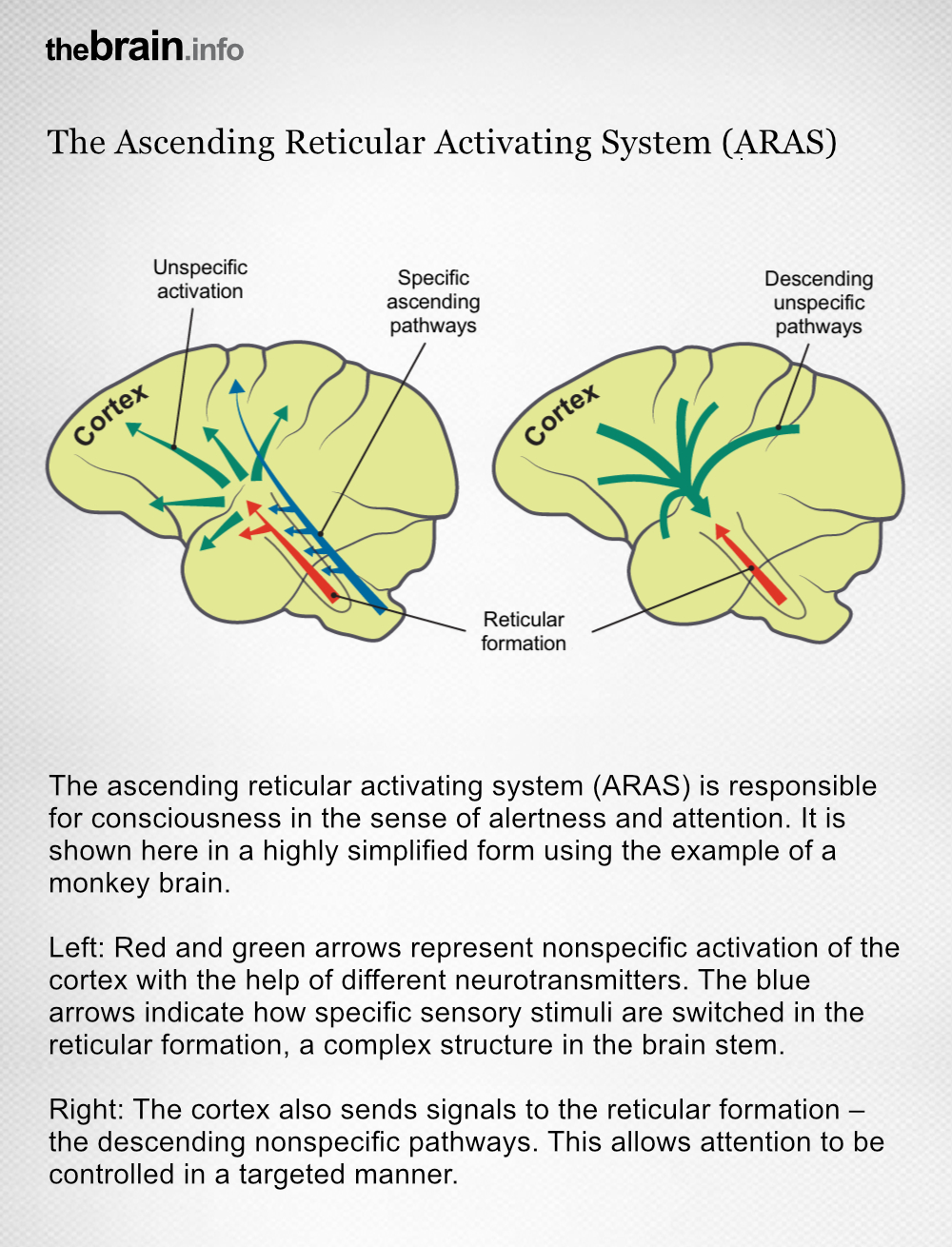
One of the most complex and versatile structures in the brain is the Reticular formation in the thalamus. Nerve impulses originating here activate the entire Cortex. Specific sensory stimuli are also filtered here. You can find more on this topic in the article ▸ When consciousness fails.
Reticular formation
formatio reticularis
The Reticular formation is a network of numerous nuclei in the Brain stem It has a variety of tasks, for example, it is responsible for alertness, the integration of motor, sensory, and vegetative processes, and the sleep-wake cycle.
cortex cerebri
Cortex refers to a collection of neurons, typically in the form of a thin surface. However, it usually refers to the cerebral cortex, the outermost layer of the Cerebrum. It is 2.5 mm to 5 mm thick and rich in nerve cells. The cerebral cortex is heavily folded, comparable to a handkerchief in a cup. This creates numerous convolutions (gyri), fissures (fissurae), and sulci. Unfolded, the surface area of the cortex is approximately 1,800cm².
Reticular formation
formatio reticularis
The reticular formation is a network of numerous nuclei in the brain stem. It has a variety of tasks, for example, it is responsible for alertness, the integration of motor, sensory, and vegetative processes, and the sleep-wake cycle.
Brain stem
truncus cerebri
The "trunk" of the brain, to which all other brain structures are "attached," so to speak. From bottom to top, it comprises the medulla oblongata, the pons, and the mesencephalon. It transitions into the spinal cord below. It is a center for vital functions such as breathing and heartbeat and contains ascending and descending pathways between the cerebrum, cerebellum, and spinal cord.
Cortex
cortex cerebri
Cortex refers to a collection of neurons, typically in the form of a thin surface. However, it usually refers to the cerebral cortex, the outermost layer of the cerebrum. It is 2.5 mm to 5 mm thick and rich in nerve cells. The cerebral cortex is heavily folded, comparable to a handkerchief in a cup. This creates numerous convolutions (gyri), fissures (fissurae), and sulci. Unfolded, the surface area of the cortex is approximately 1,800cm².
Cerebrum
telencephalon
The cerebrum comprises the cerebral cortex (gray matter), the nerve fibers (white matter), and the basal ganglia. It is the largest part of the brain. The cortex can be divided into four cortical areas: the temporal lobe, frontal lobe, occipital lobe, and parietal lobe.
Its functions include the coordination of perception, motivation, learning, and thinking.