Search
-
- Basics
- Structure and Function
The Secret to Success: Communication
No other cell type is better at juggling signals: The neuron is both a data octopus and a supercomputer.
01.12.2020
-
- Basics
- Communication of Cells
Nerve Cells in Conversation
No chaos despite sensory overload – neurons communicate silently, efficiently, and at breakneck speed.
16.04.2012
-
- Basics
- Structure and Function
Myelin: High Speed
It is the white sheath that glial cells form around axons that makes high speed pathways in the brain possible.
01.12.2020
-
- News from the Institutes
Parkinson’s: ion channel as promising avenue for new drugs
Researchers decipher the function of an ion channel involved in cellular degradation processes and create new possibilities for Parkinson’s therapies.
16.01.2026
-
- Basics
- Communication of Cells
Electrical Potentials: The Language of Neurons
Neurons do not simply transmit stimuli; processing is a sophisticated process.
13.04.2012
-
- Glossary
Threshold potential
In order for an action potential to be triggered, the membrane potential at the axon hillock of a neuron must exceed the threshold value of approximately –50 mV (relative to the resting potential of –70 mV). This is the threshold potential. If the depolarization remains below this threshold, no action potential is triggered.
-
- Glossary
Membrane potential
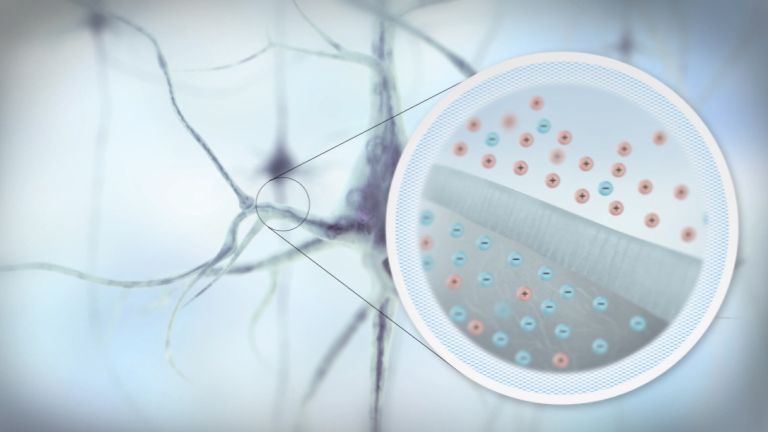
The membrane potential is a voltage measured between the inside and outside of the cell membrane. It arises from the different distribution of electrically charged particles inside and outside the cell.
-
- Basics
- Structure and Function
Communication Gaps: Ion Channels
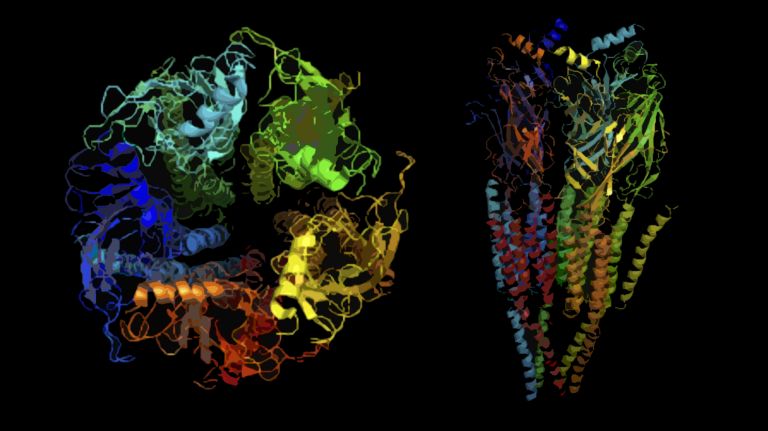
Complex proteins span the membranes of nerve cells. Without these ion channels, literally nothing works.
01.12.2020
-
- Glossary
Resting potential
The membrane potential of a neuron at rest. The inflow and outflow of ions are in equilibrium. It ranges from –50 to –100 mV.
-
- Glossary
Action potential
In excitable cells (e.g., neurons or muscle cells), very rapid changes in electrical potential occur across the cell membrane. This event is the basis for signal conduction along the axon of the nerve cell. The action potential continues along the cell membrane and, according to the all-or-nothing principle, only occurs when the cell has been sufficiently excited.