The Fourth Dimension
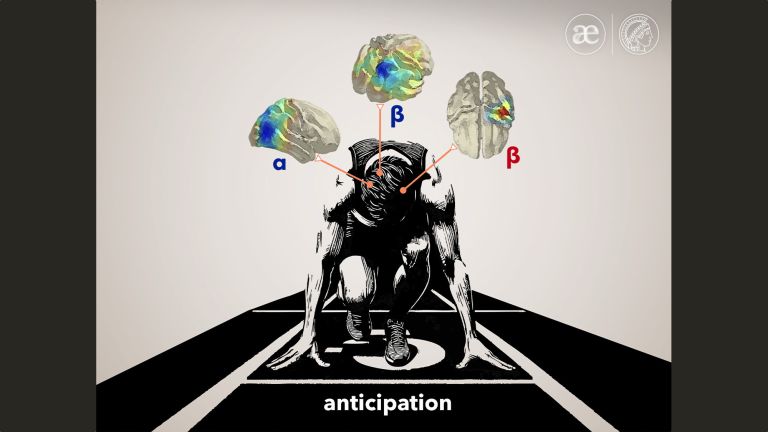
It is invisible, silent, and quite capricious: capturing time in the brain is not so easy. A vast network attempts to act as a timekeeper – but often gets confused.
Scientific support: Dr. Isabell Winkler
Published: 01.05.2024
Difficulty: easy
- Time is complicated and hard to grasp. Physics characterizes it as a marker of increasing disorder and as the fourth dimension of a space-time continuum, which can actually pass more slowly or more quickly at times.
- Life seems to tick along in a similarly variable way. The Perception of time can vary considerably depending on lifestyle, mood, and attention.
- There is no specific sensory organ for time. Instead, the sense of time arises from calculations by a complex network in the brain that compares diverse sensory impressions and cognitive processes with memories. This network primarily involves the insular cortex, frontal lobe, cingulate gyrus, temporal lobe, striatum, and claustrum.
- The Striatum and the claustrum play a particularly important role in this process. Because they are well-connected to many other brain regions, they can measure when their oscillations coincide and use this to construct an understanding of temporal intervals.
- The perception of time and how we experience space and the world as a whole are closely intertwined. The experience of time is an important dimension of our consciousness.
- If the networks involved in the perception of time are disrupted – for example, in cases of attention disorders, schizophrenia, or Parkinson’s disease – errors in time estimation become more frequent, or the internal clock runs faster or slower.
Perception
The term describes the complex process of gathering and processing information from stimuli in the environment and from the internal states of a living being. The brain combines the information, which is perceived partly consciously and partly unconsciously, into a subjectively meaningful overall impression. If the data it receives from the sensory organs is insufficient for this, it supplements it with empirical values. This can lead to misinterpretations and explains why we succumb to optical illusions or fall for magic tricks.
Attention
Attention
Attention serves as a tool for consciously perceiving internal and external stimuli. We achieve this by focusing our mental resources on a limited number of stimuli or pieces of information. While some stimuli automatically attract our attention, we can select others in a controlled manner. The brain also unconsciously processes stimuli that are not currently the focus of our attention.
frontal
An anatomical position designation – frontal means "towards the forehead," i.e., at the front.
Striatum
Corpus striatum
The striatum is a central structure of the basal ganglia. It consists of the caudate nucleus and putamen; the nucleus accumbens is also functionally part of it as its ventral portion. As the most important input structure of the basal ganglia, the striatum plays an essential role in controlling movement sequences as well as in cognition, motivational processes, and the reward system.
Our sense of time also depends on which language(s) we speak. In English and Swedish, for example, duration is often described as physical distance, such as a short pause. In Greek and Spanish, on the other hand, physical quantities are more commonly used to describe duration; the pause is then small.
These different linguistic images have a direct impact on the ability to estimate time, as researchers were able to demonstrate in a study. Swedish speakers can be misled when measuring time if a line on a screen grows longer than the actual elapsed time would suggest. However, they remain unimpressed and continue to estimate the duration correctly when they instead see a container filling up more rapidly. For Spanish speakers, it’s the opposite – they are confused by the container’s fill level, but not by the length of the line. Bilingual people can fall for both tricks – but only if they have the respective language active at that moment.
During the lockdowns of the Covid-19 pandemic, when many people barely left the house, their sense of time changed in several ways. According to responses to questionnaires filled out during the lockdowns, time seemed to pass much more slowly than usual for most people during the uneventful confinement at home. Depression and anxiety, in particular, led to a slowed Perception of time. In another study , in which respondents later looked back on the lockdown, their memories of it were compressed in time. Since they had experienced so little in their daily lives, the remembered events seemed closer together in time, as if the uneventful time in between had been lost.
In addition, the ability to estimate time suffered overall from the lack of personal experiences. According to yet another study, people misjudged the timing of publicly known events that had taken place during the lockdown just as often as they usually do with events from much earlier periods.
Depression
A mental illness whose main symptoms are sadness and a loss of joy, motivation, and interest. Current classification systems distinguish between different types of depression.
Perception
The term describes the complex process of gathering and processing information from stimuli in the environment and from the internal states of a living being. The brain combines the information, which is perceived partly consciously and partly unconsciously, into a subjectively meaningful overall impression. If the data it receives from the sensory organs is insufficient for this, it supplements it with empirical values. This can lead to misinterpretations and explains why we succumb to optical illusions or fall for magic tricks.
Time is invisible, yet it leaves clear traces. It is silent, but can be experienced in countless rhythms and cycles, from the heartbeat to the course of the day to the changing of the seasons. Time has a firm grip on all of us. No one can escape its course. Every person has only a limited amount of time at their disposal, and how we perceive and use time is decisive for many vital questions.
But what exactly is time, where does it come from, and what does it mean to us? In everyday life, time appears to be a fixed quantity. It may stretch like chewing gum at times, when every minute feels like an eternity during boring moments ▸ The double-edged Sword of Boredom – and race by at other times, when a wonderful experience seems to pass far too quickly. But despite such differences in the Perception of time, we trust that every period of time is objectively measurable in seconds, minutes, hours, days, and years, and that every moment has its fixed and unique place on the timeline. Isaac Newton formalized this view in 1687 in his Mathematical Principles of Natural Philosophy : “Absolute, true, and mathematical time, of itself, and from its own nature, flows equably without relation to anything external”.
Perception
The term describes the complex process of gathering and processing information from stimuli in the environment and from the internal states of a living being. The brain combines the information, which is perceived partly consciously and partly unconsciously, into a subjectively meaningful overall impression. If the data it receives from the sensory organs is insufficient for this, it supplements it with empirical values. This can lead to misinterpretations and explains why we succumb to optical illusions or fall for magic tricks.
Relativity
Since Albert Einstein formulated the special theory of relativity in 1905, things have become a bit more complicated. According to this theory, both spatial distances and the duration of time depend on how fast one is moving relative to something else. As speed increases, distances become shorter and seconds longer. This can even be demonstrated experimentally. If one of two highly accurate clocks is sent around the Earth by airplane, it will lag a few nanoseconds behind the clock that remained on the ground at the end of its journey, since its seconds lasted slightly longer at high speed.
Disorder
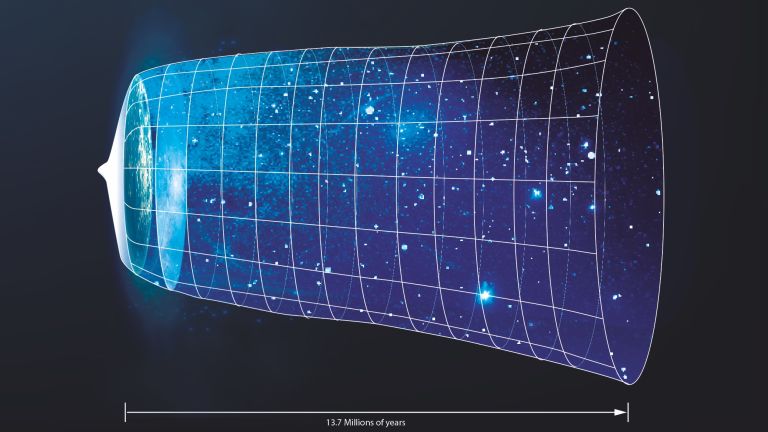
Later, Einstein interpreted time as the fourth dimension in a coordinate system of the world, in which it forms the space-time continuum together with the three dimensions of space. The fact that time can only flow in one direction follows from another fundamental law of physics: The second law of thermodynamics postulates that, without external intervention, entropy – a measure of disorder – increases. On its own, everything becomes increasingly disordered.
For order to emerge, energy must be supplied from outside. Over time, dust spreads everywhere all on its own. It can only be removed by cleaning. But this trick cannot reverse time. For while Mom tidies up the closed system of the “children’s room,” the entropy of the entire system (the universe) increases as a result of her efforts.
Internal clocks
Physical equations can tell us a great deal about time. However, the theory of relativity and thermodynamics do not yet explain how our bodies deal with time. Life is a kind of counterpoint to entropy. Energy constantly flows into the creation and maintenance of order. From the moment an organism comes into being, its molecules, cells, and tissues organize themselves into new or ongoing ordered systems and processes. Immediately after fertilization, cellular pacemakers ensure that the processes in the newly-forming being proceed in the correct order and at the correct intervals, from the rhythm of the first cell divisions to the activation and deactivation of various Gene activities that dictate the developmental paths of the embryo’s cells and tissues.
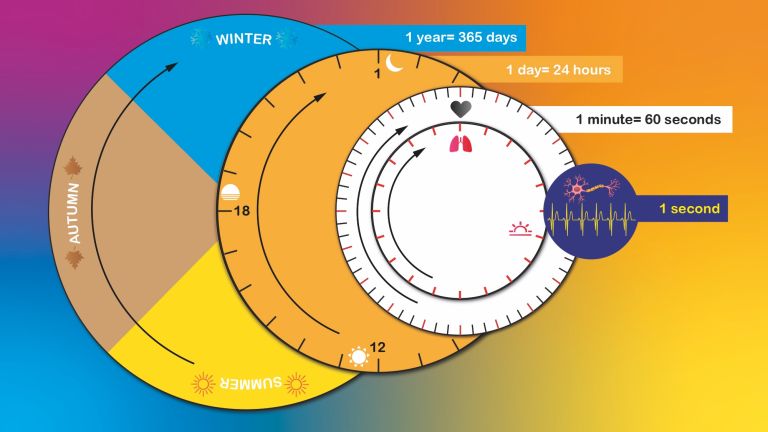
Later in life, too, a multitude of biological clocks ensures that all important processes are precisely timed and that the body and mind can respond appropriately to the passage of time ▸ Perfect Timing. There is much to measure and time. Rapid rhythms such as the firing of nerve cells, the heartbeat, and breathing; appropriate responses to the alternation of day and night and the changing of the seasons; and hormonal shifts during transitions between life stages such as childhood and puberty – all of this can be vital for survival.
Given the many roles that time plays in life, it is not surprising that our Perception of it in everyday life can vary greatly. For example, those who live faster can also see faster. Agile dragonflies perceive 300 image changes per second, sedentary starfish only 0.7, and humans, on average, 65. In some experiments, how quickly time seems to pass depends on the participants’ native language (see box). In one experiment, test subjects estimated the duration of a signal during a heartbeat to be shorter than when they perceived the same signal between two heartbeats. The display of a fear-distorted face appears longer than that of a happy one, even though both images are actually shown for the same amount of time. Whether heightened excitement makes time pass faster or slower, however, is not clearly established. At least two studies have yielded conflicting results on this point.
Gene
Information unit on DNA. Specialized enzymes translate the core component of a gene into ribonucleic acid (RNA). While some ribonucleic acids perform important functions in the cell themselves, others specify the order in which the cell should assemble individual amino acids into a specific protein. The gene thus provides the code for this protein. In addition, a gene also includes regulatory elements on the DNA that ensure that the gene is read exactly when the cell or organism actually needs its product.
Perception
The term describes the complex process of gathering and processing information from stimuli in the environment and from the internal states of a living being. The brain combines the information, which is perceived partly consciously and partly unconsciously, into a subjectively meaningful overall impression. If the data it receives from the sensory organs is insufficient for this, it supplements it with empirical values. This can lead to misinterpretations and explains why we succumb to optical illusions or fall for magic tricks.
Emotional Time
How fast or slow one experiences the passage of time depends on many other factors. There is no separate sensory organ for time; rather, our sense of it is influenced by other sensory impressions and cognitive processes. Attention, emotions, memories, working memory, and Executive functions such as planning actions and targeted impulse control can all contribute to the Perception of time stretching or shortening. Thus, a large network in the brain is involved in the formation of the sense of time.
Thanks to meta-analyses of imaging studies that searched for “clocks” in the brain, the involved areas are now largely known and are located both within the cerebral Cortex and outside it. The exact mix varies depending on the task. When it comes to fractions of a second, for example, subcortical regions that control automated and sensory processes are more active. When dealing with longer time intervals, for which cognitive processes play a greater role, there is more activity in the cortex. However, a whole range of brain regions is involved in all time measurements, and even a glance at their likely contributions shows just how complicated the matter of time perception is.
Executive functions
Brain research uses the term "executive functions" to describe the "higher" mental abilities of living beings. These include, for example, focused attention, planning actions, error correction, decision-making, impulse control, and emotional regulation.
Perception
The term describes the complex process of gathering and processing information from stimuli in the environment and from the internal states of a living being. The brain combines the information, which is perceived partly consciously and partly unconsciously, into a subjectively meaningful overall impression. If the data it receives from the sensory organs is insufficient for this, it supplements it with empirical values. This can lead to misinterpretations and explains why we succumb to optical illusions or fall for magic tricks.
Cortex
cortex cerebri
Cortex refers to a collection of neurons, typically in the form of a thin surface. However, it usually refers to the cerebral cortex, the outermost layer of the cerebrum. It is 2.5 mm to 5 mm thick and rich in nerve cells. The cerebral cortex is heavily folded, comparable to a handkerchief in a cup. This creates numerous convolutions (gyri), fissures (fissurae), and sulci. Unfolded, the surface area of the cortex is approximately 1,800cm².

When time breaks down
Just how quickly our Perception of time can reach its limits in everyday life becomes apparent when we have to estimate the timing of different sensory impressions simultaneously. In an experiment, people perceive a dot that changes both its color and direction of movement simultaneously as if it were changing color first and then direction. For people with schizophrenia, temporal perceptions often diverge even more markedly, and they frequently struggle to correctly estimate the current time as well as the duration and sequence of events. It is now believed that such distorted perceptions of time can directly contribute to symptoms such as hallucinations and psychosis. Schizophrenia is likely caused by disrupted networks in the brain. No wonder, then, that the sense of time also becomes unstable.
In extreme cases, people can even completely lose track of time in certain respects. This happened, for example, to the “lost sailor” Jimmie G., whom neurologist Oliver Sacks described. In his mid-forties, G. suffered alcohol-induced brain damage that erased all memories from his youth onward, as well as his entire future. From then on until his death, G. believed himself to be a 19-year-old in the year 1945 and was unable to form any new memories. He spent the rest of his life in a narrowly confined present and forgot everything he experienced anew within minutes or even seconds.
Perception
The term describes the complex process of gathering and processing information from stimuli in the environment and from the internal states of a living being. The brain combines the information, which is perceived partly consciously and partly unconsciously, into a subjectively meaningful overall impression. If the data it receives from the sensory organs is insufficient for this, it supplements it with empirical values. This can lead to misinterpretations and explains why we succumb to optical illusions or fall for magic tricks.
Further reading
- Eagleman DM. Human time perception and its illusions. Curr Opin Neurobiol. 2008;18(2):131-136. ( Zum Volltext ).
- Matthews WJ, Meck WH. Time perception: the bad news and the good. Wiley Interdiscip Rev Cogn Sci. 2014;5(4):429-446. ( zum Volltext )