The Brain’s Cleanup Crew
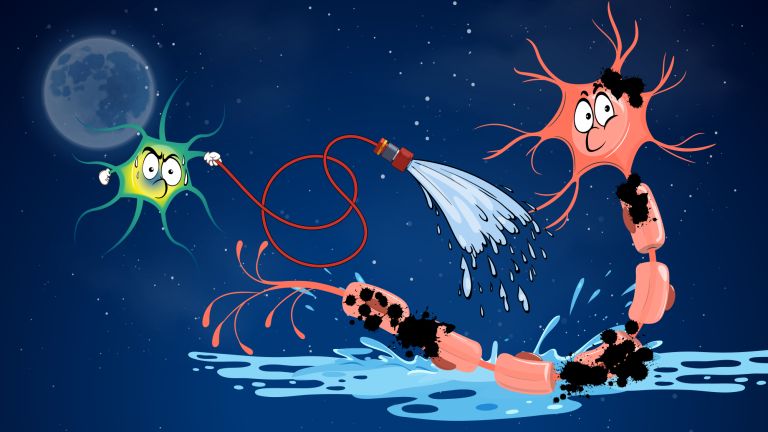
The brain is active around the clock. This generates a lot of waste. To get rid of it, our brain cells have their own cleaning crew, which we’ve only known about for a relatively short time. Cleaning processes run at full speed, especially while we sleep.
Scientific support: Prof. Dr. Stefanie Kürten
Published: 06.11.2024
Difficulty: easy
- In the rest of the body, the lymphatic system removes waste products.
- In 2012, Maiken Nedergaard and her team discovered the glymphatic system, which functions similarly to the lymphatic system.
- The glymphatic system uses cerebrospinal fluid, which flows through channels and intercellular spaces in the brain, to absorb and transport metabolic waste products and toxins.
- Sleep may enhance the efficiency of the glymphatic system: the spaces between cells in the brain expand during sleep, allowing for better waste removal.
- Norepinephrine appears to influence the size of these spaces and thus the efficiency of waste transport.
- Some research findings support the theory that sleep promotes waste removal, while others question this.
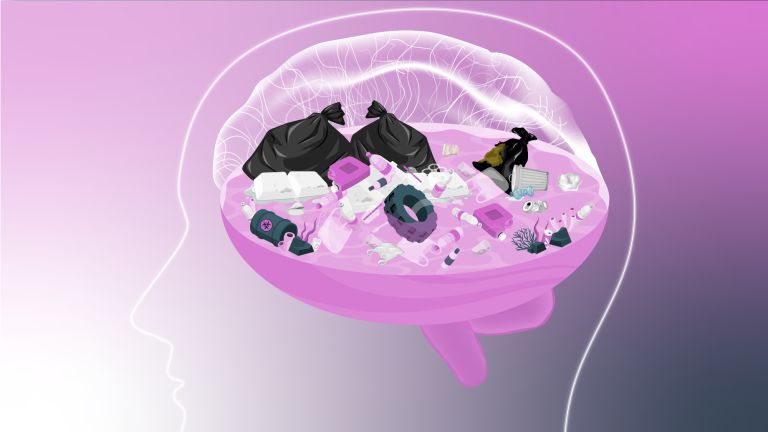
The brain is somewhat like a modern office building. In this picture, the brain regions are the individual departments. In any well-functioning office complex, an efficient cleaning system is needed to keep everything spotless. The brain also has its own cleaning crew that ensures everything runs smoothly.
In the rest of the body, the lymphatic system removes excess fluid, waste products, cellular debris, pathogens, and other unwanted substances from the tissues. But how does the brain get rid of its waste? This question is not entirely unimportant, since the brain has a particularly active metabolism. Consequently, it also produces a fair amount of waste products.
The flow of cerebrospinal fluid
Until recently, researchers believed the brain had no lymphatic system of its own to handle cleansing. For over a century, it was assumed that the flow of Cerebrospinal fluid performed this function. Cerebrospinal fluid surrounds the brain and spinal cord, protecting them from impact and transporting nutrients to the nerve cells – and carrying substances away from them.
While people who aren’t quite as bright are often mocked as “empty-headed,” we are all some kind of empty-headed, because deep inside, the brain is actually hollow. This is due to the ventricular system, a network of interconnected cavities containing cerebrospinal fluid. These ventricles produce the fluid and distribute it.
Researchers had previously assumed that waste products and metabolic byproducts produced by nerve cells and Glial cells accumulate in the cerebrospinal fluid and are removed via a sort of passive transport. The catch with this theory: this process would be far too slow to constitute an effective waste removal system. It must therefore work differently.
Cerebrospinal fluid
liquor cerebrospinalis
A clear fluid that fills the ventricular system and bathes the brain and spinal cord in the subarachnoid space, protecting them from impact. Three to five times a day, 100 to 160 ml of fluid is renewed by the choroid plexus. Certain diseases are reflected in the composition of the cerebrospinal fluid.
Glial cells
Glia cells are the second largest group of cells in the brain after neurons. For a long time, they were considered inactive elements of the brain, referred to as "nerve cement." Today, we know that the different types of glia cells (astrocytes, oligodendrocytes, and microglia in the CNS; Schwann cells in the PNS) perform clearly defined tasks in the nervous system. For example, they respond to pathogens, play an important role in nourishing nerve cells, and insulate nerve fibers. They account for slightly more than 50 percent of the brain's cells, compared to neurons.
The fine-grained picture
It wasn’t until 2012 that researchers led by Danish neuroscientist Maiken Nedergaard at the University of Rochester Medical Center discovered that the brain has its own waste disposal system – similar to the lymphatic system in the rest of the body. They named it the “glymphatic system.” The name is a combination of “glia” and “lymphatic,” since Glial cells play an important role in it. The glymphatic system is a flowing, continuous system for the removal of excess and harmful substances, in which Cerebrospinal fluid also plays an important role.
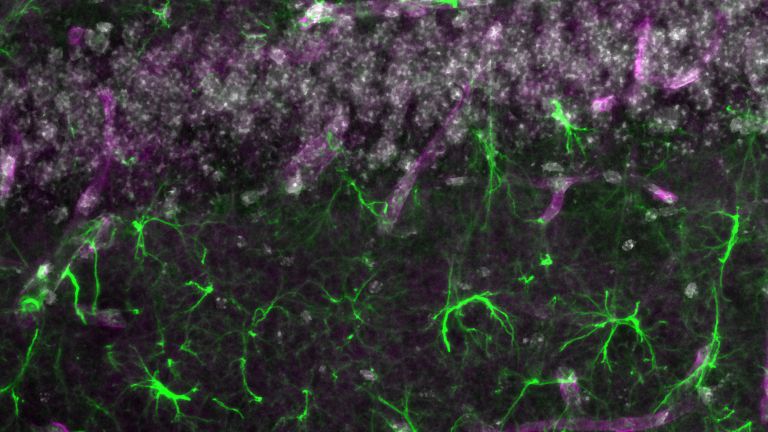
As part of the waste disposal process, cerebrospinal fluid flows through various spaces in the brain ▸ Hidden channels. These include tiny channels that run parallel to the blood vessels. They are located between the blood vessels and the surrounding tissue.
The cerebrospinal fluid then enters the brain tissue. This is where the glial cells – more specifically, astrocytes – come into play. These brain cells have water-conducting channels in their end feet. Through these channels, the cerebrospinal fluid is distributed into the intercellular spaces of the brain tissue – that is, into the area not occupied by blood vessels, nerve fibers, or cells.
The key point is this: As the cerebrospinal fluid flows through the brain tissue, it absorbs waste products generated by cellular metabolism. As the original studies by Maiken Nedergaard and her colleagues in 2012 made clear, this includes Beta-amyloid. This protein has a bad reputation because the accumulation and deposition of the protein are linked to the development of Alzheimer’s disease ▸When the Brain Gets Cluttered. Ultimately, the cerebrospinal fluid, along with waste products, is transported away via the veins. If the removal of substances like beta-amyloid does not function properly, this could potentially contribute to the development of neurodegenerative diseases such as Alzheimer’s.
Glial cells
Glia cells are the second largest group of cells in the brain after neurons. For a long time, they were considered inactive elements of the brain, referred to as "nerve cement." Today, we know that the different types of glia cells (astrocytes, oligodendrocytes, and microglia in the CNS; Schwann cells in the PNS) perform clearly defined tasks in the nervous system. For example, they respond to pathogens, play an important role in nourishing nerve cells, and insulate nerve fibers. They account for slightly more than 50 percent of the brain's cells, compared to neurons.
Cerebrospinal fluid
liquor cerebrospinalis
A clear fluid that fills the ventricular system and bathes the brain and spinal cord in the subarachnoid space, protecting them from impact. Three to five times a day, 100 to 160 ml of fluid is renewed by the choroid plexus. Certain diseases are reflected in the composition of the cerebrospinal fluid.
Beta-amyloid
A peptide consisting of 36 to 42 amino acids that is considered the main component of senile plaques and is believed to be responsible for the development of Alzheimer's disease. The starting product is the amyloid precursor protein (APP). Certain enzymes in the cell membrane cut the precursor protein into peptides of various sizes. Amyloids consisting of 40 and 42 amino acids are found in senile plaques, with the 42-amino-acid product forming aggregates particularly quickly, at least in the Petri dish. The normal function of beta-amyloid has not yet been conclusively clarified.
Why we sleep
Almost as an aside, Maiken Nedergaard’s research on the glymphatic system has also uncovered a possible reason why we sleep at all. We usually realize how important good sleep is only when we lack it. When the night has once again been far too short, it doesn’t just affect our mood. Most of the time, we’re not mentally on top of our game. Science doesn’t know the exact reason for this.
One of the functions of sleep could be that the brain uses this time to get its own house in order. As Maiken Nedergaard demonstrated in a 2013 study on mice, most waste appears to be cleared away during slumber. The space between the cells in the brain tissue increased by up to 60 percent during sleep due to the shrinkage of the cell bodies.
One of the factors responsible for this is norepinephrine, a Neurotransmitter that regulates alertness. It also appears to control the size of the intercellular space. Norepinephrine-mediated signals apparently alter cell volume, thereby reducing the space between brain cells. When Nedergaard and her colleagues blocked these signals with medication, the space between the cells increased. This led to a more efficient removal of waste products, similar to what happens during sleep.
The obvious advantage of larger intercellular spaces during sleep: With more space between the cells, Cerebrospinal fluid can circulate better and remove waste products more efficiently. In fact, in Nedergaard’s study, Beta-amyloid was cleared from the brains of sleeping mice twice as fast as in awake mice. Another advantage: Sleep allows the glymphatic system to work more intensively. This is because the energy that is otherwise used in the brain for cognitive and other functions is then available for cleansing the brain. In a 2019 study, Nedergaard concluded that waste removal runs at full speed especially during deep sleep: “Sleep is crucial for the function of the brain’s waste removal system,” she says in a press release. “And this study shows that the deeper the sleep, the better.”
Neurotransmitter
A neurotransmitter is a chemical messenger, an intermediary substance. It is released by the sender neuron at the sites of cell-cell communication and has an excitatory or inhibitory effect on the receiver neuron.
Cerebrospinal fluid
liquor cerebrospinalis
A clear fluid that fills the ventricular system and bathes the brain and spinal cord in the subarachnoid space, protecting them from impact. Three to five times a day, 100 to 160 ml of fluid is renewed by the choroid plexus. Certain diseases are reflected in the composition of the cerebrospinal fluid.
Beta-amyloid
A peptide consisting of 36 to 42 amino acids that is considered the main component of senile plaques and is believed to be responsible for the development of Alzheimer's disease. The starting product is the amyloid precursor protein (APP). Certain enzymes in the cell membrane cut the precursor protein into peptides of various sizes. Amyloids consisting of 40 and 42 amino acids are found in senile plaques, with the 42-amino-acid product forming aggregates particularly quickly, at least in the Petri dish. The normal function of beta-amyloid has not yet been conclusively clarified.
Waste removal: Is it really more effective during sleep?
However, a recent study questioned whether sleep truly serves to support waste removal. Nick Franks, professor of biophysics and anesthesiology at Imperial College London, and his colleagues came to exactly the opposite conclusion: substances in the brains of mice were not eliminated more efficiently during sleep – in fact, removal was significantly reduced. “The idea that sleep could rid the brain of metabolic byproducts was appealing,” says Nick Franks. But the data intended to support this had mostly been indirect. “They measured how quickly certain tracer molecules entered the brain. And they interpreted this as a substitute for what was leaving.” His own data, he says, is more direct. In fact, Franks’ team had injected marker molecules into the brain and measured how quickly they exited. Sleep and anesthetics inhibited this clearance. “Therefore, it is unlikely that the clearance of metabolic byproducts is the main reason we need to sleep.”
So it is not entirely clear whether a major cleanup really takes place during sleep. However, evidence is mounting that the brain does indeed have its own cleaning crew. Much like a modern, well-functioning corporate building.