Search
-
- Glossary
All-or-nothing principle
According to this principle, an electrical potential is only triggered in the cell when a certain threshold value of stimulus intensity has been exceeded. The response either occurs completely or not at all.
-
- Basics
- Communication of Cells
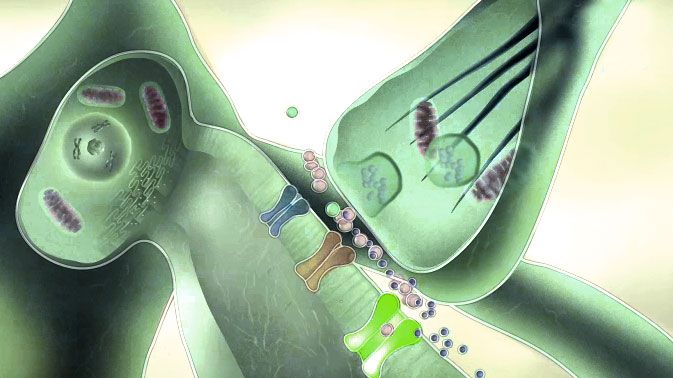
Nerve Cells in Conversation
No chaos despite sensory overload – neurons communicate silently, efficiently, and at breakneck speed.
16.04.2012
-
- Basics
- Communication of Cells
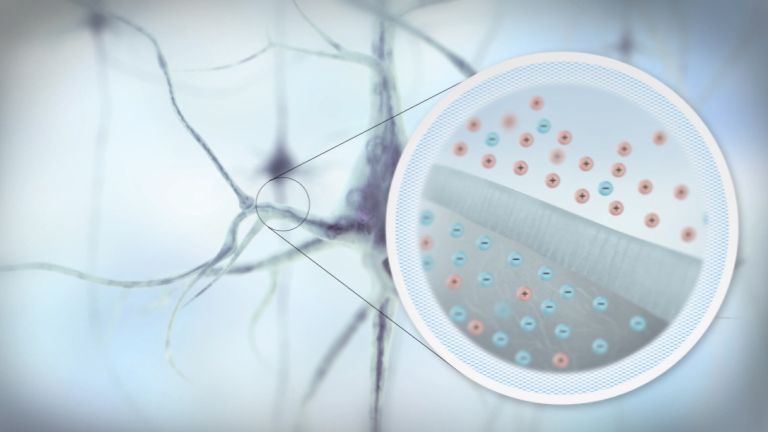
Electrical Potentials: The Language of Neurons
Neurons do not simply transmit stimuli; processing is a sophisticated process.
13.04.2012
-
- Basics
- Structure and Function
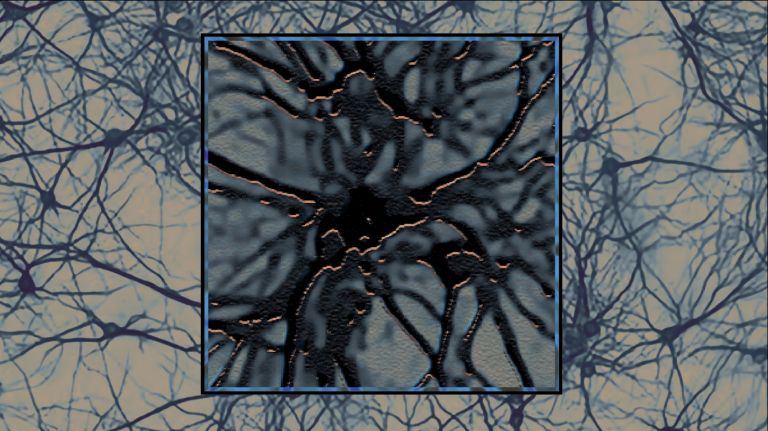
Neural Networks: So Much for “Hard-Wired”
Dialogues in the nervous system: Sometimes bottom-up, sometimes top-down
10.03.2023
-
- Basics
- Structure and Function
The Secret to Success: Communication
No other cell type is better at juggling signals: The neuron is both a data octopus and a supercomputer.
01.12.2020
-
- Basics
- Structure and Function
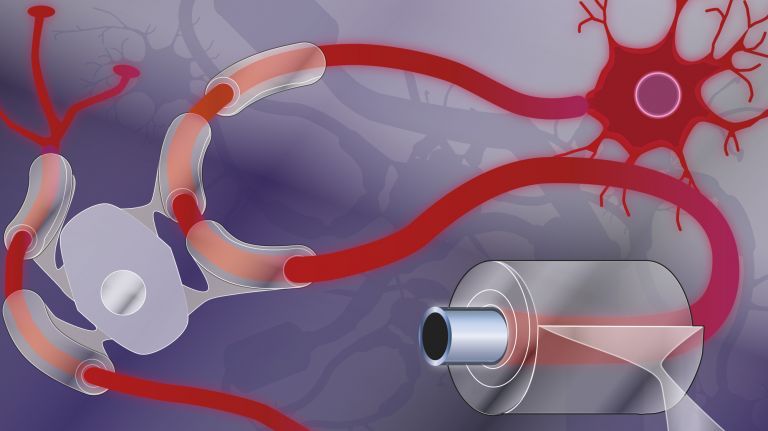
Myelin: High Speed
It is the white sheath that glial cells form around axons that makes high speed pathways in the brain possible.
01.12.2020
-
- Glossary
Action potential
In excitable cells (e.g., neurons or muscle cells), very rapid changes in electrical potential occur across the cell membrane. This event is the basis for signal conduction along the axon of the nerve cell. The action potential continues along the cell membrane and, according to the all-or-nothing principle, only occurs when the cell has been sufficiently excited.
-
- Basics
- Structure and Function
Well-Connected
The brain functions based on neural networks that change and adapt throughout a person's lifetime
30.04.2020
-
- Basics
- Communication of Cells
On the Scent of Cell Communication
A lot has to happen before nerve cells reveal their secrets. A historical review.
22.12.2023