Search
-
- News
- Question to the brain
How does a cochlear implant work?
How does sound reach the brain with a cochlear implant?
27.04.2025
-
- Glossary
Ear drum
A thin membrane at the end of the ear canal that vibrates when sound waves hit it. The eardrum forms the transition from the outer ear to the middle ear. It is approximately 0.1 mm thick and has a maximum diameter of 10 mm. Contrary to what its name suggests, it is funnel-shaped.
-
- Basics
- Structure and Function
Connecting Nerves
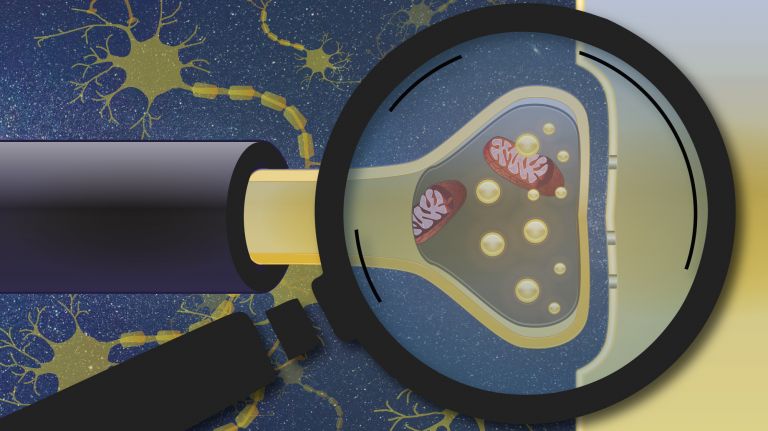
Learning is as spiny path – as synapses vividly illustrate.
01.12.2020
-
- Percieve
- Hearing
Hearing: Structure of the Ear
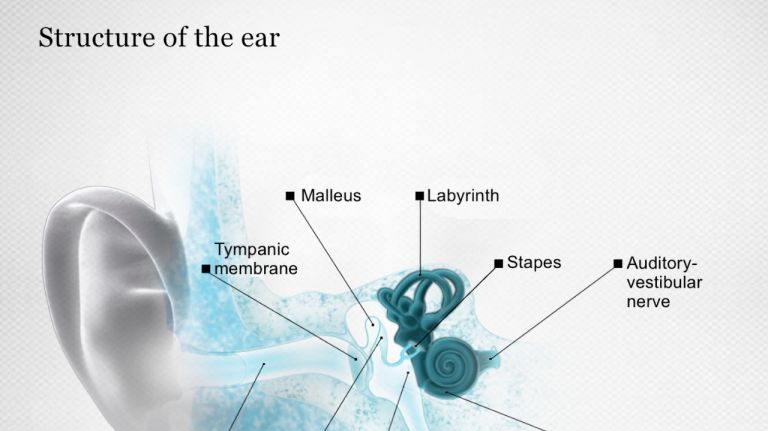
Cochlea or stirrup: The ear consists of many parts that are important for hearing.
23.10.2025
-
- Glossary
Ear canal
Sound waves captured by the outer ear enter the external auditory canal and cause the eardrum at the end of the canal to vibrate.
-
- Basics
- Structure and Function
The Wonders of Life
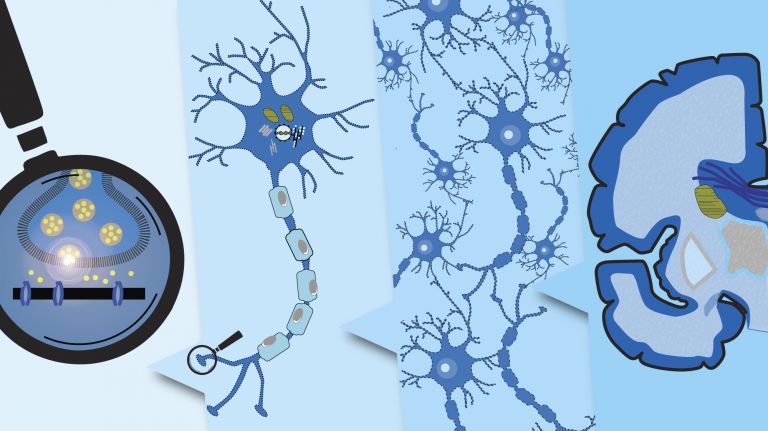
Researchers are examining life in ever greater detail. It is revealed to be intricate and complex – the miracle becomes explainable. Yet this in no way diminishes it.
30.04.2020
-
- Topic
Hearing
Neuroscientists are researching how the brain and the ear transform simple sound waves into fascinating worlds of acoustics.
-
- Glossary
Semicircular canals
The three semicircular canals per ear are interconnected, fluid-filled tubes that are positioned almost at right angles to each other and belong to the balance organ in the inner ear (vestibular apparatus). They serve to register angular accelerations, i.e., rotational movements of the head.
-
- Glossary
Round window
The round window is a membrane-covered opening in the cochlea on the middle ear side. It is connected to the scala tympani and enables the necessary pressure equalization in the inner ear when sound is transmitted through the oval window.
-
- Glossary
Stirrup
The stapes is the third ossicle in the middle ear and the smallest bone in the human body. It transmits its vibrations to the oval window, behind which the inner ear begins.