Search
-
- Basics
- Anatomy
The Striatum
The striatum is not only about complex motor skills, but also about happiness.
28.11.2025
-
- Glossary
Striatum
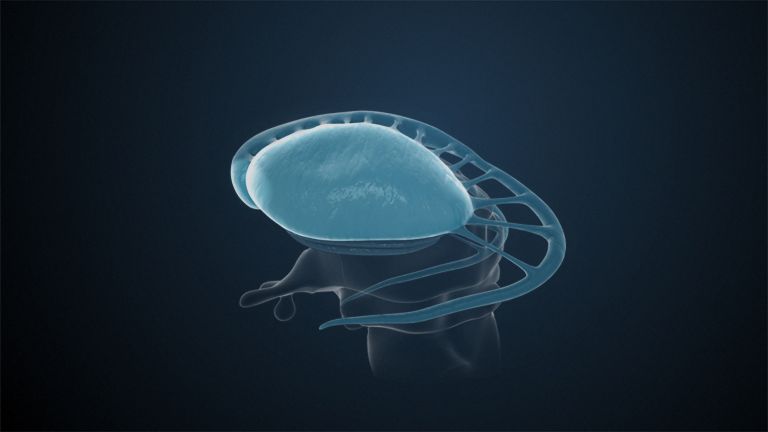
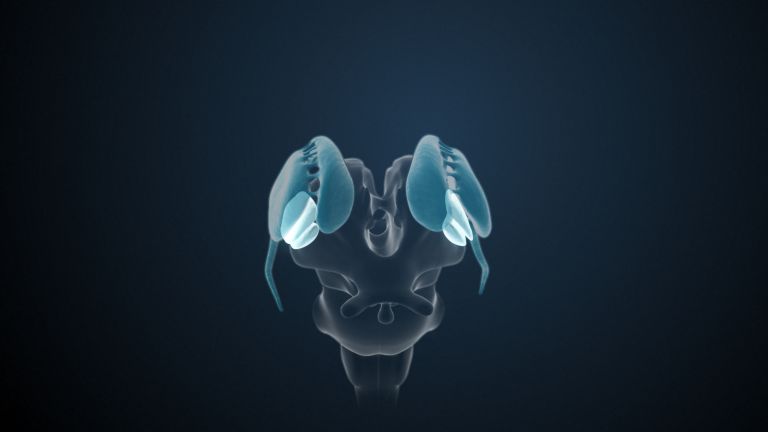
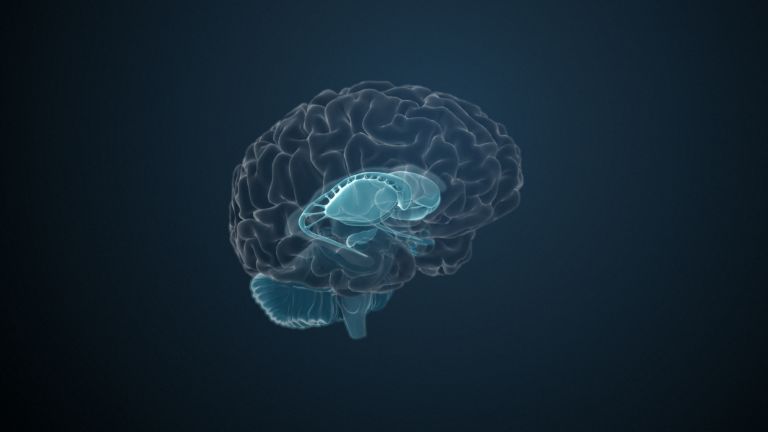
The striatum is a central structure of the basal ganglia. It consists of the caudate nucleus and putamen; the nucleus accumbens is also functionally part of it as its ventral portion. As the most important input structure of the basal ganglia, the striatum plays an essential role in controlling movement sequences as well as in cognition, motivational processes, and the reward system.
-
- Basics
- Anatomy
The Pallidum
The palladium provides a prime example of a highly complex feedback loop.
23.11.2025
-
- Basics
- Anatomy
The Basal Ganglia
Whenever we perform a deliberate movement, core areas deep within the brain are involved.
23.08.2011
-
- Basics
- Anatomy
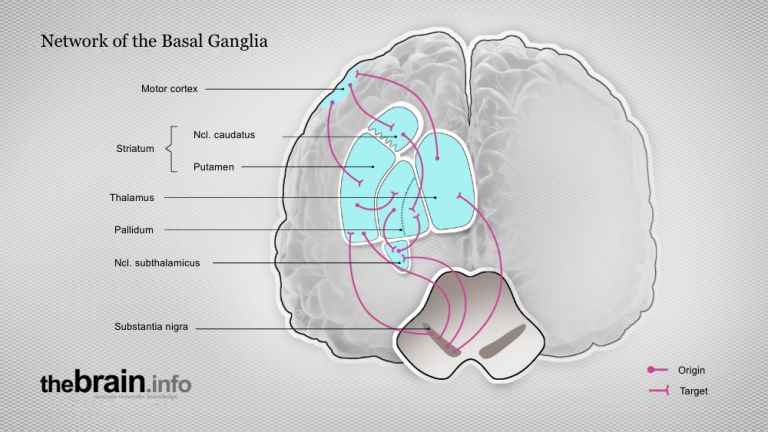
Network of the Basal Ganglia
One nucleus inhibits the other, only so that the cortex can ultimately be stimulated.
13.07.2015
-
- News from the Institutes
A switchboard with precision
How the brain licenses movements
28.05.2025
-
- Basics
- Anatomy
The Sheep Brain: Basal Ganglia
The basal ganglia control motor function and happiness – but in sheep, only unhappiness has been proven.
29.06.2013
-
- Glossary
Caudate nucleus
Part of the basal ganglia, it forms the striatum together with the putamen. Anatomically, the caudate nucleus is located frontally in the center of the brain and extends backward, forming a C shape. It consists of a head (caput nuclei caudati), a body (corpus nuclei caudati), and a tail (cauda nuclei caudati). In contrast to the more motor-related parts of the basal ganglia, this area is strongly connected to the prefrontal cortex in addition to its motor functions. As a result, this part of the striatum is also heavily involved in cognition, motivation, and emotion.
-
- Page
Glossary
15.03.2017
-
- Basics
- Anatomy
The Amygdala
Without the amygdala, humans lose their sense of fear. With the amygdala, they also recognize the fear of others.
22.12.2023