Smell: From the Nose straight to the Brain
Published: 29.11.2013
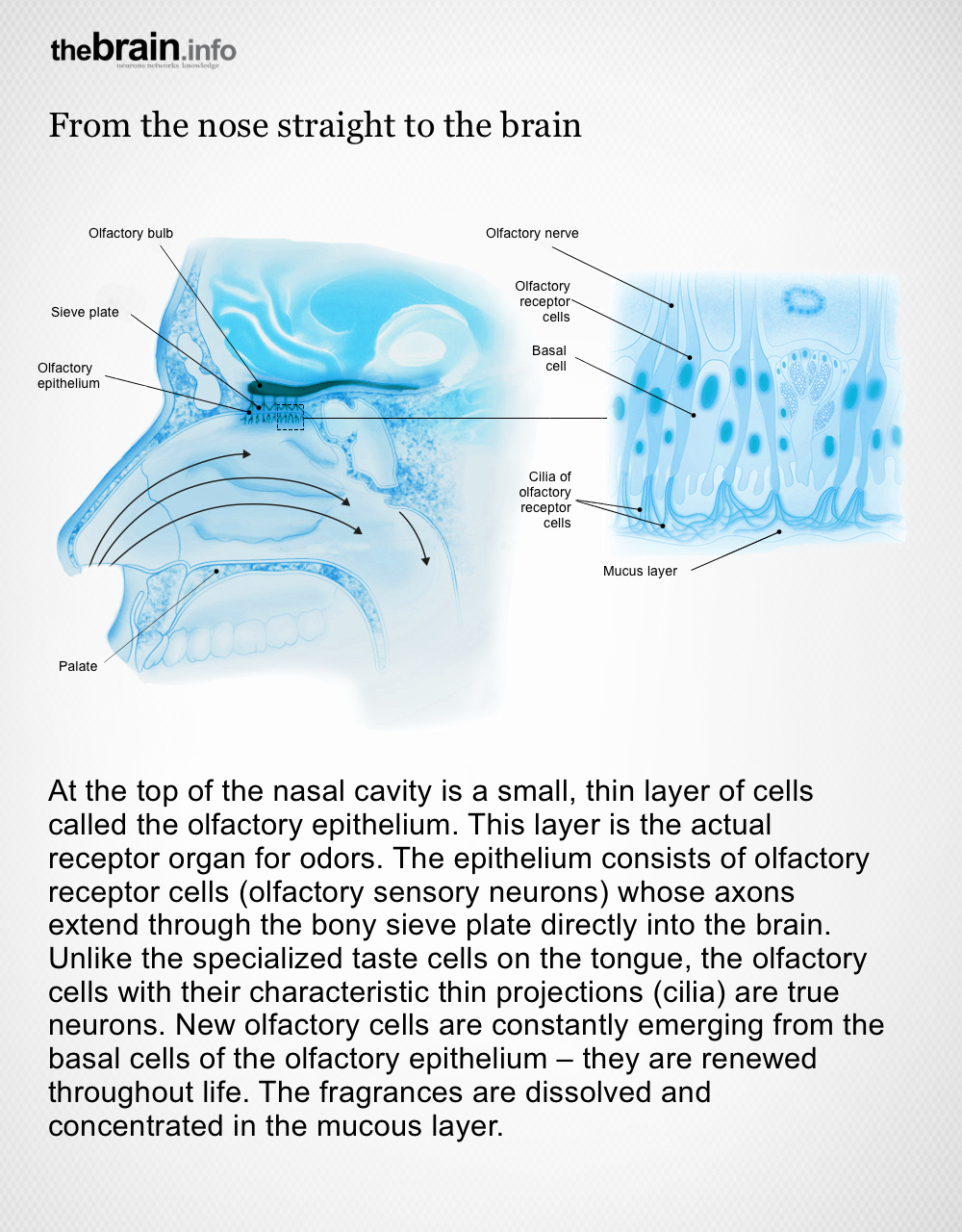
The Olfactory epithelium forms a direct connection between the nasal cavity and the brain. The olfactory Receptor cells are true neurons. Their extensions (axons) penetrate the cribriform plate and reach the Olfactory bulb as olfactory nerves. The olfactory cells are renewed throughout life.
You can find out more about this in the article ▸ The Anatomy of Fragrance.
Olfactory epithelium
An area of olfactory cells measuring approximately 5 cm² located at the rear of the nasal Septum. The axons (long, fiber-like extensions of nerve cells) of the olfactory cells form the olfactory nerve and travel through the ethmoid bone to the olfactory bulb.
A receptor is a protein, usually located in the cell membrane or inside the cell, that recognizes a specific external signal (e.g., a neurotransmitter, hormone, or other ligand) and causes the cell to trigger a defined response. Depending on the type of receptor, this response can be excitatory, inhibitory, or modulatory.
Olfactory bulb
bulbus olfactorius
The anterior part of the brain that transmits information from the olfactory nerves to the olfactory brain (rhinencephalon) after initial processing via the olfactory tract.
Septum
area septalis
The septal nuclei are located medially in the basal forebrain, near the anterior tip of the cingulate gyrus. They are connected to the olfactory cortex and linked to other limbic structures via the fornix. Functionally, they play a role in emotional processes and reward processing.
Receptor
A receptor is a protein, usually located in the cell membrane or inside the cell, that recognizes a specific external signal (e.g., a neurotransmitter, hormone, or other ligand) and causes the cell to trigger a defined response. Depending on the type of receptor, this response can be excitatory, inhibitory, or modulatory.