
How the brain learns to like coffee, chocolate and milkshakes
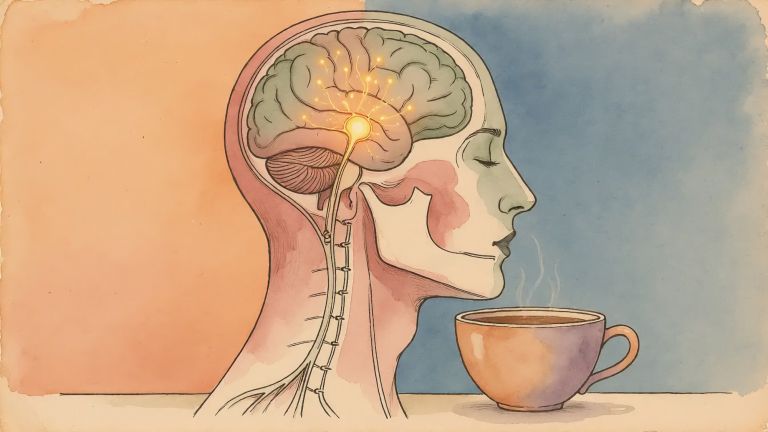
If you think back to your first sip of coffee, it may not have been particularly pleasant. We naturally avoid bitter tastes. So how do coffee fans learn to love it? An international study involving the Max Planck Institute for Metabolism Research has now shown how the brain links taste to bodily signals. A dopamine signalling pathway between the gut and the brain helps us to learn what happens in the body after eating or drinking. The findings, published in Nature, explain how the brain learns from dietary experiences, whilst also providing insight into a fundamental principle of learning.
Published: 11.11.2026
To the point
- Circuit between the gut and the brain discovered: Nutrients in the gut trigger a long-lasting Dopamine signal in the basolateral Amygdala. The circuit links this delayed bodily signal with the immediate Taste sensation of a food.
- Key aspects also detectable in humans: Imaging studies show involvement of the left basolateral amygdala – the same brain region as in the mouse model.
- Fundamental learning principle: The brain links sensory impressions from the environment with signals from the body. The study illustrates this principle using food as an example: experiences can thus be categorised and utilised for future behaviour.
The taste of a food provides the brain with an initial, rapid piece of information. However, whether a food actually supplies the body with energy or important nutrients only becomes apparent later, once the food has reached the digestive system. To learn from this, the brain must link both pieces of information together, even though they arrive at different times.
In experiments with mice, the researchers demonstrated that nutrients in the gut trigger a sustained release of dopamine in the anterior basolateral amygdala. This region of the brain is involved in learning, evaluation and Motivation. When this circuit was disrupted, the mice continued to eat normally but were no longer able to learn that a particular taste was associated with calories. When it was artificially activated, the animals learnt the corresponding association even without actually consuming any nutrients.
Unlike many known dopamine signals, which respond very quickly to external stimuli, the newly described signal only builds up after the intake of nutrients and persists over a longer period. This makes it particularly well-suited to linking delayed feedback from the body with previous sensory impressions.
“We were able to show that this dopamine signal helps us to learn to like certain foods over time, and we can see where and how this happens in the brain,” says Zachary Knight of the University of California, San Francisco, one of the study’s lead authors. “Once your brain has learnt to associate the taste of your favourite coffee with the caffeine kick, that coffee starts to taste much better.”
Dopamine
Dopamine is an important neurotransmitter in the central nervous system that belongs to the catecholamine group. It plays a role in motor function, motivation, emotion, and cognitive processes. Disruptions in the function of this transmitter play a role in many brain disorders, such as schizophrenia, depression, Parkinson's disease, and substance dependence.
Amygdala
corpus amygdaloideum
An important core area in the temporal lobe that is associated with emotions: it evaluates the emotional content of a situation and reacts particularly to threats. In this context, it is also activated by pain stimuli and plays an important role in the emotional evaluation of sensory stimuli. Inaddition, it is involved in linking emotions with memories, emotional learning ability, and social behavior. The amygdala is part of the limbic system.
Taste
The sensory impression we refer to as "taste" results from the interaction between our senses of smell and taste. In terms of sensory physiology, however, "taste" is limited to the impression conveyed to us by the taste receptors on the tongue and in the surrounding mucous membranes. It is currently assumed that there are five different types of taste receptors that specialize in the taste qualities sweet, sour, salty, bitter, and umami. In 2005, scientists also identified possible taste receptors for fat, whose role as a distinct taste quality is still being investigated.
Motivation
A motive is a reason. When this motive takes effect, the living being feels motivation – it strives to satisfy its need. For example, for food, protection, or reproduction. Motivation can be intrinsic (from within, e.g., curiosity) or extrinsic (from outside, e.g., reward).
A similar mechanism in humans
Researchers at the Max Planck Institute for Metabolism Research used imaging techniques to investigate whether a similar mechanism is also at work in humans. In one experiment, they measured where in the brain Dopamine is released after consuming a milkshake. In a further experiments, they recorded participants’ brain activity after they had drunk a glucose solution or water. Both approaches indicated involvement of the left basolateral Amygdala. The results thus show that key aspects of the mechanism found in mice are also detectable in the human brain.
“Our brain is constantly linking sensory impressions with information from the body,” says Marc Tittgemeyer from the Max Planck Institute for Metabolism Research. “The study shows how dopamine brings this diverse information together, thereby enabling learning. It is particularly exciting that we were able to demonstrate this process not only in an animal model but also in humans.”
Dopamine
Dopamine is an important neurotransmitter in the central nervous system that belongs to the catecholamine group. It plays a role in motor function, motivation, emotion, and cognitive processes. Disruptions in the function of this transmitter play a role in many brain disorders, such as schizophrenia, depression, Parkinson's disease, and substance dependence.
Amygdala
corpus amygdaloideum
An important core area in the temporal lobe that is associated with emotions: it evaluates the emotional content of a situation and reacts particularly to threats. In this context, it is also activated by pain stimuli and plays an important role in the emotional evaluation of sensory stimuli. Inaddition, it is involved in linking emotions with memories, emotional learning ability, and social behavior. The amygdala is part of the limbic system.
Left and right react differently
It was also striking that the left and right hemispheres of the brain reacted differently. Signals generated directly whilst eating were more strongly linked to the right Amygdala. Later signals from the gut, by contrast, triggered a stronger reaction in the left amygdala. This could explain how the brain links immediate Taste impressions with later feedback from the body.
Amygdala
corpus amygdaloideum
An important core area in the temporal lobe that is associated with emotions: it evaluates the emotional content of a situation and reacts particularly to threats. In this context, it is also activated by pain stimuli and plays an important role in the emotional evaluation of sensory stimuli. Inaddition, it is involved in linking emotions with memories, emotional learning ability, and social behavior. The amygdala is part of the limbic system.
Taste
The sensory impression we refer to as "taste" results from the interaction between our senses of smell and taste. In terms of sensory physiology, however, "taste" is limited to the impression conveyed to us by the taste receptors on the tongue and in the surrounding mucous membranes. It is currently assumed that there are five different types of taste receptors that specialize in the taste qualities sweet, sour, salty, bitter, and umami. In 2005, scientists also identified possible taste receptors for fat, whose role as a distinct taste quality is still being investigated.
A fundamental principle of learning
The findings go beyond the question of how the brain learns about food. They demonstrate a fundamental principle of learning. The brain links sensory impressions from the environment with signals from the body. In this way, experiences can be categorised, evaluated and used to guide future behaviour. In the long term, these findings could help us better understand why certain foods become particularly appealing and whether such learning processes can be specifically influenced.
Original publication
James C. R. Grove, Anna M. Hakimi, Queenie Li, Jingkun Zhang, Heiko Backes, Bojana Kuzmanovic, Jaewon Choi, Violeta Ubadiah, Longhui Qiu, Zhengya Liu, Dana M. Small, Marc Tittgemeyer & Zachary A. Knight;
The neural basis of flavour–nutrient learning; Nature (2026)
DOI
