Energy!
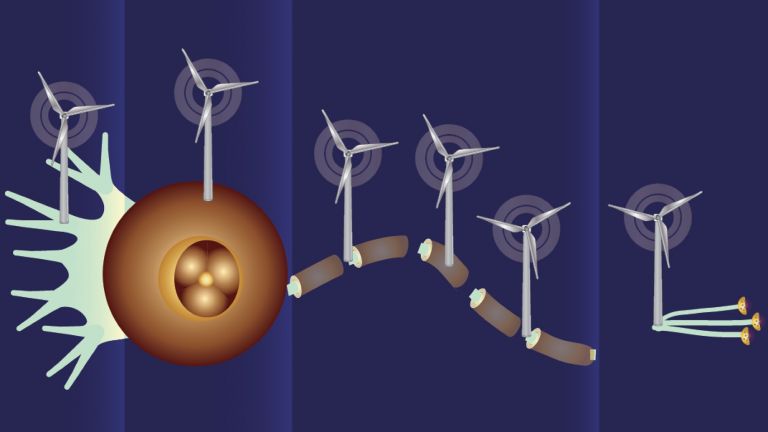
No other organ in our body consumes as much energy as the brain. In humans, it consists of around 86 billion neurons, and although a lot of energy is used for communication via electrical impulses on the membrane, the processes inside the cell also consume a considerable amount. This energy is supplied by certain cell organelles called mitochondria, which form the main powerhouse of all body cells. But unlike other cells, neurons are sometimes extremely long, with dendrite trees and axons that can grow to a meter or more in length. And even their furthest end, the terminal button, needs energy because it has to release its messenger substances at the synapse.
These four compartments of the neuron – dendrites, cell body, axon, and presynapse – have different supply requirements, but all need energy immediately. In the case of axons, for example, special glial cells called oligodendrocytes are recruited. We actually know them more as accelerators of the action potential, but this is probably more of a side effect of their primary evolutionary task: supplying energy.
The Homeo-Hirn research network is investigating how the cell ensures the supply in all its compartments and, despite all the diverse requirements, still maintains the energetic balance, homeostasis. This is done partly with specially developed methods and always with a view to diseases of the nervous system – for example, after strokes or multiple sclerosis.
The text Energy Supply of Neurons by Nora Schultz provides an initial overview.