The Connectome
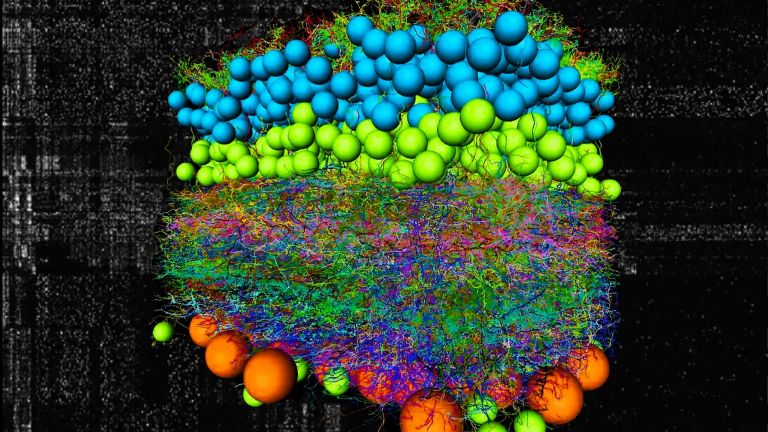
Science has often changed the way humans view the world. Aristotle believed that the brain was merely a cooling system for the blood and that the human soul resided in the heart. But back then, the sun still revolved around the Earth.
Since then, we have made some progress in our understanding of the brain: we owe Ramón y Cajal not only the first images of neurons, but also the realization that these are individual units and that the brain is not a coherent mass. How nerve cells communicate – pharmacologically via chemical messengers or physiologically via electrical impulses – led to a lively dispute ( "soup vs. spark" ) that ended in a fair compromise: Both are correct. Numerous insights were gained during World War II , through the treatment of epileptics , and through functional magnetic resonance imaging. Advances in genetic engineering and microscopy have greatly expanded the methodological toolbox, and scientists are now researching not only brain areas and synapses, but also mapping the brain at the cellular level: the connectome.
Its goal is nothing less than to map all connections between every neuron and every other neuron – an enormous task! One that requires us to get used to incredible numbers: in just 500,000 cubic micrometers of tissue, there are 89 neurons with a total axon length of 1.79 meters. Including dendrites, there are even 2.69 meters of fibers! This shows the complexity of our brain on a whole new scale.
Significant research on this highly exciting topic is taking place at the Max Planck Institute for Brain Research in Frankfurt. There, Moritz Helmstaedter and his colleagues are developing Neuroanatomy 2.0.
To start with, our author Christian Wolf asks: Are we our connectome?