Alois Alzheimer: Mad-Doctor with a Microscope
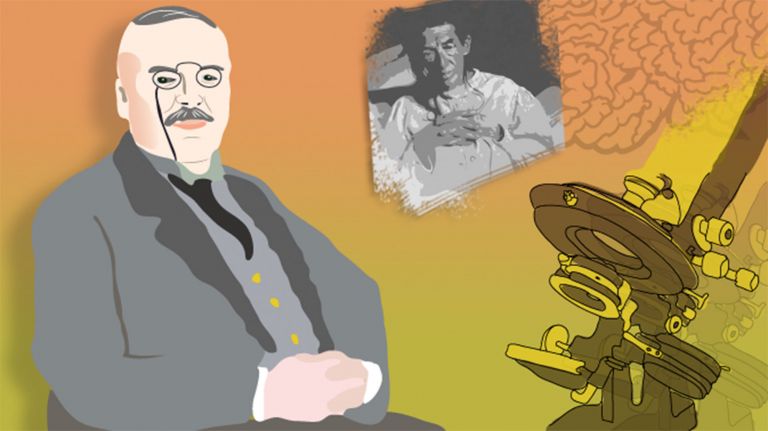
He was so fascinated by the mysterious symptoms of one patient that he did everything he could to examine her. It took not only his perseverance, but also numerous strokes of luck for Alois Alzheimer to become famous.
Scientific support: Dr. Oliver H. Peters
Published: 18.09.2013
Difficulty: easy
- Alois Alzheimer met Auguste Deter in 1901. She showed unusual confusion for a 51-year-old. She could remember almost nothing.
- Even when Alois Alzheimer moved to another clinic, he kept himself informed about the progression of Auguste Deter's illness.
- After Auguste Deter's death, Alois Alzheimer found noticeable changes in her brain: The Cortex had shrunk, and under the microscope he saw unusual fibrils and plaques.
- When Alois Alzheimer presented his findings on Auguste Deter at a conference, the scientific world reacted with disinterest.
- His name was first linked to this disease in a textbook by his chief Emil Kraepelin: “Alzheimer's Disease.”
Cortex
cortex cerebri
Cortex refers to a collection of neurons, typically in the form of a thin surface. However, it usually refers to the cerebral cortex, the outermost layer of the cerebrum. It is 2.5 mm to 5 mm thick and rich in nerve cells. The cerebral cortex is heavily folded, comparable to a handkerchief in a cup. This creates numerous convolutions (gyri), fissures (fissurae), and sulci. Unfolded, the surface area of the cortex is approximately 1,800cm².
Plaques
Senile plaques
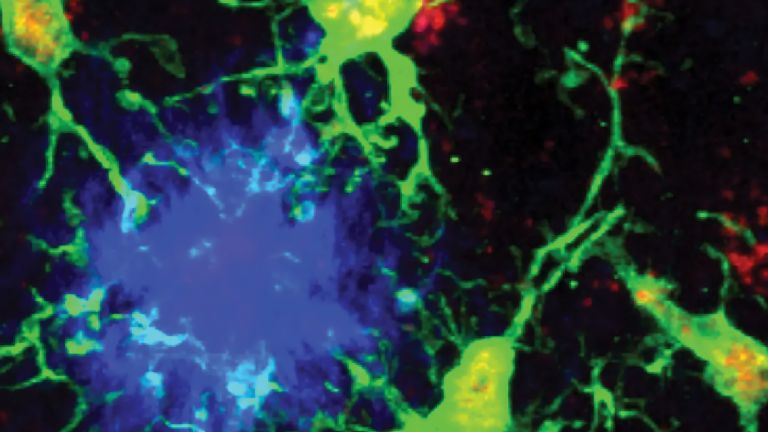
Senile plaques accumulate in the gray matter of the brain when a protein – known as amyloid precursor protein – is not broken down correctly. Inflammation and disorders of fat or sugar metabolism can promote plaque formation. On average, the deposits reach a diameter of 50 micrometers. The appearance of plaques is one of several anatomical changes in the brain that pathologists can use to diagnose Alzheimer's disease after death.
June 14, 1864 Alois Alzheimer is born in Marktbreit in Lower Franconia
1884–1888 Studies medicine and obtains his doctorate in Berlin, Würzburg, and Tübingen
1888–1902 Works as a physician at the Institution for the Insane and Epileptic in Frankfurt am Main
1895 Marries widow Cecile Geisenheimer, who bears him three children
1901 Death of Cecile Alzheimer
1901 First encounter with patient Auguste Deter
1902–1912 Works under Emil Kraepelin, initially in Heidelberg, then from 1903 at the Psychiatric Clinic in Munich
1906 Lecture before the Assembly of Southwest German Psychiatrists in Tübingen, in which Alzheimer first describes the disease that would later be named after him
1912 Appointment as professor at the University of Breslau
December 19, 1915 Alois Alzheimer dies of kidney failure
At first, Alois Alzheimer only knows Auguste Deter from her medical records. She is only 51 years old, but she shows a level of confusion that is more commonly expected in very old people. Her husband has admitted her to the Institution for the Insane and Epileptics in Frankfurt am Main. At that time, in 1901, Alzheimer is a senior physician there, and his assistant physician, Fritsche, has conducted the patient's initial examination. What he wrote about it aroused Alzheimer's curiosity, and he paid Deter a visit. He documented his first conversation in detail:
“What is your name?”
“Auguste.”
“Family name?”
“Auguste.”
“What is your husband's name?”
“I think Auguste.”
“Your husband?”
“Oh, my husband...”
“Are you married?”
“To Auguste.”
The entire conversation continues in this vein: Sometimes Auguste Deter answers normally, but most of the time her answers do not really match the questions. Alzheimer finds this so extraordinary that he immediately decides to pay special Attention to the patient. This decision has far-reaching consequences, because it means that today, more than 100 years after this encounter, the name Alzheimer is known worldwide and is inextricably linked to a common form of Dementia. But for this fame to come about, it took many coincidences – and the perseverance of Alzheimer, whose research findings were initially ignored by the scientific community.
The first stroke of luck was the aforementioned Frankfurt institution where Alzheimer was working at the time of his encounter with Deter. This institution did not limit itself to locking up the mentally ill, as was still common practice in many places at the time. Instead, it placed great importance on treating patients according to the most modern psychiatric findings of the time. Alcoholics, for example, were given work therapy, while those suffering from delusions were given long baths. Above all, however, the doctors dealt with the patients in depth – otherwise Deter's unusual symptoms would not have been described and examined in such detail.
“Write ‘Mrs. Auguste Deter,’” Alzheimer instructs her on the first day of examination. She writes “Mrs.,” then stops, having already forgotten the rest. When he prompts her with the next word, she first writes ‘Augtr’ and then “Auguse.” It is as if her former knowledge is only returning in small fragments. The piece of paper with the writing attempts is part of the medical file that was long considered lost and was only found in 1995 in the archives of the Frankfurt University Hospital. The quoted dialogue and the now world-famous photo of the first diagnosed Alzheimer's patient, Auguste Deter, also come from this file.
Attention
Attention
Attention serves as a tool for consciously perceiving internal and external stimuli. We achieve this by focusing our mental resources on a limited number of stimuli or pieces of information. While some stimuli automatically attract our attention, we can select others in a controlled manner. The brain also unconsciously processes stimuli that are not currently the focus of our attention.
Dementia
Dementia
Dementia is an acquired deficit of cognitive, social, motor, and emotional abilities. The most well-known form is Alzheimer's disease. "De mentia" means "without mind" in English.
stroke
Cerebral apoplexy
In a stroke, the brain or parts of it are no longer supplied with sufficient blood, which impairs the supply of oxygen and glucose. The most common cause is a blockage in an artery (ischemic stroke), less commonly a hemorrhage (hemorrhagic stroke). Typical symptoms include sudden visual disturbances, dizziness, paralysis, speech or sensory disturbances. Long-term consequences can include various sensory, motor, and cognitive impairments.
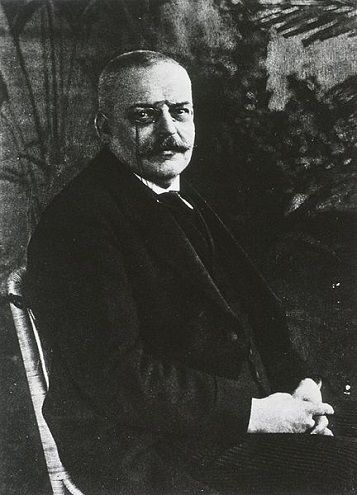
The paths of doctor and patient diverge
“Her entire demeanor bore the stamp of complete helplessness”, Alzheimer later said about her. “When reading, she jumps from one line to the next, reading letter by letter or with meaningless emphasis.” She often has crying fits because she is so angry at her own inability. “I have lost myself, so to speak,” she once said. A year after her admission, her husband has difficulty paying the costs of her stay in the institution, and Deter is to be transferred to another clinic. Alzheimer has now developed such a keen scientific interest that he campaigns vigorously for Deter to remain. He writes certificates and petitions to the authorities and convinces his head – with success, she stays.
Alzheimer, on the other hand, leaves the institution shortly afterwards. He wants to pursue a scientific career and qualify as a professor under a famous psychiatrist: Emil Kraepelin. He conducts research with him, first in Heidelberg, later in Munich. But he cannot let go of the case of Auguste Deter and regularly checks in with his former colleagues in Frankfurt to find out how her illness is progressing. He learns that the patient is getting worse and worse. "Always lies in bed with her legs drawn up; regularly soiled with feces and urine; never speaks. She just hums to herself and has to be fed. Sometimes she becomes agitated for no apparent reason, disturbing others with loud screaming and humming," states an entry in her medical record from July 1905. She died a year later from blood poisoning as a result of bedsores.







Auguste Deter's brain is dissected
After her death, the most decisive coincidence for Alzheimer's later fame occurs. He has not been Deter's doctor for four years, but nevertheless manages to persuade his former head in Frankfurt to do something unusual: he has the brain of the patient with the mysterious disease sent to Munich.
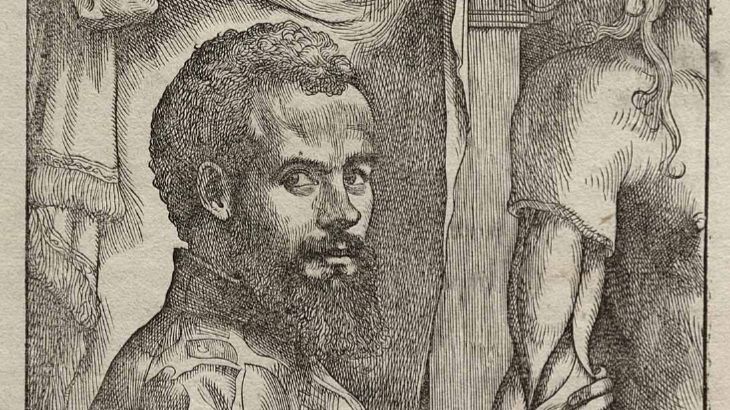
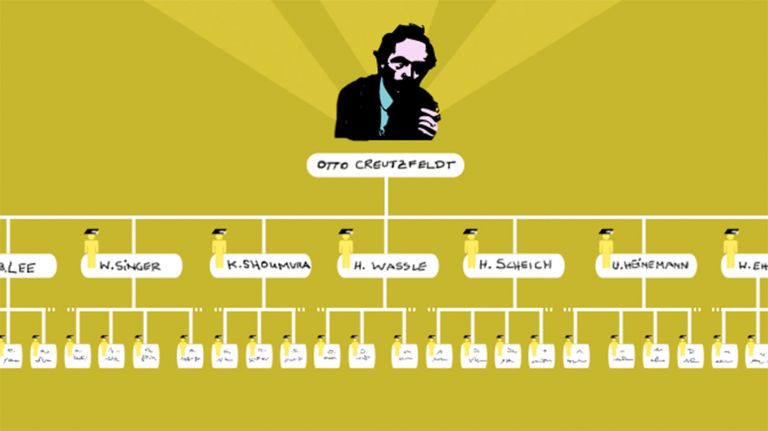
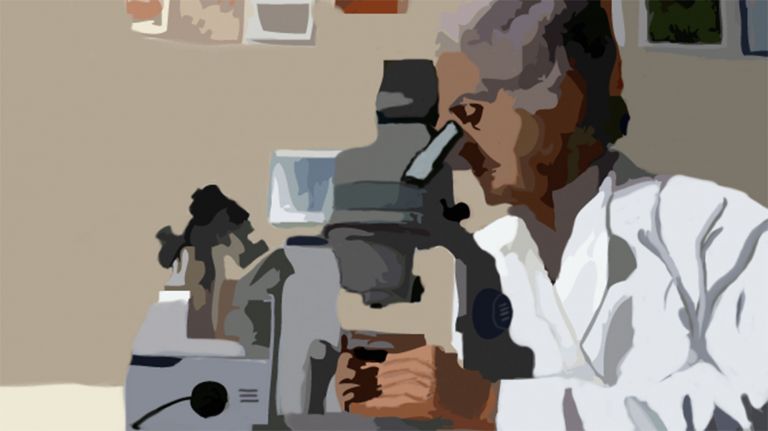
Alzheimer was highly trained in examining the organ – another stroke of luck. During his studies in Würzburg, a luminary had initiated him into the secrets of microscopy: Albert von Kölliker. His students included the future Nobel Prize winner Alfonso Corti, who discovered the organ of Corti, and Franz von Leydig, who discovered Leydig cells. Franz Nissl, inventor of Nissl staining and discoverer of Nissl bodies, became a good friend of Alzheimer. His passion for examining brain sections dates back to this time; he is often referred to as the “mad-doctor with a microscope.” His skill in this field stands him in good stead when analyzing Deter's brain.
First, he notes that the cerebral Cortex has shrunk significantly. Using a microscope, he discovers two further abnormalities: unusual fibrils are visible. He also finds strange lumpy structures, known as plaques, in the cells. Alzheimer speculates that a metabolic product has accumulated there and promoted the disease – a conjecture that proves to be correct decades later.
stroke
Cerebral apoplexy
In a stroke, the brain or parts of it are no longer supplied with sufficient blood, which impairs the supply of oxygen and glucose. The most common cause is a blockage in an artery (ischemic stroke), less commonly a hemorrhage (hemorrhagic stroke). Typical symptoms include sudden visual disturbances, dizziness, paralysis, speech or sensory disturbances. Long-term consequences can include various sensory, motor, and cognitive impairments.
Cortex
cortex cerebri
Cortex refers to a collection of neurons, typically in the form of a thin surface. However, it usually refers to the cerebral cortex, the outermost layer of the cerebrum. It is 2.5 mm to 5 mm thick and rich in nerve cells. The cerebral cortex is heavily folded, comparable to a handkerchief in a cup. This creates numerous convolutions (gyri), fissures (fissurae), and sulci. Unfolded, the surface area of the cortex is approximately 1,800cm².
1906: The Congress in Tübingen
In 1906, Alzheimer proudly presents his findings at the Meeting of Southwest German Psychiatrists in Tübingen. Many important scientists are present, including those who would later give their names to phenomena such as “Bumke's Zeichen” (Oswald Bumke), “Binswanger's disease” (Otto Binswanger), and “Doederlein's bacillus” (Albertz Döderlein). None of them have any idea of the importance of the findings Alzheimer presentsby . None of the researchers present asked any questions – that's how unimportant they found the lecture. It was much more exciting to argue about a new scientific discipline: psychoanalysis. After all, C.G. Jung, a student of Sigmund Freud, was present. Diseases that cannot be traced back to childhood experiences but – as in the case of Auguste Deter – have physiological causes in the brain are of no interest. The minutes of the event describe Alois Alzheimer's lecture, which was later so often quoted, as “not suitable for a presentation.” It only appeared in a specialist magazine a year later.
The fact that the disease was named after him despite this ignorance on the part of the scientific world is thanks to another stroke of luck: Emil Kraepelin, his chief at the clinic in Munich, is the author of the seminal work Psychiatrie: ein Lehrbuch für Studierende und Ärzte (Psychiatry: A Textbook for Students and Doctors). The 8th edition is about to be revised, and in it he mentions his colleague in the chapter “Senile and Presenile Insanity”: “Alzheimer described a peculiar group of cases with very severe cellular changes.” The table of contents contains the first mention of the name of the disease that would later become so famous: “Alzheimer's disease.”
stroke
Cerebral apoplexy
In a stroke, the brain or parts of it are no longer supplied with sufficient blood, which impairs the supply of oxygen and glucose. The most common cause is a blockage in an artery (ischemic stroke), less commonly a hemorrhage (hemorrhagic stroke). Typical symptoms include sudden visual disturbances, dizziness, paralysis, speech or sensory disturbances. Long-term consequences can include various sensory, motor, and cognitive impairments.
Further reading
- Maurer, K et al: Auguste D and Alzheimer’s disease. Lancet 1997 (349)1546 – 49 (to the text).