
Prions: Proteins That Drive You Crazy
For a handful of special proteins, the rules of biology don’t seem to apply. How they cause mad cow disease and were able to spread to humans is a creepy story.
Scientific support: Dr. Hermann Altmeppen
Published: 02.05.2023
Difficulty: easy
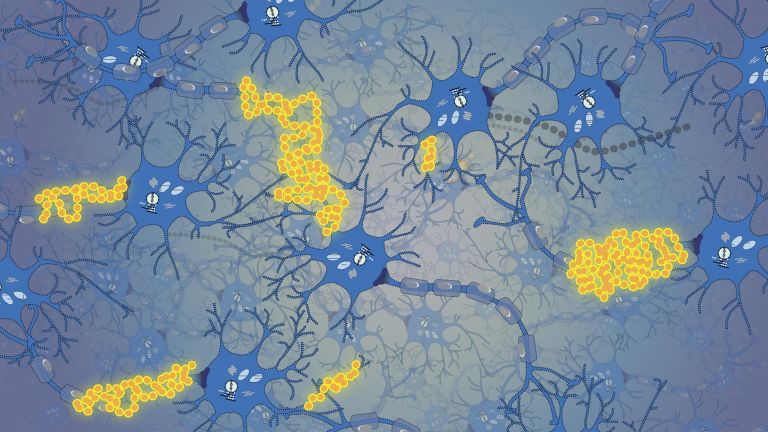
- Prions are infectious proteins whose transmission can trigger a range of diseases even without the involvement of genetic material. This occurs in the manner of a chain reaction, in which the misfolded, disease-causing prions refold their natural counterpart, the cellular prion protein. This leads to the formation of aggregates and the death of nerve cells.
- The prion hypothesis, proposed by Stanley Prusiner, was long controversial but was awarded the Nobel Prize in Medicine in 1997 and has been extensively corroborated by experiments.
- Examples of prion diseases in animals include scrapie (in sheep and goats), bovine spongiform encephalopathy (BSE) in cattle – transmitted through the feeding of sheep carcasses – and chronic wasting disease in deer, moose, and roe deer.
- Transmissible prion diseases in humans include kuru, which was transmitted among certain indigenous peoples in New Guinea through ritual cannibalism, and “variant Creutzfeldt-Jakob disease” (vCJD), which was triggered by contaminated beef products in the mid-1980s and has since claimed over 200 lives. Prion diseases have also been unintentionally transmitted through medical procedures, such as corneal transplants.
- In humans, hereditary prion diseases also occur, such as the familial form of CJD, Gerstmann-Sträussler-Scheinker (GSS) syndrome, and Fatal Familial Insomnia (FFI). These are caused by specific mutations in the Gene (PRNP) that encodes the prion protein. They are autosomal-dominant hereditary diseases.
- The sporadic form of CJD, which occurs without any identifiable genetic or external causes, accounts for by far the largest proportion of all human prion diseases.
- In several neurodegenerative diseases (Alzheimer’s, Parkinson’s, Huntington’s), misfolded proteins also form large aggregates and deposits in the brain. Various forms of these misfolded proteins likewise lead to the destruction of synapses and the death of nerve cells. Despite these similarities, however, these diseases are not contagious in the conventional sense. Classifying them as prion diseases is controversial.
Gene
Information unit on DNA. Specialized enzymes translate the core component of a gene into ribonucleic acid (RNA). While some ribonucleic acids perform important functions in the cell themselves, others specify the order in which the cell should assemble individual amino acids into a specific protein. The gene thus provides the code for this protein. In addition, a gene also includes regulatory elements on the DNA that ensure that the gene is read exactly when the cell or organism actually needs its product.
Had Stanley Prusiner been born a few hundred years earlier, he might have been burned at the stake as a heretic. Or at least expelled from the community of believers. For the virologist at the University of California, San Francisco, and Berkeley had challenged the creed of his profession. The “Central Dogma of Molecular Biology” dates back to 1958 and was formulated by none other than Francis Crick, a co-founder of modern biology and a rather immodest genius. This dogma states that information in biological systems always flows from the genetic material DNA to the messenger molecule RNA and is ultimately translated into proteins. The notion that a single protein could be sufficient to transmit a disease was, in fact, incompatible with this. Yet this was precisely what Prusiner had claimed. Or at least, he had pursued and expanded upon this hypothesis. Strictly speaking, the idea of an infectious protein had already emerged in the 1960s.
His initial focus was on sheep – the subjects of his studies – that had died of scrapie (from the English “to scratch”). This deadly animal disease, characterized by gait and behavioral disorders, had been known in Europe since the 18th century, and the animals’ brains, riddled with cavities, had also been described time and again.
Using tissue samples and blood, the disease could be transmitted in the laboratory from sick to healthy sheep – as well as to goats, minks, rats, and mice. U.S. researchers had already achieved something similar in 1972 when they transmitted infectious material from the brains of sheep, first to mice and then from the mouse brains to Javanese macaques (Macaca fascicularis) – an early key experiment, even though the authors of the study assumed that a virus was behind the disease.
However, this suspicion was not confirmed. The pathogen was unusually resilient, slipping through even the finest filters and surviving a wide variety of methods for inactivating nucleic acids. When protein-cleaving enzymes (proteases) were added, however, the tissue samples lost at least some of their infectivity. By 1982, Prusiner had gathered enough evidence. He published his discovery in the journal Science under the headline: “Novel proteinaceous infectious particles cause scrapie”. Prusiner named these mysterious pathogens “prions,” derived from the English term “proteinaceous infectious particles.”
Nobel prize for an outsider
The scientific outsider spent about ten more years defending his prion hypothesis against the doubts and attacks of many of his fellow researchers. But he was proven right and – in recognition of his perseverance – was honored in 1997 with the Nobel Prize in Physiology or Medicine. Today we know that while the blueprint for prion proteins is encoded in a sequence of DNA building blocks just like that of “normal” proteins – and the pathway from DNA to RNA to protein is thus fully established, in accordance with the dogma – the prion protein (PrP) encoded in the genome can adopt an alternative conformation (that is, an alternative three-dimensional folding pattern) aggregate with other prion proteins, and then impose its abnormal structure on normal prion proteins. In rare cases, and often over long periods of time, this can lead to a fatal chain reaction that goes unnoticed for many years.
All of this might have remained nothing more than a footnote in veterinary medicine had it not been for the discovery of a whole series of other diseases that resemble scrapie and can also affect humans. According to Prusiner himself, his interest as a physician was piqued when a patient with the rare Creutzfeldt-Jakob disease (CJD) under his care died. Typical symptoms of this disease – which remains incurable to this day – include movement disorders, Memory loss, and confusion, as well as a rapid progression that is usually fatal within four months to two years.
The neurologist was also fascinated by rumors of a mysterious disease called kuru, which was prevalent among some indigenous peoples in the eastern half of New Guinea (now Papua New Guinea) and was apparently spread there through ritual cannibalism until around 1950. The first white people to venture into the highlands in 1933 literally encountered a forgotten world. The people there were still living in the Stone Age, belonged to dozens of tribes that waged war against one another, and spoke different languages and dialects.
Memory
Memory is a generic term for all types of information storage in the organism. In addition to pure retention, this also includes the absorption of information, its organization, and retrieval.
Researchers among cannibals
Numerous reports – not only from missionaries but also from anthropologists and the famous American ethnologist Margaret Mead – confirm that cannibalism was widespread. After visiting the village of Timbunke on the Sepik River, she wrote: “The river is synonymous with mosquitoes, crocodiles, cannibals, and corpses floating in the water – and I can assure you, I’ve seen it all.” Michael Rockefeller, a member of the well-known American family and an amateur ethnographer, disappeared in 1961 on the southern coast of New Guinea and, according to his biographer, was killed by members of the Asmat people.
Eventually, Prusiner also traveled to New Guinea. In 1982, he met Carleton Gajdusek there, a high-achiever who had studied physics, chemistry, and mathematics, learned from Nobel laureates Linus Pauling and Frank Burnet, and ultimately earned his Doctor of Medicine degree at Harvard. Gajdusek was on the trail of the pathogen responsible for kuru and had already transmitted the disease to chimpanzees in 1966. Two years later, he succeeded with CJD, and in 1972 with scrapie. Like Prusiner, Gajdusek also received the Nobel Prize in Medicine, though several years earlier, in 1976. According to Prusiner’s memoirs, the two scientists did not get along particularly well. They were likely more rivals than colleagues, as is evident from a retrospective that Prusiner published in 2008.
Kuru, a disease that led to rapid death after onset, apparently had several things in common with CJD and scrapie, as Prusiner and other colleagues recognized. Both physicians had observed the tremors and other movement disorders that were followed by Dementia in Kuru. For Gajdusek, however, the disease was similar to Parkinson’s disease – but not for Prusiner. The main point of contention, however, was that Gajdusek did not believe in Prusiner’s prion hypothesis. When Prusiner wanted to list Gajdusek as a co-author in a publication on Kuru, Gajdusek only agreed after the word “prions” had been removed from the article.
Beyond the realm of science, Gajdusek made a name for himself in a negative way: From his travels to the tropics, he had brought back a total of 56 children – with their parents’ consent – and raised them in his home in a sort of commune. When allegations of sexual abuse surfaced, one of his “protégés” – who was now a college student and had lived with Gajdusek at the age of 14 – came forward to testify. The researcher was subsequently sentenced to one year in prison, lost his position as head of the brain laboratory at the National Institute of Neurological Disorders and stroke (NINDS), and, after serving his sentence, lived in Paris, Amsterdam, and Tromsø until his death – a choice he reportedly preferred because he could work better there in the constant darkness of winter.
Today, scrapie, kuru, and the transmissible variant of CJD (there are also an inherited and a sporadic form) are classified as “transmissible spongiform encephalopathies” (TSE) based on their pathology – in other words, “transmissible sponge-like brain disorders.” The umbrella term “prion diseases” is also commonly used. The best-known of all TSEs was first identified in England in 1984 and named “bovine spongiform encephalopathy” (BSE). This animal disease is better known as mad cow disease.
BSE stemmed from a dangerous combination of unnatural meat-production practices, routine violations of the law, and attempts to cover up the truth, as revealed by witness testimony before an official investigative committee. For example, meat and bone meal derived from sheep carcasses had been fed to cattle as a kind of “concentrated feed.” The heat-and-pressure sterilization process – which was actually required by law – was either neglected or even manipulated to cut costs, allowing the scrapie pathogen from infected sheep to survive, enter the cattle’s nervous system from their stomachs, adapt to the new host, and kill the cattle. Nearly 200,000 animals died of BSE, and nearly four million cattle were culled across the entire EU.
Dementia
Dementia
Dementia is an acquired deficit of cognitive, social, motor, and emotional abilities. The most well-known form is Alzheimer's disease. "De mentia" means "without mind" in English.
stroke
Cerebral apoplexy
In a stroke, the brain or parts of it are no longer supplied with sufficient blood, which impairs the supply of oxygen and glucose. The most common cause is a blockage in an artery (ischemic stroke), less commonly a hemorrhage (hemorrhagic stroke). Typical symptoms include sudden visual disturbances, dizziness, paralysis, speech or sensory disturbances. Long-term consequences can include various sensory, motor, and cognitive impairments.
Recklessness and unscrupulousness on the brink of the apocalypse
If scrapie is transmissible from sheep to cattle, isn’t there also a risk of BSE being transmitted to humans? From today’s perspective, that fear was understandable. Nevertheless, contaminated hamburgers, sausages, and other meat products found their way into the stomachs of consumers around the world. Gelatin made from skin and bones was processed into pudding, cake fillings, or gummy bears. And it took 10 years from the experts’ first warnings until the British government admitted in 1996 that there might indeed be a link between mad cow disease and a new variant of CJD, from which 10 people had already died by that point.
As of now, there have been more than 200 deaths worldwide, the vast majority of them in the United Kingdom, just under 30 in France – but not a single case in Germany. Humanity has apparently been lucky. If BSE had spread to humans as easily as many viruses do, there might have been millions of deaths.

Many diseases – one mechanism
The form of CJD transmitted from cattle to humans via prions is designated vCJD (for “variant”). And there is yet another form, iatrogenic CJD (iCJD), with a relatively small number of documented cases in which the disease was transmitted from person to person through medical procedures such as the transplantation of meninges or corneas, or the administration of growth Hormone preparations.
All of the prion diseases mentioned so far are transmitted. Together, however, they account for less than one percent of all cases. At more than 85 percent, sporadic Creutzfeldt-Jakob disease is the most common human prion disease, accounting for about two deaths per 1 million people per year. The remainder – about 15 percent – is distributed among hereditary, i.e., genetically caused, prion diseases such as the familial form of CJD, Gerstmann-Sträussler-Scheinker (GSS) syndrome, and fatal familial insomnia (FFI).
In hereditary prion diseases, the order of the building blocks in the natural PRNP Gene on chromosome 20 is altered. More than 60 variants of this gene are now known. A comparison of the genomes of over 16,000 patients with approximately 600,000 unaffected individuals across three databases revealed that only a few variants inevitably lead to the onset of the disease, whereas many variants were also found in healthy people. In the latter cases, additional adverse factors must apparently be present, such as environmental toxins or pre-existing conditions caused by other diseases.
Central to understanding prion diseases are the prion proteins themselves. The pathological, misfolded, and aggregated form is referred to as PrPSc – where the “Sc” refers to the sheep disease scrapie – and the normal, “healthy” form as cellular PrPC. If even a few PrPSc molecules enter an environment full of PrPC, the “healthy” molecules are also misfolded, and the chain reaction takes its course. The concentration of PrPSc in the brain and Spinal cord rises rapidly, ultimately leading to the death of nerve cells.
Hormone
Hormones are chemical messengers in the body. They serve to transmit information between organs and cells, usually slowly, e.g., to regulate blood sugar levels. Many hormones are produced in glandular cells and released into the blood. At their destination, e.g., an organ, they dock at binding sites and trigger processes inside the cell. Hormones have a broader effect than neurotransmitters; they can influence various functions in many cells of the body.
Gene
Information unit on DNA. Specialized enzymes translate the core component of a gene into ribonucleic acid (RNA). While some ribonucleic acids perform important functions in the cell themselves, others specify the order in which the cell should assemble individual amino acids into a specific protein. The gene thus provides the code for this protein. In addition, a gene also includes regulatory elements on the DNA that ensure that the gene is read exactly when the cell or organism actually needs its product.
Spinal cord
medulla spinalis
The spinal cord is the part of the central nervous system located in the spine. It contains both the white matter of the nerve fibers and the gray matter of the cell nuclei. Simple reflexes such as the knee-jerk reflex are already processed here, as sensory and motor neurons are directly connected. The spinal cord is divided into the cervical, thoracic, lumbar, and sacral spinal cord.
A confusing array of functions
Although there are dozens of research studies on the function of the prion protein, these are often contradictory or insufficient to understand – let alone prevent – the death of nerve cells. PrPC, for example, is involved, according to a review article, in neuronal development, cell adhesion, neuroprotection, the regulation of circadian rhythms, the maintenance of ion homeostasis, etc. It is now fairly well understood which reaction pathways are involved in the refolding process. The three-dimensional structures of the protein fragments and intermediates involved are also becoming increasingly well known. It has also been demonstrated that, when transmitted through food – such as by consuming BSE-contaminated beef – PrPSc apparently enters the nervous system from the stomach and attaches itself to the membranes of nerve cells. However, exactly what happens from this point on remains quite unclear.
Anyone who thinks that Stanley Prusiner, after winning the Nobel Prize and seeing his prion hypothesis confirmed, would simply sit back and rest on his laurels is mistaken. In his view, prions – or rather, a prion-like mechanism of self-propagating protein misfolding in the brain – could also be at work in other neurodegenerative diseases. In Alzheimer’s disease, Parkinson’s disease, and Huntington’s disease, different proteins play a role (Aβ, tau, α-synuclein, and huntingtin), whose behavior is very reminiscent of that of prions. Many researchers fully acknowledge these parallels. Although there is no hard evidence that even a single one of these diseases could be contagious in the conventional sense, outright opposition to Stanley Prusiner has become less common. In “Harrison’s,” the most important medical textbook, Prusiner authored the chapter on prion diseases – a kind of accolade that attests to the fact that the former outsider has long since gained scientific recognition.
Further reading
- Sigurdson CJ et al. Cellular and Molecular Mechanisms of Prion Disease. Annu Rev Pathol. Jan. 24, 2019;14:497-516. doi: 10.1146/annurev-pathmechdis-012418-013109 (Full text)
- Prusiner SB, Miller BL. Prion Diseases. In: Jameson J, Fauci AS, Kasper DL, Hauser SL, Longo DL, Loscalzo J., eds. Harrison's Principles of Internal Medicine, 20th ed. McGraw Hill; 2018. (Book chapter)