Language fades – Music remains
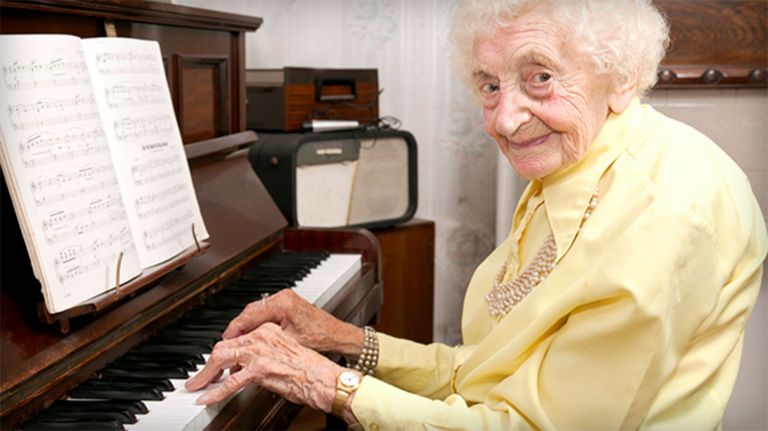
Alzheimer’s patients lose their cognitive abilities – yet despite dementia, they can still sing familiar songs or learn to play an instrument. Even when speaking and playing are no longer possible, music remains a means of communication.
Scientific support: Prof. Dr. Tom Fritz, Annika Firley
Published: 12.03.2026
Difficulty: intermediate
- Alzheimer’s patients often still enjoy specific music that holds personal significance and can sing along to familiar songs.
- While the loss of skills is the primary concern for patients in many areas, progress is still possible musically – under the right conditions. Even learning a new instrument is conceivable.
- For people with dementia, music can not only bring joy and a sense of participation but – thanks to the involvement of diverse networks in the brain – can also help alleviate typical Alzheimer’s symptoms such as restlessness (agitation).
- Even in cases of severe dementia, when verbal communication is no longer possible, contact can still be established through music or music therapy, thereby meeting patients’ fundamental human need for connection.
Studies show that Alzheimer’s disease also affects musical Memory: For example, memorizing and recognizing new melodies is significantly more difficult for patients than for a comparison group of similar age. They also notice grammatical errors in song lyrics less frequently. Distinguishing familiar melodies from unfamiliar ones, on the other hand, poses no difficulty. Procedural musical memory also remains largely intact in many musicians who develop Alzheimer’s disease. This is not about explicit knowledge of specific melodies or concepts, but rather skills such as playing an instrument (Abstract).
Memory
Memory is a generic term for all types of information storage in the organism. In addition to pure retention, this also includes the absorption of information, its organization, and retrieval.
Teaching older adults, especially those with dementia, presents its own unique challenges. For instance, not all instruments are suitable, and progressive cognitive impairments eventually make reading sheet music impossible. Playing well-known songs or pieces memorized in advance, as well as improvising, works quite well, however.
Since the demands on teachers are quite different from those in “normal” music lessons, Theo Hartogh, together with his Münster colleague Hans Hermann Wickel and others, coined the term “music geragogy” (Musikgeragogik“): While the standard term (music) “pedagogy” includes not only the Greek word for “to lead, to guide” but also “child” (pais), here this is replaced by “elder” (geron).
For many of those present, it can probably be described as the weekly highlight: A few chairs and wheelchairs are arranged in a circle; almost exclusively occupied by women, most with white hair. Many have slumped in their seats; their gaze seems distant. Only a few pairs of eyes follow as the only younger woman in the room opens a songbook and positions a guitar. “Go forth, my heart, and seek joy,” she announces, “fitting for the beautiful summertime.” Then she begins to play and sing.
With thin voices, some shaky, some slightly off-key, the rest of the attendees join in. The atmosphere shifts, though at first almost imperceptibly: eyes fill with life, upper bodies straighten, and some of the furrowed faces are seized by a beaming smile.
This is how things regularly unfold in many nursing homes – including the Wilhelm-Frommel-Haus and St. Anna Day Care Center in Heidelberg. “Even people with Alzheimer’s Dementia remember these songs if they had a connection to them in the past,” says music therapist Anna Pfeiffer, who has worked here. “They then come alive, smile, and take a deep breath. They feel like part of the group, as if they’re participating in what’s happening, and can keep up – whereas otherwise they’re almost always silent, unable to give appropriate responses.”
Dementia
Dementia
Dementia is an acquired deficit of cognitive, social, motor, and emotional abilities. The most well-known form is Alzheimer's disease. "De mentia" means "without mind" in English.
Free rein for emotion
Patients who simply can’t remember that they turned on the stove three minutes ago still have no trouble with songs from their youth: the older a memory, the later it is lost. In addition, when it comes to music, people with Alzheimer’s are in a sense at an advantage. Music therapist Dorothea Muthesius explained it this way in an interview: With dementia, cognitive abilities are lost; but self-censorship also disappears; this creates space for the free expression of feelings. “Music offers a great deal here: It appeals to the emotional, and that is still very well preserved in people with dementia.”
Music can thus become a vehicle for joy, a means of stimulation, but also a path to communication. This doesn’t even require trained professionals. Some years ago, former Bremen Mayor Henning Scherf – who, in the course of researching his books on aging, had visited many different facilities for people with Dementia – shared: he often managed to connect with someone who no longer knew their own name through songs. “When you sing together, a wonderful closeness develops. That is genuine, meaningful communication – people with dementia then light up.”
Dementia
Dementia
Dementia is an acquired deficit of cognitive, social, motor, and emotional abilities. The most well-known form is Alzheimer's disease. "De mentia" means "without mind" in English.
Progress despite dementia
oy, participation, communication: but the possibilities of music in Alzheimer’s don’t end there. As musicologist Theo Hartogh from the University of Vechta emphasizes: people with Dementia can – even as other abilities fade – actually make musical progress. They can sing in choirs, even learn an instrument like the piano. “In this area, dementia doesn’t mean decline. Instead, skills and resources can be discovered, challenged, and nurtured here.” This creates a sense of normalcy in patients’ lives, along with plenty of positive side effects: creativity, memory, cognitive abilities, and motor skills are trained through regular music-making and may even improve. Above all, however, the restlessness that so often afflicts people with dementia noticeably decreases.
However, the conditions must also be right, says Hartogh: the elderly person must already have an interest, and the focus must always be on music that was significant to them in their life story. A dissertation by one of Hartogh’s colleagues demonstrates how, for example, beginners with Alzheimer’s can still be taught to play the piano: in her work, Eva-Maria Kehrer developed and evaluated a teaching concept that she also implemented with several participants at various stages of dementia. The focus is on playing songs, improvisation, and listening to music, with the primary goal being a musical and aesthetic experience. Kehrer’s conclusion: learning success is possible, and dementia symptoms are alleviated in the process.
Berlin-based violinist and music therapist Julia Alexa Kraft pursues a similar concept: she works specifically with patients who learned an instrument in their youth and attempts to reactivate this ability. The focus is on playing together – ideally on a weekly basis; Kraft herself refers to this as “training.” Communication is essentially nonverbal. Kraft explains that over time, as the disease progresses, cognitive abilities such as reading music are inevitably lost. But: “Certain aspects improve at the same time. Recordings show that the sound quality has actually improved in several patients – they play more cleanly, which is crucial for string instruments. And they have become much more relaxed while playing.” The positive effects do not end when the therapy session is over. “I am in contact with the wife of one patient. From her, I know, for example, that in the evenings after a therapy session, he is much clearer-headed, more alert, and in a better mood.”
Dementia
Dementia
Dementia is an acquired deficit of cognitive, social, motor, and emotional abilities. The most well-known form is Alzheimer's disease. "De mentia" means "without mind" in English.


Music: optimally connected in the brain
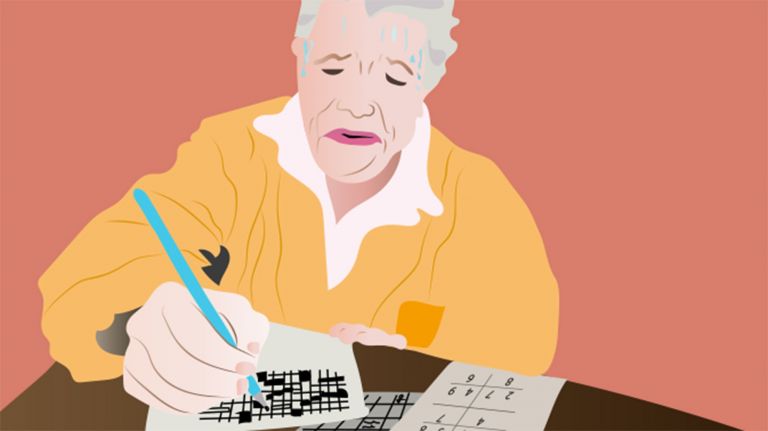
From a (neuro)biological perspective, such effects of music on Alzheimer’s patients have by no means been satisfactorily investigated and understood, but they are at least supported by individual cases or small studies and are certainly plausible. For when we listen to music or make music ourselves, it is not some sort of “music center” in the brain that is responsible, but rather a diverse array of networks. “Musical memory” consists of close connections with almost all important functional units in the brain, including the systems responsible for motor skills, emotions, language, and behavior.
Of course, this does not explain exactly what these connections look like in detail, and above all, what implications they have for the brains of people with Alzheimer’s. Current findings do, however, show that the brains of people with (Alzheimer’s) dementia, depending on the stage of the disease, retain the ability to adapt structurally and functionally to partially compensate for losses. In this regard, music, like no other medium, is capable of stimulating a wide variety of brain areas simultaneously and thus promoting cognition. Empirical studies have particularly well-examined issues related to patient care – for example, music therapy has proven to be one of the most effective non-pharmacological interventions for reducing agitation.
Methodological difficulties, not least, stand in the way of a better data foundation: giving instructions, receiving verbal feedback – such experimental requirements often cannot be implemented with Dementia patients; and in imaging procedures, patients must actively cooperate for extended periods, such as when they are required to remain still for several minutes in an MRI scanner – this is often unrealistic and can also cause stress.
Dementia
Dementia
Dementia is an acquired deficit of cognitive, social, motor, and emotional abilities. The most well-known form is Alzheimer's disease. "De mentia" means "without mind" in English.
Remaining human until the very end
A rough guide to which abilities are affected by Alzheimer’s Dementia and how quickly is provided by a schema formulated as early as the 1990s by the emeritus Frankfurt neuroanatomist Heiko Braak: according to this, neurons that mature particularly late during development are also particularly sensitive to the onset of Alzheimer’s disease and are affected first. Applied to cognitive abilities, this means that the dementia patient essentially goes through the same developmental process as a child, only in reverse. Parents, of course, know that even when dealing with completely helpless newborns, music is a good way to soothe and engage them. And in the same way, the opportunity for music therapists to be there for Alzheimer’s patients does not end simply because these patients can no longer actively accomplish almost anything. In any case, Anna Pfeiffer spends most of her working hours not singing folk songs, but in one-on-one sessions with patients who can no longer be reached through speech at all.
“Contact can also be established on a completely nonverbal level,” explains the Heidelberg-based therapist. And so she enters the room of the dementia patients with a guitar or a kind of large zither that can be placed on the stomach or back and played – a so-called body tambura. First, she tries to synchronize with the patient’s breathing rhythm. “That’s when I can already sense how the person is likely feeling: whether they’re afraid, nervous – things like that.” Then the communication begins: “Through music or simply through rhythm. The patient can express themselves using whatever they’re still capable of – even if only a single finger moves.” Anna Pfeiffer then responds to this through musical means, in the broadest sense. A very unique, very individual, very intimate dialogue unfolds – and helps the patient, who has lost more or less everything, to remain human until the very end: “After all, we are, first and foremost, social beings. Experiencing relationships and helping to shape them ourselves is a basic need that remains until the very end.” With music, it can at least be satisfied in certain moments.
Dementia
Dementia
Dementia is an acquired deficit of cognitive, social, motor, and emotional abilities. The most well-known form is Alzheimer's disease. "De mentia" means "without mind" in English.
Originally published on August 21, 2014
Last updated on March 12, 2026