Terminals of Communication
Published: 10.05.2012
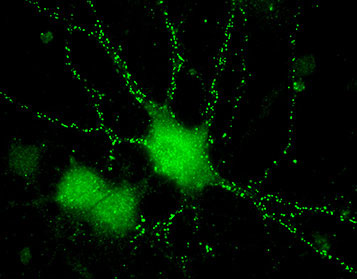
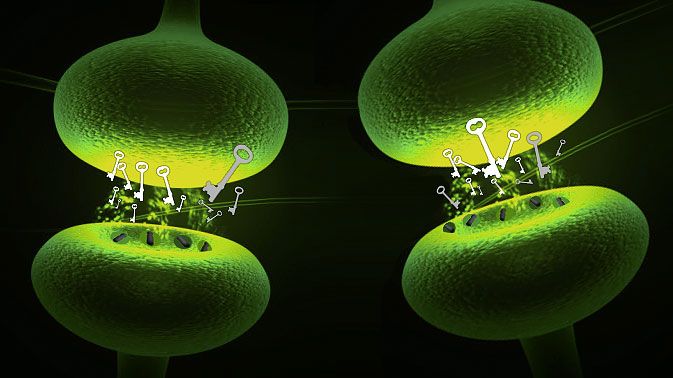
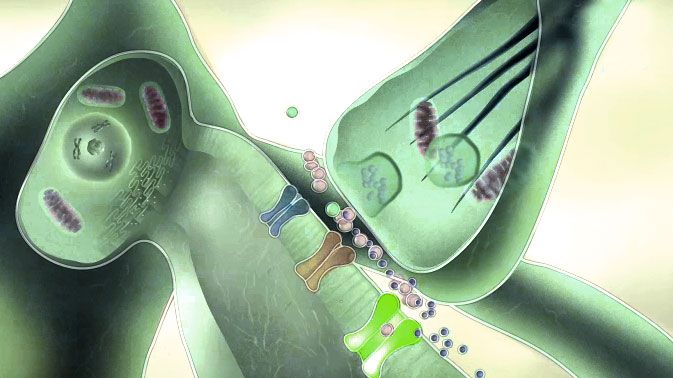
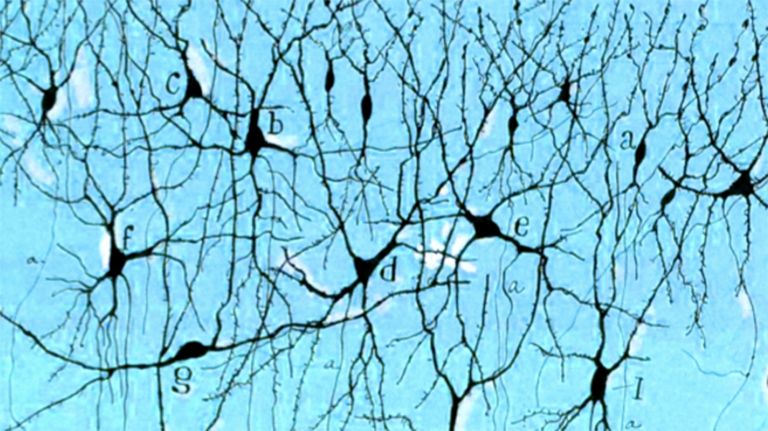
Most nerve cells use chemical synapses to communicate. With their so-called synaptic terminals, they dock onto other nerve cells – separated only by a narrow gap through which they release neurotransmitters. This image shows these docking sites of other nerve cells on a target cell. Each of these synapses can stimulate the target Neuron to transmit impulses by releasing the Neurotransmitter Glutamate. The shape of the Neuron can be imagined based on the high density of synapses lining the cell body.
For more information and exciting images on this topic, see our slideshow. ▸ Communication under the Microscope
© Sabrina Eichler /AG Jochen Meier /MDC Berlin, 2010
Neuron
A neuron is a specialized cell in the nervous system that is responsible for processing and transmitting information. It receives signals via its dendrites and transmits them via its Axon. Transmission occurs electrically within the neuron and, between neurons, usually chemically via synapses.
A neurotransmitter is a chemical messenger, an intermediary substance. It is released by the sender neuron at the sites of cell-cell communication and has an excitatory or inhibitory effect on the receiver neuron.
Glutamate is an amino acid and the most important excitatory neurotransmitter, which acts as a messenger substance in the transmission of information between neurons at their synapses.
Neuron
A neuron is a specialized cell in the nervous system that is responsible for processing and transmitting information. It receives signals via its dendrites and transmits them via its axon. Transmission occurs electrically within the neuron and, between neurons, usually chemically via synapses.
Axon
axon
The axon is the extension of the nerve cell that is responsible for conducting nerve impulses to the next cell. An axon can branch out many times, reaching a large number of downstream nerve cells. It can be more than a meter long. The axon ends in one or more synapses.
Neurotransmitter
A neurotransmitter is a chemical messenger, an intermediary substance. It is released by the sender neuron at the sites of cell-cell communication and has an excitatory or inhibitory effect on the receiver neuron.
excitatory
Exciting synapses are described as excitatory when they depolarize the subsequent cell membrane and can thus lead to the formation of an action potential. An excitatory effect is usually produced by an exciting transmitter (messenger substance), such as glutamate. The opposite is an inhibitory synapse.
Glutamate
Glutamate is an amino acid and the most important excitatory neurotransmitter, which acts as a messenger substance in the transmission of information between neurons at their synapses.