Search
-
- Basics
- Structure and Function
The Secret to Success: Communication
No other cell type is better at juggling signals: The neuron is both a data octopus and a supercomputer.
01.12.2020
-
- News from the Institutes
AI looks deeper into visual system
Artificial intelligence models provide insights to understand the processing of visual stimuli in the brain
10.04.2025
-
- Glossary
excitatory
Exciting synapses are described as excitatory when they depolarize the subsequent cell membrane and can thus lead to the formation of an action potential. An excitatory effect is usually produced by an exciting transmitter (messenger substance), such as glutamate. The opposite is an inhibitory synapse.
-
- News from the Institutes
Making up for lost time: Inhibitory neurons catch up during brain development
New insights into the emergence of brain cells that keep neural activity in balance
08.07.2025
-
- News from the Institutes
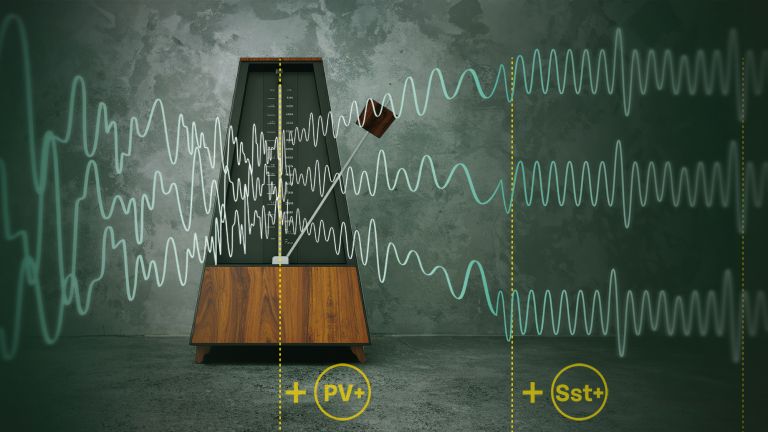
Interaction between interneurons stabilizes gamma oscillations in a brain
PV+ cells act as the “conductors” of visually induced gamma oscillatory rhythm
26.05.2025
-
- Basics
- Anatomy
The Subthalamus
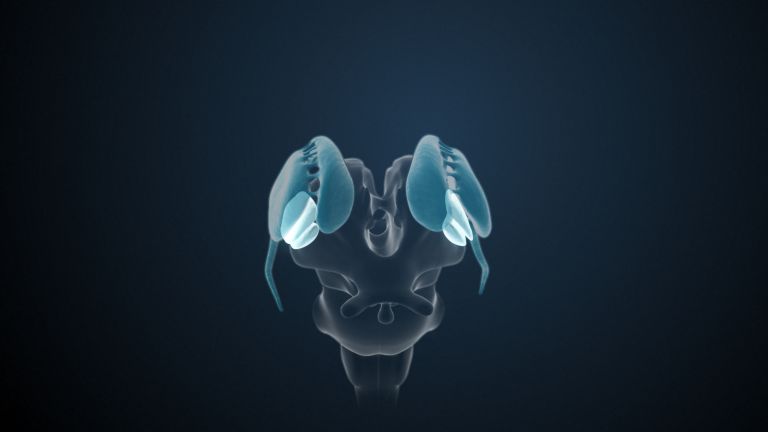
A pale nucleus and an excitatory lens, and the zone of uncertainty – that is the subthalamus.
01.10.2025
-
- News from the Institutes
New Insights into the Molecular Basis of Ataxia
Receptor responsible for stress-induced motor incoordination in people with ataxia identified.
10.10.2025
-
- Basics
- Anatomy
The Pallidum
The palladium provides a prime example of a highly complex feedback loop.
23.11.2025
-
- News from the Institutes
Remote-Control in the Cortex
How distant synapses are equipped for change
30.09.2026
-
- Page
The Advisors
20.03.2017