Search
-
- Glossary
Rods
The rods are light-sensitive cells with high light sensitivity. They react even to weak light and are therefore responsible for scotopic vision, black-and-white vision, and vision at dusk. The rods are concentrated in the outer areas of the retina and therefore do not provide high visual acuity.
-
- Discover
- Milestones
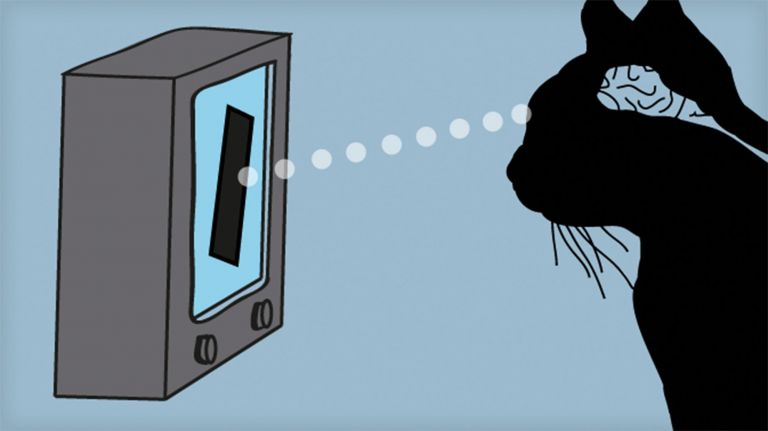
Hubel and Wiesel: Cutting the Lawn with Nail Scissors
Hubel and Wiesel worked diligently to establish fundamental knowledge about visual information processing.
26.09.2012
-
- News from the Institutes
How saccades enable mammals to simultaneously chase prey and navigate through complex environments
How do predators use their eyesight while pursuing their prey, which is running for its life, even in completely unclear terrain?
04.02.2025
-
- Glossary
Photopigment
Photopigments are light-sensitive molecules in the receptors of the retina. When photons (particles of light) strike the photopigment, it isomerizes, triggering a cascade of various processes. In this way, light is converted into a nerve impulse. All rods have the same type of photopigment, while the cones have one of three possible photopigments.
-
- Glossary
Photoreceptors
Photoreceptors are the light-sensitive cells of the retina; they convert light into electrical potentials. There are approximately 127 million photoreceptors in the retina, including seven million cones and 120 million rods.
-
- Glossary
Fovea centralis
The fovea centralis is located in the center of the macula and is the area of sharpest vision in birds and higher mammals. Its diameter in humans is approximately 1.5 mm. There are no rods in the fovea, only cones, which are interconnected to the ganglion cells in the central area of the fovea at a ratio of 1:1, resulting in very high "resolution."
-
- Glossary
Retina
The retina is the inner layer of the eye covered with pigment epithelium. The retina is characterized by an inverse (reversed) arrangement: light must first pass through several layers before it hits the photoreceptors (cones and rods). The signals from the photoreceptors are transmitted via the optic nerve to the processing areas of the brain. The reason for the inverse arrangement is the evolutionary development of the retina, which is a protrusion of the brain.The retina is approximately 0.2 to 0.5 mm thick.
-
- Glossary
Opsin
Opsins are light-sensitive proteins in the retina that, together with the chromophore retinal, absorb light and convert it into electrical signals. The following opsins occur in humans: rhodopsin in rods, for twilight vision, S-opsin → short-wave cones (blue), M-opsin → medium-wave cones (green), L-opsin → long-wave cones (red). These three cone opsins enable color vision.
-
- Glossary
Rhodopsin
A specific opsin found in the rods of the retina.
-
- Basics
- Time
Perfect Timing
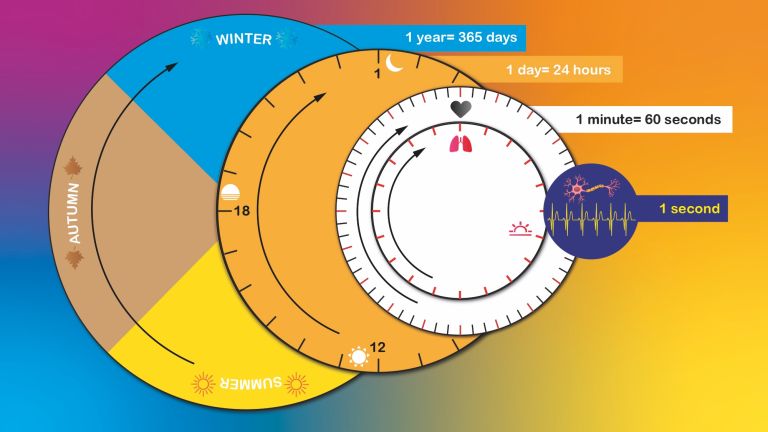
Chronobiology: from firing neurons to the nature of time
02.05.2024