Search
-
- Think
- Consciousness
The Night Side of Consciousness
Our brain goes through different stages of consciousness during the night.
03.09.2025
-
- Glossary
Cingulate cortex
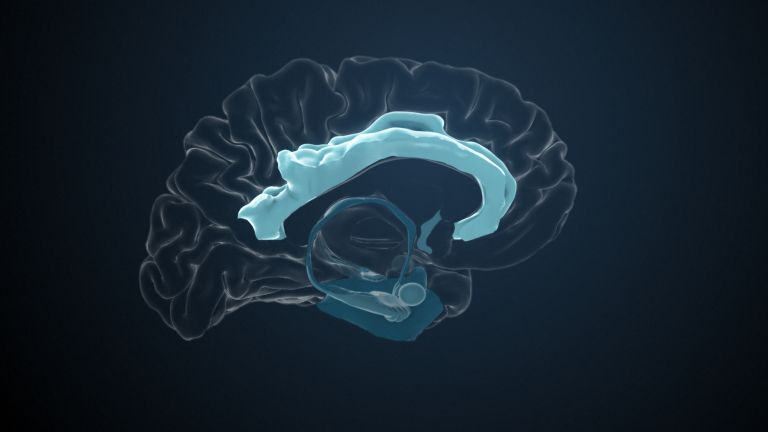
A component of the prefrontal cortex located at the front of the brain. Like half a doughnut, the cingulate cortex wraps around the corpus callosum. Functionally, it belongs to the limbic system and is involved in emotion, memory, and motor function.
-
- Glossary
Anterior cingulate cortex
The anterior cingulate cortex (cingulate gyrus) plays a role not only in autonomic functions such as blood pressure and heart rate regulation, but also in rational processes such as decision-making. This area of the brain is also involved in emotional processes, such as impulse control. Anatomically, the anterior cingulate cortex (ACC) is characterized by a large number of spindle neurons (Von Economo neurons). These special nerve cells have a long, spindle-shaped structure and have so far only been found in mammals such as primates, elephants, and some whale and dolphin species. Spindle neurons contribute to higher social and emotional processes such as self-awareness, empathy, and quick emotional decisions. In pain perception, it is particularly associated with the affective component of pain – including social pain, such as that experienced through exclusion.
-
- Glossary
Primary visual cortex
The part of the occipital lobe whose primary inputs originate from the visual system. According to Brodmann, who originally divided the cerebral cortex into 52 areas in 1909, the primary visual cortex is area 17.
-
- Glossary
Prefrontal cortex
The prefrontal cortex (PFC) forms the front part of the frontal lobe and is one of the brain's most important integration and control centers. It receives highly processed information from many other areas of the cortex and is responsible for planning, controlling, and flexibly adapting one's own behavior. Its central tasks include executive functions, working memory, emotion regulation, and decision-making. In addition, the PFC plays an important role in the cognitive evaluation and modulation of pain.
-
- Glossary
Visual cortex
The visual cortex refers to the areas of the occipital lobe that are involved in processing visual information. These include the primary visual cortex and the associative visual cortices V1 to V5. According to Brodmann, the visual cortex comprises areas 17, 18, and 19.
-
- Glossary
Orbitofrontal cortex
A convolution in the orbitofrontal cortex of the cerebral cortex, located anatomically behind the eyes. The orbitofrontal cortex plays a crucial role in decision-making and monitoring social interactions and is correspondingly complex in structure. It consists of four different substructures: the medial, lateral, anterior, and posterior orbital gyri, as well as the rectus gyrus.
-
- Glossary
Gustatory cortex
Here, the brain processes information from the taste receptors. When these are stimulated, the sensory cells in the taste buds send a signal to the thalamus via various intermediate stations. The thalamus then forwards this signal to the insular lobe. This is where the primary gustatory cortex is located, which combines the information from the taste pathways with other sensory impressions. The primary gustatory cortex then forwards the combined data package to its secondary counterpart. This is located in the orbitofrontal cortex, where the final processing of olfactory information also takes place.
-
- Glossary
Secondary auditory cortex
The secondary auditory cortex is an area in the temporal lobe (temporal lobe) that is downstream of the primary auditory cortex. It processes complex auditory information such as speech, sounds, and music, and plays a role in recognizing patterns in acoustic signals. Wernicke's area, which specializes in language comprehension, is located within this area but is not synonymous with the entire secondary auditory cortex.
-
- Glossary
Secondary somatosensory cortex
The posterior parietal lobe receives input from numerous other cortex areas - this is where visual, auditory and proprioceptive signals are integrated into a whole, enabling orientation and movement in space. The S2 cortex, located posterior and ventral to S1, is also involved in the conscious processing of pain.