Search
-
- Glossary
Lateral nucleus
The lateral nucleus belongs to the basolateral nucleus group of the amygdala. The basolateral amygdala is the largest part of the amygdala. It receives sensory information from the temporal lobe and neuromodulatory signals from the VTA, locus coeruleus, and basal forebrain, processes them, and sends them to the central nucleus. It is important for emotional learning and fear conditioning.
-
- Glossary
Auditory cortex
The auditory cortex is a part of the temporal lobe that is involved in processing acoustic signals. It is divided into the primary and secondary auditory cortex.
-
- Glossary
Hippocampus
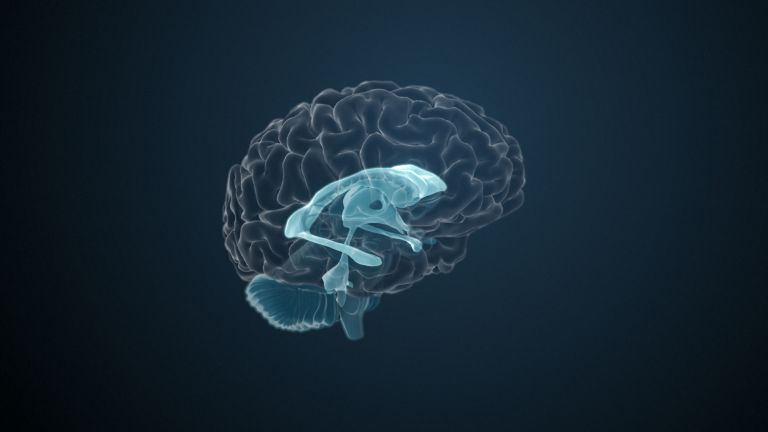
The hippocampus is the largest part of the archicortex and an area in the temporal lobe. It is also an important part of the limbic system. Functionally, it is involved in memory processes, but also in spatial orientation and learning. It comprises the subiculum, the dentate gyrus, and the Ammon's horn with its four fields CA1-CA4. Changes in the structure of the hippocampus due to stress are associated with chronic pain. The hippocampus also plays an important role in the amplification of pain through anxiety.
-
- Glossary
Praepiriform area
The praepiriform area is part of the piriform cortex in the ventral temporal lobe and belongs to the primary olfactory cortex, i.e., the primary olfactory cortex. Among other things, it contains inputs from the olfactory bulb (bulbus olfactorius) and is therefore involved in the initial cortical processing of olfactory stimuli.
-
- Glossary
Heschl's gyrus
Heschl's gyrus is an area in the temporal lobe that was first described by Richard Heschl in 1855. It is the seat of the primary auditory cortex, i.e., the hearing center in the cerebral cortex.
-
- Grundlagen
- Anatomy
The Amygdala
Without the amygdala, humans lose their sense of fear. With the amygdala, they also recognize the fear of others.
22.12.2023
-
- Glossary
Parahippocampal gyrus
The parahippocampal gyrus runs along the hippocampus in the lower, inner temporal lobe. Its anterior part is covered by the entorhinal cortex. It is connected to numerous areas of the cerebral cortex and projects to the hippocampus, which it also acts as a gateway to. This means that it is involved in the consolidation of explicit memory content, among other things. In addition, the posterior part of the parahippocampal gyrus contains the parahippocampal place area (PPA), which responds particularly to complex visual scenes such as rooms, landscapes, or streets and thus plays an important role in spatial orientation and location recognition.
-
- Glossary
Parahippocampal cortex
The parahippocampal cortex is located next to the hippocampus and is part of the temporal lobe. It processes spatial-visual memory content and appears to be involved in the consolidation of memory content. It receives inputs from numerous polymodal cortical areas, and its outputs go to the hippocampus, amygdala, and striatum.
-
- Glossary
Amygdala
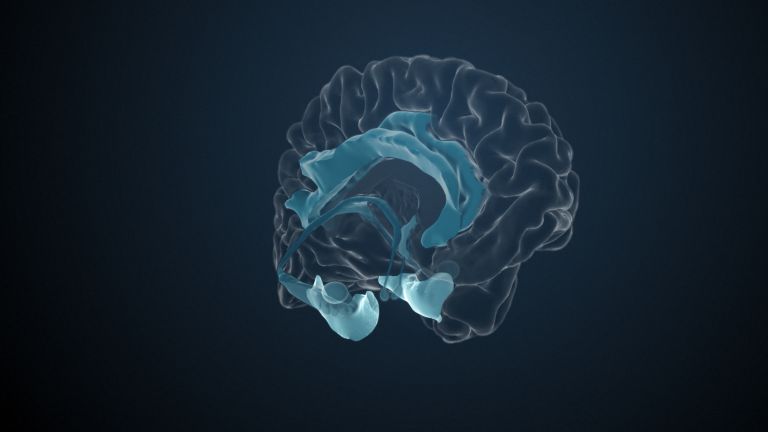
An important core area in the temporal lobe that is associated with emotions: it evaluates the emotional content of a situation and reacts particularly to threats. In this context, it is also activated by pain stimuli and plays an important role in the emotional evaluation of sensory stimuli. Inaddition, it is involved in linking emotions with memories, emotional learning ability, and social behavior. The amygdala is part of the limbic system.
-
- Glossary
Fusiform gyrus
The fusiform gyrus is located in the inferior, i.e., inner temporal lobe and plays an important role in object recognition. Facial recognition is believed to take place in the right fusiform gyrus, which is why this structure is also referred to as the fusiform face area.