Search
-
- Glossary
agonist
Due to the lock-and-key principle, transmitters (messenger substances) can only bind to specific receptors. However, an agonist is chemically so similar to this transmitter that it can also bind to this receptor and thus trigger an identical response. Partial agonists, on the other hand, only trigger a weaker response, while inverse agonists bind to the receptor and inhibit its response.
-
- Glossary
Lock and key
In terms of the processes in a synapse, this means that the chemical messenger and its receptor must fit together like a key in a lock. The receptor therefore only "accepts" a very specific messenger.
-
- Percieve
- Smell & Taste
Not just in the Mouth and Nose
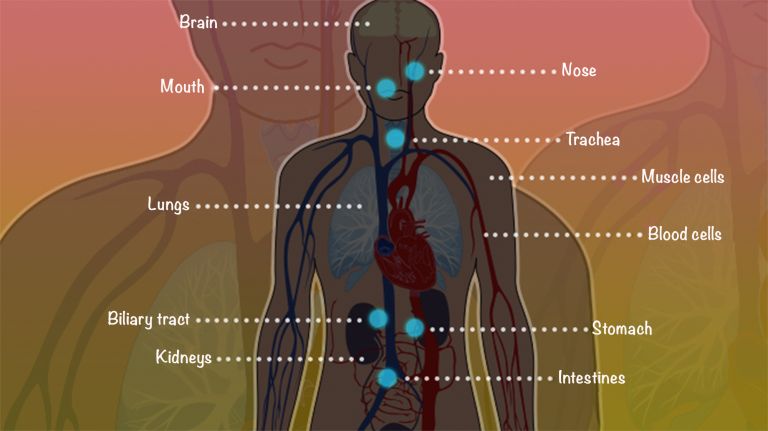
Taste and smell receptors are not only found in the mouth and nose.
02.09.2025
-
- Glossary
Chemoreceptor
Receptor that responds to chemical stimuli, e.g., taste or smell receptors. Chemoreceptors are also found in internal organs, such as the intestines and liver.
-
- Glossary
Homunculus
In the brain, every part of the body is represented in precisely defined locations, both sensorily and motorically. Body parts with a high density of sensory receptors (fingertips, tongue) are represented more prominently than those with a lower receptor density (back, legs). Neural maps are developed, e.g., of the hand or face. If these maps are graphically assigned to their body parts, the result is a homunculus, i.e., a small human being. The size of its respective body parts reflects their motor capabilities or sensitivity. This makes the homunculus appear strangely distorted.
-
- Glossary
Second messenger
A second messenger is a chemical substance that transmits a signal within the cell after a receptor on the cell membrane has been activated. It is formed or released intracellularly and mediates the effect of the original signal on various target structures in the cell, often amplifying the signal.
-
- Glossary
Synaptic depression
Weakening of signal transmission at a synapse due to reduced neurotransmitter release or decreased receptor sensitivity; occurs, for example, with repeated stimulation (habituation).
-
- Discover
- Milestones
Hubel and Wiesel: Cutting the Lawn with Nail Scissors
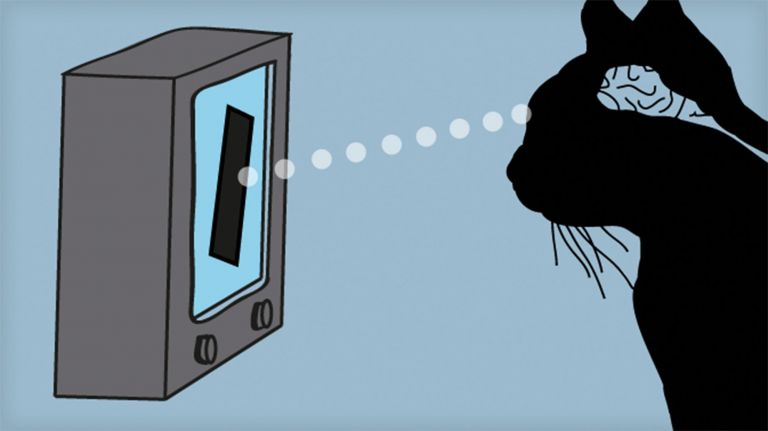
Hubel and Wiesel worked diligently to establish fundamental knowledge about visual information processing.
26.09.2012
-
- Basics
- Communication of Cells
Nerve Cells in Conversation
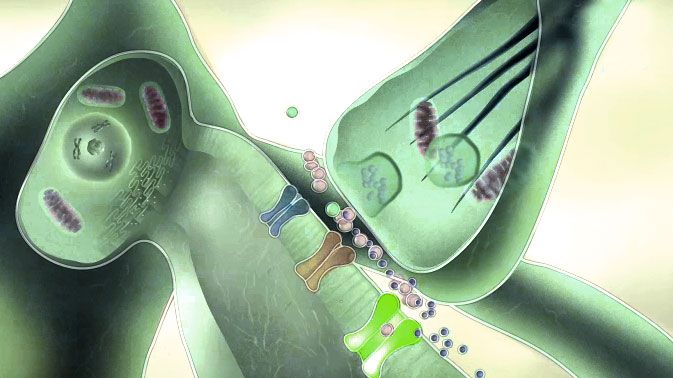
No chaos despite sensory overload – neurons communicate silently, efficiently, and at breakneck speed.
16.04.2012
-
- Basics
- Structure and Function
Communication Gaps: Ion Channels
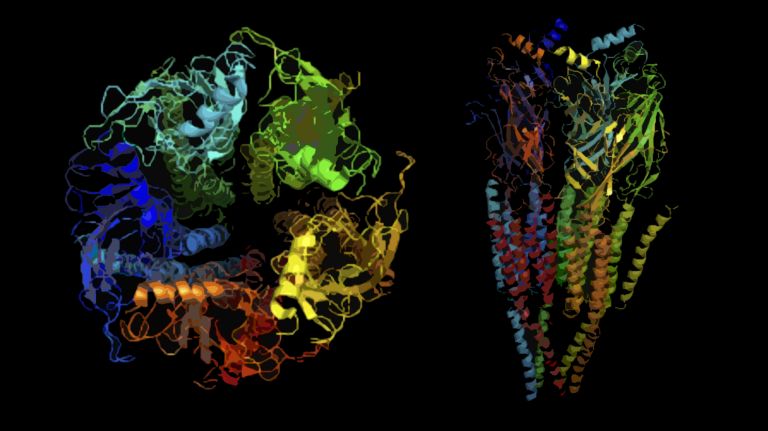
Complex proteins span the membranes of nerve cells. Without these ion channels, literally nothing works.
01.12.2020