Search
-
- Basics
- Communication of Cells
Neurotransmitters: Messenger Molecules in the Brain
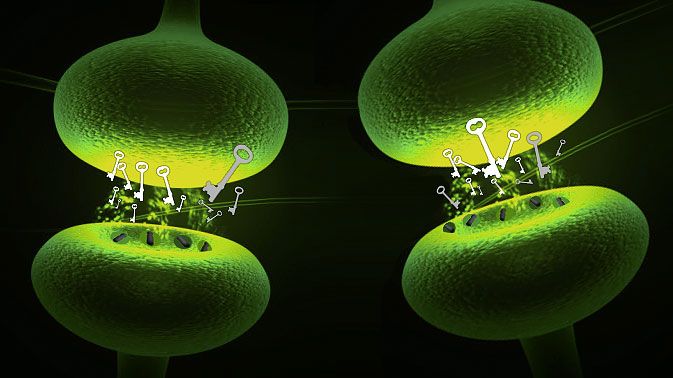
“Happy hormone” & Co.: Without neurotransmitters, nerve cells would not be able to communicate.
05.08.2025
-
- Glossary
Glutamate
Glutamate is an amino acid and the most important excitatory neurotransmitter, which acts as a messenger substance in the transmission of information between neurons at their synapses.
-
- Basics
- Communication of Cells
Terminals of Communication
Most nerve cells use chemical synapses to communicate.
10.05.2012
-
- Basics
- Structure and Function
The Secret to Success: Communication
No other cell type is better at juggling signals: The neuron is both a data octopus and a supercomputer.
01.12.2020
-
- News from the Institutes
AI looks deeper into visual system
Artificial intelligence models provide insights to understand the processing of visual stimuli in the brain
10.04.2025
-
- Glossary
excitatory
Exciting synapses are described as excitatory when they depolarize the subsequent cell membrane and can thus lead to the formation of an action potential. An excitatory effect is usually produced by an exciting transmitter (messenger substance), such as glutamate. The opposite is an inhibitory synapse.
-
- Glossary
Gliotransmitter
Chemical messengers released by astrocytes and other glial cells. They enable glial cells to communicate with other cells in the nervous system, for example when forming a synapse. The most common types of gliotransmitters are the amino acids glutamate and D-serine, as well as adenosine triphosphate (ATP).
-
- Glossary
NMDA receptor
NMDA receptors are specialized receptor channels in the membrane of nerve cells that only open under very specific conditions. First, the neurotransmitter glutamate must bind to the receptor, and second, the receptor needs a cofactor such as glycine or D-serine. In addition, the postsynaptic cell membrane must be depolarized so that the magnesium ion (Mg²⁺) normally located in the channel pore is removed. If these conditions are met, an ion channel opens in the center of the receptor and allows calcium ions (Ca²⁺) in particular, but also sodium ions (Na⁺), to flow into the cell, while potassium ions (K⁺) flow out of the cell. The cell can respond to the influx of calcium in a variety of ways. NMDA receptors enable the brain to modify synaptic connections throughout life. They are crucial for forms of synaptic plasticity such as long-term potentiation (LTP) and long-term depression (LTD) and thus play a central role in the formation and storage of memory content.
-
- Diseases
- Successful aging
Molecular Detectives
We are our memories. But neural firing alone cannot unravel the traces of memory.
01.02.2026
-
- Basics
- Anatomy
The Striatum
The striatum is not only about complex motor skills, but also about happiness.
28.11.2025