Search
-
- Basics
- The Glymphatic System
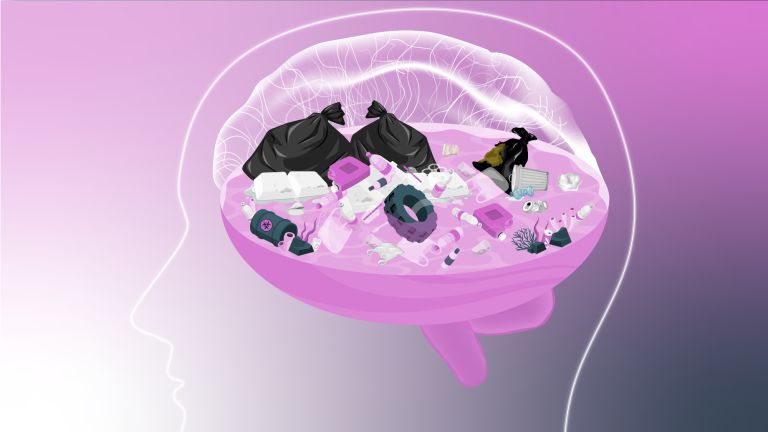
When the Brain gets clogged with Waste
Not even a coffee cup full of “nerve water” can flush out the brain at night – but woe betide you if you don't.
06.11.2024
-
- Basics
- Structure and Function
Future Regeneration
The brain is amazing, but vulnerable – which makes effective treatments all the more important. In fact, there is hope: stem cell therapy works in mice.
30.04.2020
-
- Basics
- The Glymphatic System
The Brain’s Cleanup Crew
The glymphatic system is the brain's cleanup crew, flushing away waste products.
06.11.2024
-
- Glossary
Beta-amyloid
A peptide consisting of 36 to 42 amino acids that is considered the main component of senile plaques and is believed to be responsible for the development of Alzheimer's disease. The starting product is the amyloid precursor protein (APP). Certain enzymes in the cell membrane cut the precursor protein into peptides of various sizes. Amyloids consisting of 40 and 42 amino acids are found in senile plaques, with the 42-amino-acid product forming aggregates particularly quickly, at least in the Petri dish. The normal function of beta-amyloid has not yet been conclusively clarified.
-
- Diseases
- Alzheimer's disease
Alzheimer's – a Disease makes History
After more than 100 years, Alzheimer's disease is still incurable. Possible causes are emerging.
20.10.2025
-
- Diseases
- Alzheimer's disease
A Slow Descent into Forgetfulness
After a long asymptomatic phase, Alzheimer's disease progresses through three stages
18.03.2026
-
- Diseases
- Alzheimer's disease
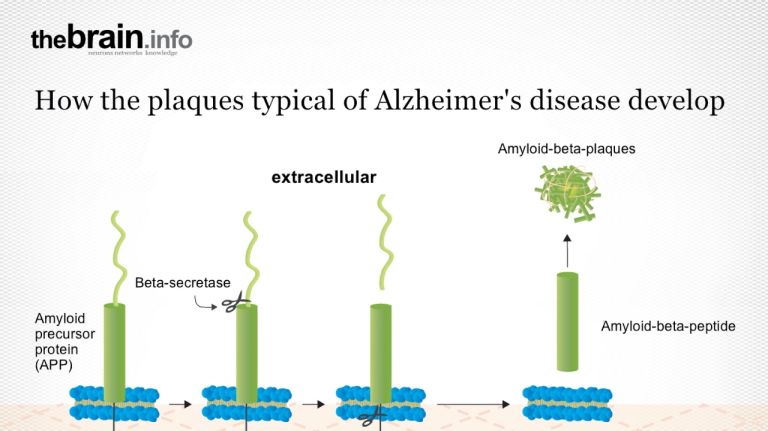
How the plaques typical of Alzheimer's disease develop
Two cuts are necessary for the protein APP to form beta-amyloid.
23.09.2013
-
- Glossary
Biomarker
In medicine, a biomarker is a substance that provides information about the physiological state of an organism. Biomarkers can either be produced in the body itself or describe chemical compounds that doctors introduce into the body to test certain physiological functions. Several indicators, for example, are being discussed as possible biomarkers for Alzheimer's disease. These include the concentration of soluble amyloid precursor protein in the blood and the activity of the enzyme that cleaves the precursor protein to produce plaque-forming beta-amyloid. Disease-related changes detected by imaging techniques are also often referred to as biomarkers. For example, the breakdown of brain tissue can be detected by MRI.
-
- Glossary
Neurodegeneration
Collective term for diseases in which nerve cells gradually lose their structure or function until they eventually die. In many cases, misfolded proteins are the trigger – such as certain forms of the proteins beta-amyloid and tau in the case of Alzheimer's disease. In other diseases, such as Parkinson's disease or Huntington's disease, proteins within the neurons are not broken down properly. As a result, toxic aggregates are deposited there, leading to the respective disease symptoms. While Huntington's disease is clearly genetic, in Parkinson's and Alzheimer's there appear to be certain gene variants that promote their development. None of these neurodegenerative diseases can be cured at present.
-
- Glossary
Oligomer
Chemists define an oligomer as a molecule composed of several structurally similar or identical units. Typically, an oligomer consists of a few monomers (e.g., 2–10, occasionally up to about 30). An example from biochemistry is collagen, which is composed of three identical polypeptide chains and occurs as a trimeric protein in connective tissue. If the number of building blocks significantly exceeds this range, as is the case with DNA, it is referred to as a polymer. Oligomers of beta-amyloid may play an important role in the development of Alzheimer's disease.